Russia and Sahel states: a strategic partnership or emerging dependency?
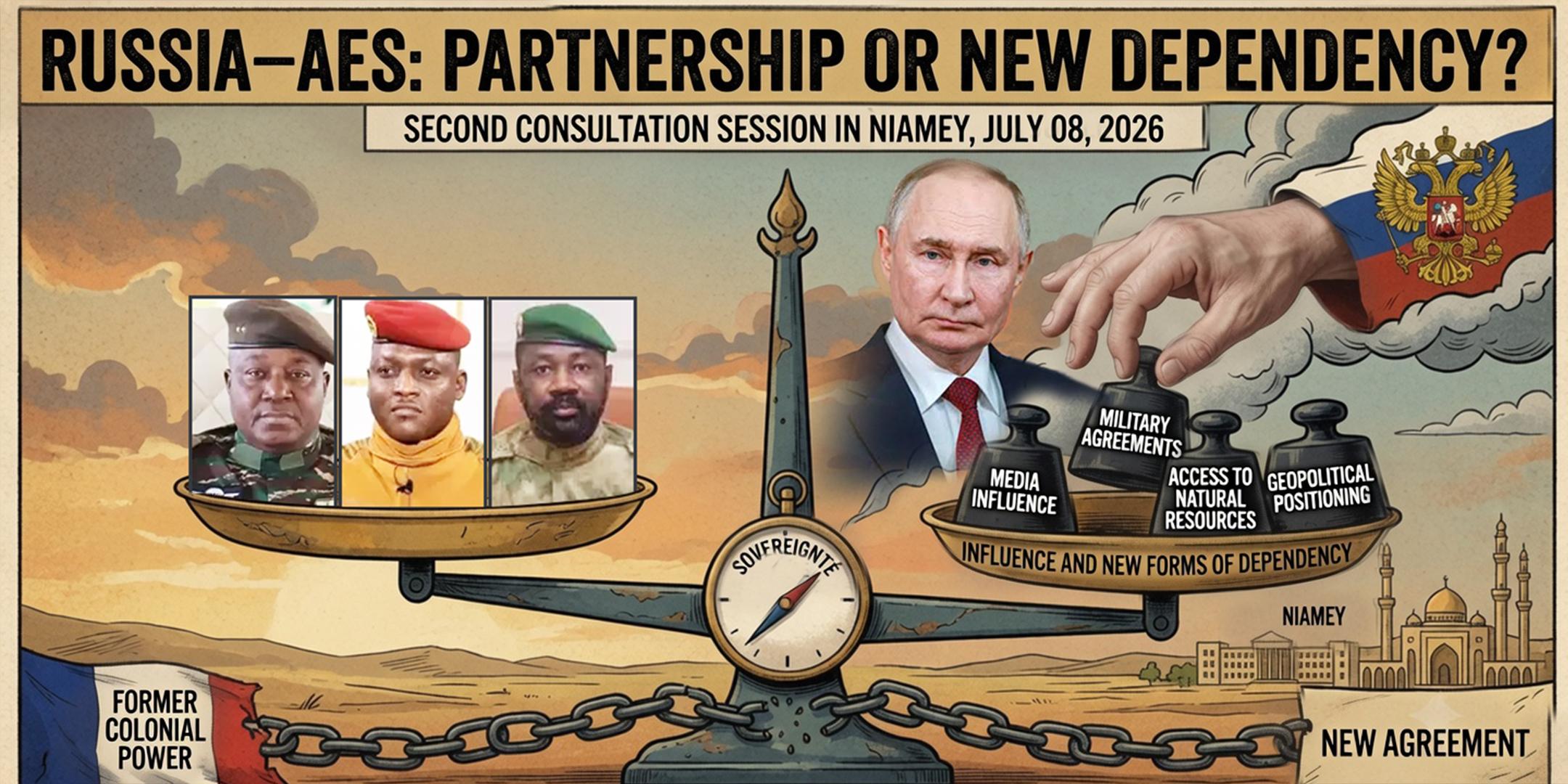
The second session of consultations between the foreign ministers of the Sahel States Confederation (AES) and Russian counterpart Sergei Lavrov, held in Niamey on July 8, 2026, has been framed by authorities as a pivotal step toward a partnership rooted in sovereignty and mutual respect. Yet beneath the official narrative lies a pressing question: could this alignment inadvertently lay the groundwork for a fresh dependency—one directed toward Moscow?
From historical grievances to new alliances
For years, the AES leadership has vocally criticized the lingering influence of former colonial powers—particularly France—under the banner of national sovereignty. However, replacing one foreign power with another does not inherently guarantee greater autonomy. Historical precedent suggests that interstate relations are often driven by geopolitical, economic, and strategic interests, which may not always align with the stated goals of independence.
Moscow’s expanding footprint in the Sahel
The Kremlin’s engagement in the region has intensified across multiple fronts. Military cooperation, diplomatic agreements, economic exchanges, and cultural outreach are all expanding. While AES governments emphasize this diversification as a sovereign choice, critics question whether deepening ties with Moscow could lead to a new form of dependency. The concern is not merely theoretical: the risk lies in the potential erosion of self-determination as external influences grow.
The calculus of power: interests over ideals
Major powers rarely extend cooperation without expecting tangible returns. Whether securing access to natural resources, securing diplomatic leverage, or strengthening strategic positioning on the continent, each partnership serves national agendas. Russia’s involvement in the Sahel follows this well-established pattern. The question remains: can this collaboration serve the AES states’ long-term interests, or will it merely replicate past dependencies?
The geopolitical tightrope: sovereignty in question
A close alliance with a single power can constrain a nation’s diplomatic flexibility, narrowing its capacity to cultivate diverse partnerships. In an era marked by great-power rivalry, the Sahel risks becoming less an autonomous actor and more a battleground for competing external interests. True sovereignty, experts argue, is not defined by the mere act of switching allies but by the ability to engage globally without falling under any single influence.
Assessing the rhetoric: from promises to practice
The AES leadership has framed this partnership as ‘mutually beneficial.’ Yet the true measure of its success will lie in tangible outcomes: sustainable security improvements, economic development, job creation, skills transfer, and institutional strengthening. Without measurable progress in these areas, the rhetoric of sovereignty risks sounding hollow to the very citizens it is meant to inspire.
A path forward: beyond dependency
The coming years will determine whether cooperation with Russia empowers the AES states to enhance their autonomy or merely shifts them from one sphere of influence to another. The path to genuine independence, many believe, lies not in replacing one dominant partner with another, but in building a diplomacy capable of engaging with all actors while remaining beholden to none.