Inside Niger’s power struggle: the CFPD, Domol Leydi and the missing billion

Behind the official security measures, a fierce contest is unfolding over manpower, money and control of the state apparatus.
A decree signed. Billions potentially at stake. A new defense architecture. Shifting responsibilities. And then another mobilization mechanism emerges.
Taken separately, these events can be dismissed as routine administrative or military decisions. Taken together, they raise a far more sensitive question: who really controls the men, the resources and the levers of national defense in Niger?
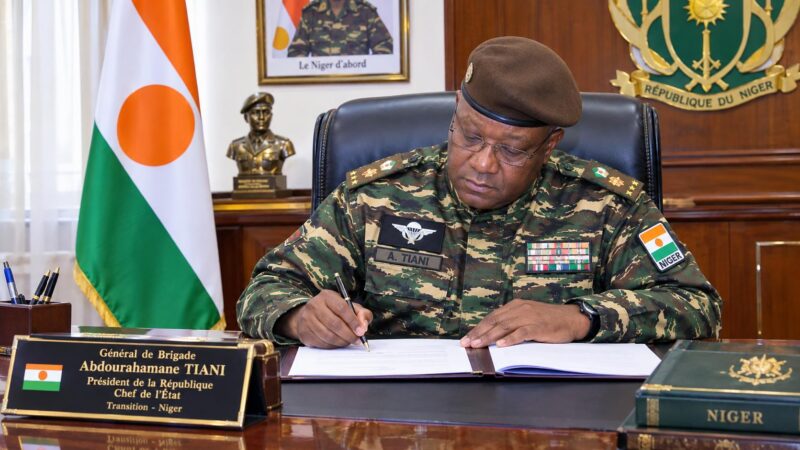
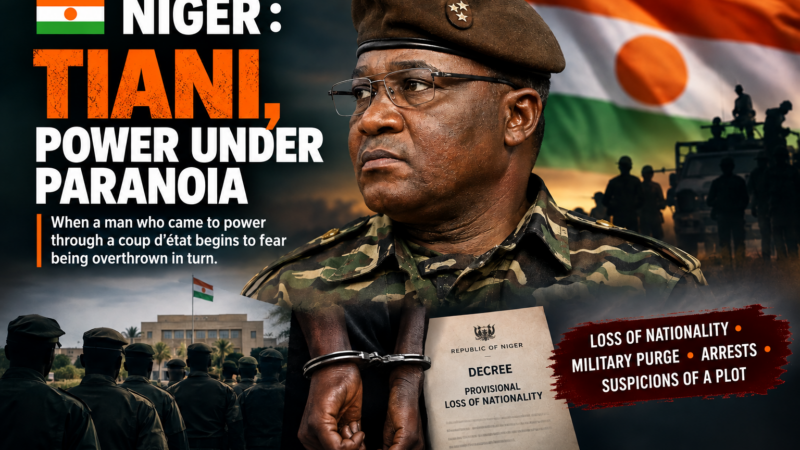
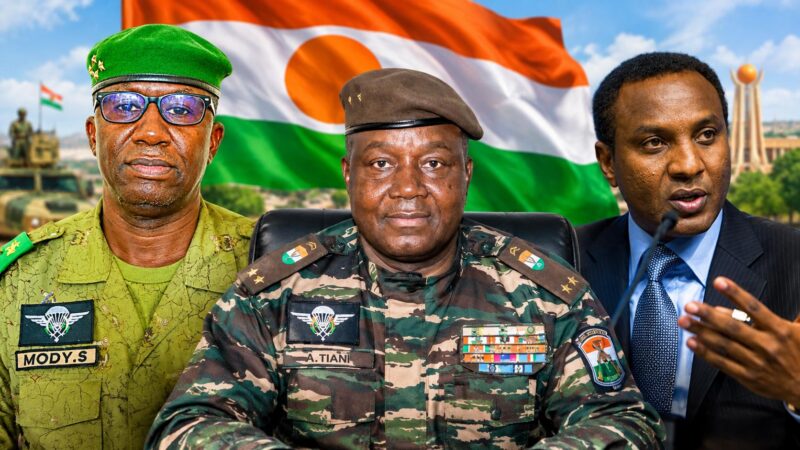
Caught in this tangle are three major figures of the regime: General Abdourahamane Tiani, General Salifou Mody and former Prime Minister Lamine Zeine.
At the heart of the matter lies the Command of Protection and Development Forces (CFPD) and, more recently, the community self-defense organizations known as “Domol Leydi”.
But behind these two mechanisms lurks a third, less visible yet decisive issue: money.
First twist: a decree that changes the equation
On May 9, 2024, decree No. 2024-309/P/CNSP/MDN established the Command of Protection and Development Forces.
This was no symbolic measure. The force was designed to help protect mining and oil sites, strategic infrastructure, corridors and several development projects. The Nigerien Press Agency at the time presented the CFPD as an instrument intended notably to secure extractive resources, the WAPCO pipeline, CNPC-NP, SORAZ and strategic corridors.
The decree also provides for a specific financial mechanism.
And that is where the file takes on a new dimension.
Because a military force does not operate on men and orders alone. It requires equipment, transport, food, logistics, maintenance and, above all, regular funding.
The text lays out precisely this machinery.
Second twist: the 12,000 CFA francs that open the door to a multi-billion equation
Article 28 of the decree stipulates that corporate contributions are collected on the basis of contracts signed with the state, and that a lump-sum standby allowance is paid to the CFPD according to actual troop numbers.
The minimum value indicated is 12,000 CFA francs per man per day. The text also details several components of this envelope: daily duty allowance, food, hygiene, operations and maintenance.
Based on a hypothetical 5,000 men, the order of magnitude reaches around 60 million CFA francs per day, or nearly 1.8 billion per month and approximately 21.9 billion over a year.
But one clarification is essential: this is a projection calculated from the theoretical troop strength and the mechanism set out in the text, not proof that such a sum was actually collected.
That is precisely what makes the investigation necessary.
The real question is not only: “How much could the mechanism generate?”
It is far more precise:
How much was actually committed? How much was paid? For how many men? For what missions? And to which beneficiaries?
Third twist: the CFPD is a very real entity
Yet it would be too simplistic to present the CFPD as an abandoned structure.
In 2026, Defense Minister Salifou Mody publicly stated that personnel from the Protection and Development Force were engaged in securing economic installations, particularly at posts linked to the pipeline.
The problem is therefore more complex.
The CFPD exists. It is officially integrated into the defense architecture. It carries out certain missions.
But another question remains:
Does its actual operation fully match the architecture, troop numbers and financial mechanism originally planned?
This is where administrative and financial documents become essential.
Between planned and actual troop numbers, between theoretically available sums and amounts actually paid, there can be a considerable gap.
And that gap must be documented.
Fourth twist: who controls the financial chain?
According to information reported in this case, CFPD funding is said to have been at the center of tensions between different power centers.
One particularly sensitive piece of information attributes to President Tiani an instruction to not implement certain financial provisions of the mechanism.
At this stage, no public document consulted allows this instruction to be formally established.
But if confirmed, the implications would go far beyond a simple administrative difficulty.
It would raise a major institutional question:
How can a mechanism created by decree function when some of its financial provisions are deliberately prevented or delayed?
The question is all the more important because the decree itself organizes the CFPD’s resources and their use.
Fifth twist: the Finance Ministry at the heart of the problem
The alleged conflict then takes on a broader dimension.
On one side, Defense seeks the means necessary for its missions.
On the other, the finance ministry must control public resources and their use.
Above both sits the political authority that arbitrates.
It is this articulation that must be examined.
Because in a highly centralized defense system, controlling resources also means controlling operational capacity.
Whoever controls the credits controls part of the means.
Whoever controls the troops controls another part of the power.
And whoever arbitrates between the two holds the ultimate lever.
Sixth twist: Zeine loses Finance but keeps the Prime Ministership
In January 2026, Lamine Zeine lost the Economy and Finance portfolio while retaining the Prime Ministership.
This change deserves scrutiny.
Because it alters the distribution of levers without necessarily changing the overall political balance.
The question then becomes:
Why strip Zeine of direct control over finances while keeping him at the head of government?
According to information reported in this case, General Mody then considered taking the head of government, with the possibility of combining it with Defense.
This information is not established by the public documents consulted.
But if confirmed, it would reveal a much deeper issue: the concentration in the same hands of the two main levers of state power — Defense and the Prime Ministership.
Seventh twist: Domol Leydi enters the scene
Then a new stage begins.
In late 2025, Niger adopted an ordinance instituting general mobilization. The authorities present it as a mechanism designed to allow the transition from peace to war and to mobilize the human, material and financial resources needed to defend the homeland.
Within this framework, community self-defense organizations called “Domol Leydi” appear.
The Defense Minister himself explained in April 2026 that these organizations must work under the control and supervision of the Defense and Security Forces.
The mechanism therefore officially responds to a security logic.
But its emergence raises a strategic question:
Why multiply mobilization and protection mechanisms when a specialized command like the CFPD already exists?
The missions are not identical.
The CFPD is a military structure tasked notably with protecting strategic interests.
Domol Leydi is more about territorial mobilization and community self-defense.
But the two mechanisms meet on common ground: men, security, resources and the chain of command.
Eighth twist: the real problem is the boundaries between the mechanisms
From there, one question becomes unavoidable:
Where does the CFPD’s role end and Domol Leydi’s begin?
Who recruits?
Who trains?
Who equips?
Who finances?
Who gives orders?
Who controls the men?
And above all, who answers politically and legally when something goes wrong?
These questions are not secondary.
The more a state multiplies structures involved in security, the more essential clarity in the chain of command becomes.
Sovereignty is not measured only by the number of soldiers mobilized.
It is also measured by the state’s ability to know who commands whom, with what means and under what control.
Ninth twist: the mystery of troop numbers
This may be one of the keys to the case.
The CFPD’s financial mechanism is calculated based on actual troop numbers.
This means an apparently technical question becomes politically fundamental:
How many men were actually deployed and how many effectively generated expenses under the mechanism?
The answer should be found in administrative documents:
- troop strength reports;
- mission orders;
- attendance records;
- security contracts;
- expenditure commitments;
- payment orders;
- execution reports.
Without these documents, the billions remain projections.
With them, it becomes possible to reconstruct precisely the financial reality of the mechanism.
Tenth twist: who controls the contracts?
The decree provides that corporate contributions are based on contracts established between these companies and the state.
This provision opens another avenue of investigation.
Which companies signed these contracts?
What amounts were agreed?
What security services were planned?
How many personnel were to be assigned to each site?
Were the services actually performed?
Were the corresponding sums fully paid?
And above all:
Which administration oversees this financial chain?
These answers would determine whether the case is a simple operational problem or a much more serious dysfunction.
Eleventh twist: when security also becomes a question of power
At this stage, the file ceases to be a simple matter of decree.
It touches the very structure of power.
The CFPD concentrates men and missions.
Companies can contribute to its funding under the planned mechanism.
The Defense Ministry supervises the operational dimension.
Finance necessarily intervenes in the public resource chain.
The Prime Ministership is another coordination center.
And the presidency retains supreme political authority.
In other words, several essential levers intersect around a single mechanism.
That is precisely what makes any opacity concerning.
Twelfth twist: the question of high treason cannot be treated lightly
The term “high treason” is extremely heavy.
It cannot simply be used to describe a political conflict or a poor administrative decision.
Nigerien law has historically associated this notion with particularly serious attacks on the fundamental interests of the state. The 2010 Constitution, for example, referred notably to breach of oath, certain grave human rights violations, fraudulent cession of part of the territory or compromising national interests in the management of natural resources.
The current institutional situation must nevertheless be assessed in light of the Charter of Refoundation, which now constitutes the fundamental text governing public authorities during this period.
Therefore, the journalistic issue is not to declare that “high treason” has already occurred.
The real question is more demanding:
If public officials knowingly diverted, paralyzed or manipulated a strategic defense mechanism for personal or factional interests, what legal and institutional consequences could ensue?
This question can only be settled by evidence.
Thirteenth twist: the most sensitive scenario would be the instrumentalization of defense resources
This is where the heart of the case lies.
A state facing a major security threat creates a mechanism to protect its strategic resources.
A financial mechanism is planned.
Troops must be mobilized.
Companies are called upon to contribute.
If, in parallel, personal or institutional rivalries were to determine who receives the means, who controls them or who can prevent their implementation, then the problem would no longer be merely administrative.
It would directly touch on the governance of national defense.
But this hypothesis remains to be demonstrated.
It requires documents, corroborating testimonies and financial traceability.
Fourteenth twist: numbers will speak louder than speeches
The government can talk about sovereignty.
Military officials can talk about mobilization.
Press releases can talk about security.
But documents will tell another story: that of actual expenditures.
It will therefore be necessary to compare:
- announced versus actual troop numbers;
- planned versus executed missions;
- theoretical amounts versus actual payments;
- signed contracts versus services actually provided;
- announced structures versus their actual operation.
It is this confrontation that will determine the real scale of the case.
The question that remains
The CFPD-Domol Leydi affair alone does not establish an accusation of high treason.
But it raises enough questions to justify a thorough examination of the chain of command, troop numbers, contracts and above all financial flows.
Because when a defense mechanism is associated with potentially considerable resources, the issue cannot be solely about who commands the men.
It must also be about:
Who controls the money;
Who controls the contracts;
Who verifies troop numbers;
Who controls the services;
Who can block or release resources;
And who is ultimately accountable for their use.
That is perhaps where the real crux of the case lies.
And if documentary evidence were to show that private interests had indeed taken precedence over national defense interests, the question would no longer be a simple tug-of-war between officials.
It would become a matter of state.
Because in national defense, diverting resources, manipulating structures or deliberately neutralizing a strategic mechanism would not be a mere power squabble: it would potentially be a grave attack on the fundamental interests of the Nation.
For now, established facts, source claims and hypotheses must be carefully distinguished.
But one thing is certain: the only way to lift the veil on this affair will be to follow the men, the orders, the contracts and above all the money.