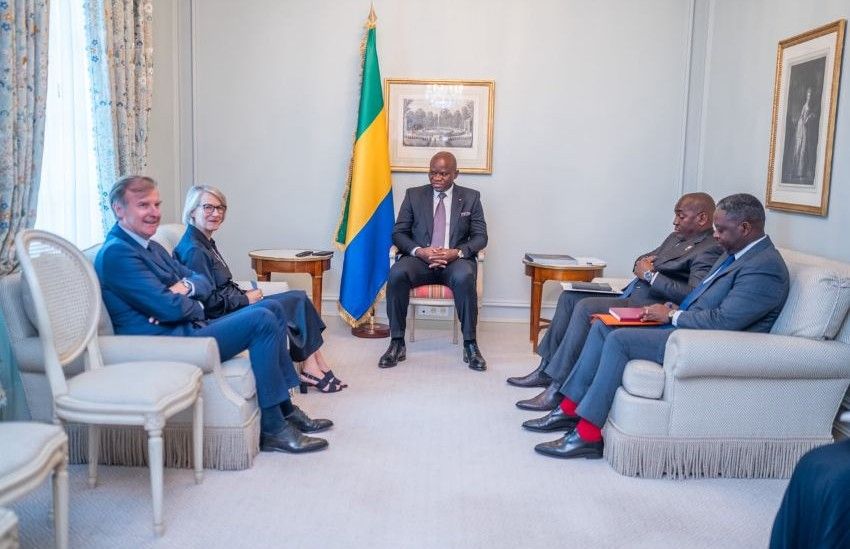
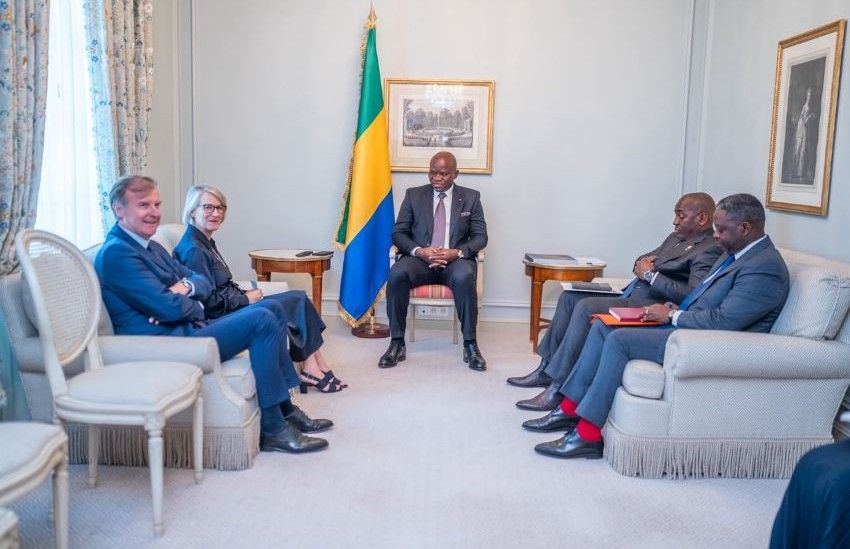
Libreville, August 4, 2026 — The state visit of Gabonese leader Brice Clotaire Oligui Nguema to Paris from July 19 to 22 was more than a diplomatic showcase. Beyond military honors at Les Invalides, a tour of the Palace of Versailles, and a state dinner at the Élysée Palace, Libreville had a clear economic agenda: securing measurable commitments that could reshape Gabon’s future.
The mission was substantial, involving over 80 delegates, including key figures from Gabon’s private sector. While the identities of French corporate leaders meeting with the president were previously undisclosed, official communications now reveal the scope of discussions and the names behind them.
Air connectivity and mineral transformation take center stage
On arrival in Paris, President Oligui Nguema met with Anne Rigail, CEO of Air France. The air transport dossier is critical. Air France and Fly Gabon already collaborate commercially, and negotiations are underway for a codeshare agreement expected by year-end. This would allow Fly Gabon to market tickets to Paris under its own branding, enhancing the country’s air connectivity—a vital factor for business travel, tourism, and foreign investment.
No final agreement was signed during the visit, but the timeline is closely watched. Improved air links could unlock new opportunities for Gabon’s economy, connecting people and ideas across continents.
Manganese processing: a bold vision with unanswered questions
The next day, at the Élysée Palace, mining took precedence. Representatives from Eramet and its subsidiary Comilog discussed a framework agreement with Gabonese authorities to accelerate local manganese processing. Christel Bories, Eramet’s president, presented a roadmap described as jointly developed with Gabon’s government.
The proposed plan aims to process up to 700,000 tons of manganese locally by the end of 2031. However, several scenarios are still under review. The agreement also envisions a “Fabriqué au Gabon” fund and the development of a biocharcoal sector—ambitious goals that hinge on further studies, financing, and infrastructure investments.
For now, these remain proposals rather than definitive commitments. The true test will come when concrete actions replace planning stages.
Energy and infrastructure: Booué and beyond
Energy security was another key topic. Gabon’s government, EDF Power Solutions, and Gabon Power Company signed an agreement to develop the Booué hydroelectric project on the Ogooué River, with a planned capacity of 400 megawatts. This initiative addresses a persistent imbalance: Gabon boasts significant hydroelectric potential but currently generates only around 700 megawatts, far below the national demand exceeding 1,000 megawatts.
The agreement sets a deadline of October 31 for finalizing development terms, with monthly meetings to track progress. This timeline will serve as an early indicator of the project’s viability.
Additionally, Omega Consortium, specializing in water and electricity infrastructure, held discussions with the president to explore ways to expand access to essential services—a priority for Libreville.
Gauging success: beyond diplomacy
Following the visit, presidential communications highlighted progress in mining, energy, water, security, and investment. Yet, specific financial figures and detailed commitments remain undisclosed, fueling public anticipation.
The true measure of success will not be the number of meetings held or documents signed, but the tangible impact on Gabonese lives. Citizens are waiting for jobs, reliable electricity, improved water networks, enhanced mobility, and greater value addition within Gabon’s borders. These outcomes will determine whether the Paris visit translates into meaningful change.
The October 31 deadline for Booué, the anticipated air transport agreement by year-end, and the evolution of the manganese roadmap will be closely monitored. The proof of Gabon’s economic diplomacy lies in its ability to deliver on its promises—not in the grandeur of its engagements, but in their real-world impact.