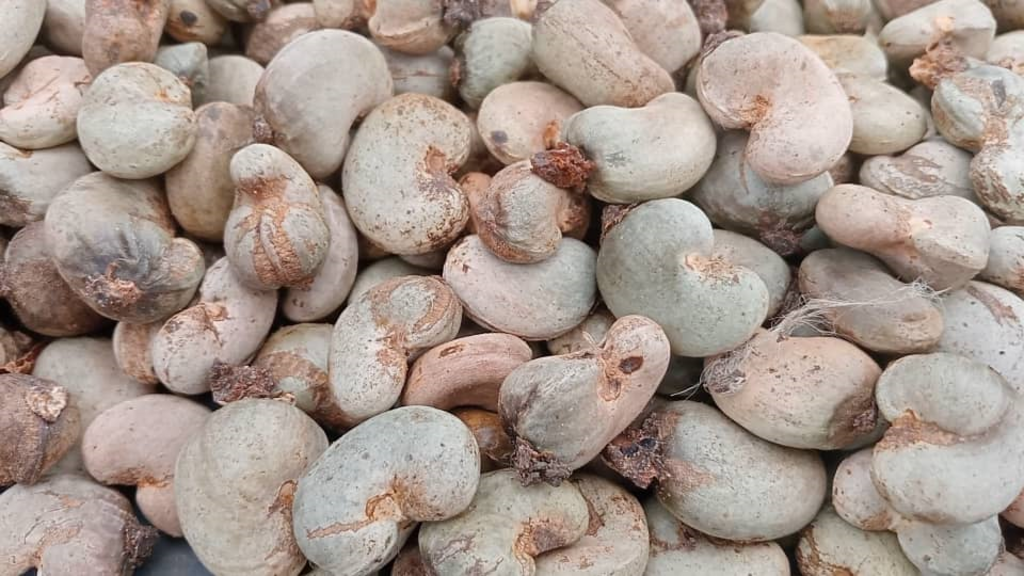
In Côte d’Ivoire, the cashew harvest season is in full swing, yet the outlook for this year’s yield is far from promising. The Cotton and Cashew Council projected a total of 1.3 million tonnes of cashews, a figure consistent with recent years but down by 200,000 tonnes compared to the previous harvest. The decline is particularly pronounced in the northern region of Bounkani, where farmers are grappling with erratic rainfall patterns.
Climate shifts and economic fallout in Bounkani
Kouamé Ouattara, a farmer in Bouna, shared his struggles with the failed cashew crop this season. His three-hectare plantation, which once yielded 500 kg per hectare, now barely produces enough for two bags. «Three years ago, I could harvest 500 kg per hectare. Now, I can’t even collect two bags from these 3 hectares.» His predicament stems from disrupted rainfall patterns. «We usually get heavy rains between November and December, which help the cashew trees bloom. But this year, the rains stopped in October, leaving us without precipitation from October to February. Without flowering, the harvest fails.»
The consequences extend beyond cashew farmers. Local beekeepers, who rely on cashew blossoms for honey production, are also facing significant losses. Koffi Ouattara, president of the Koflangué beekeepers’ association, noted a dramatic drop in honey yields. «Last year, we harvested 100 litres of honey. This season, we barely managed 30 litres. It’s a major loss for us.»
Outdated farming practices exacerbate the crisis
Dr. Sibirina Soro, a researcher at the University of Daloa and coordinator of the national cashew research project, attributes part of the problem to poor farming practices. «The main issue is the density of cashew plantations. Many are overgrown, with trees planted too closely together, ignoring recommended spacing.» The ideal density, he explained, is 100 trees per hectare. «Farmers need to rehabilitate their plantations to meet this standard. Without proper spacing, trees compete for resources, reducing yields.»
Soro also highlighted the threat posed by insect pests. He emphasized the need for better training and support for farmers, who avoid chemical pesticides in cashew cultivation. «This makes them more vulnerable to losses when harvests are poor. Our goal is to help them adopt sustainable practices that protect both their crops and the environment.»