Mali’s capital sees relief as terror threat tightens in central regions
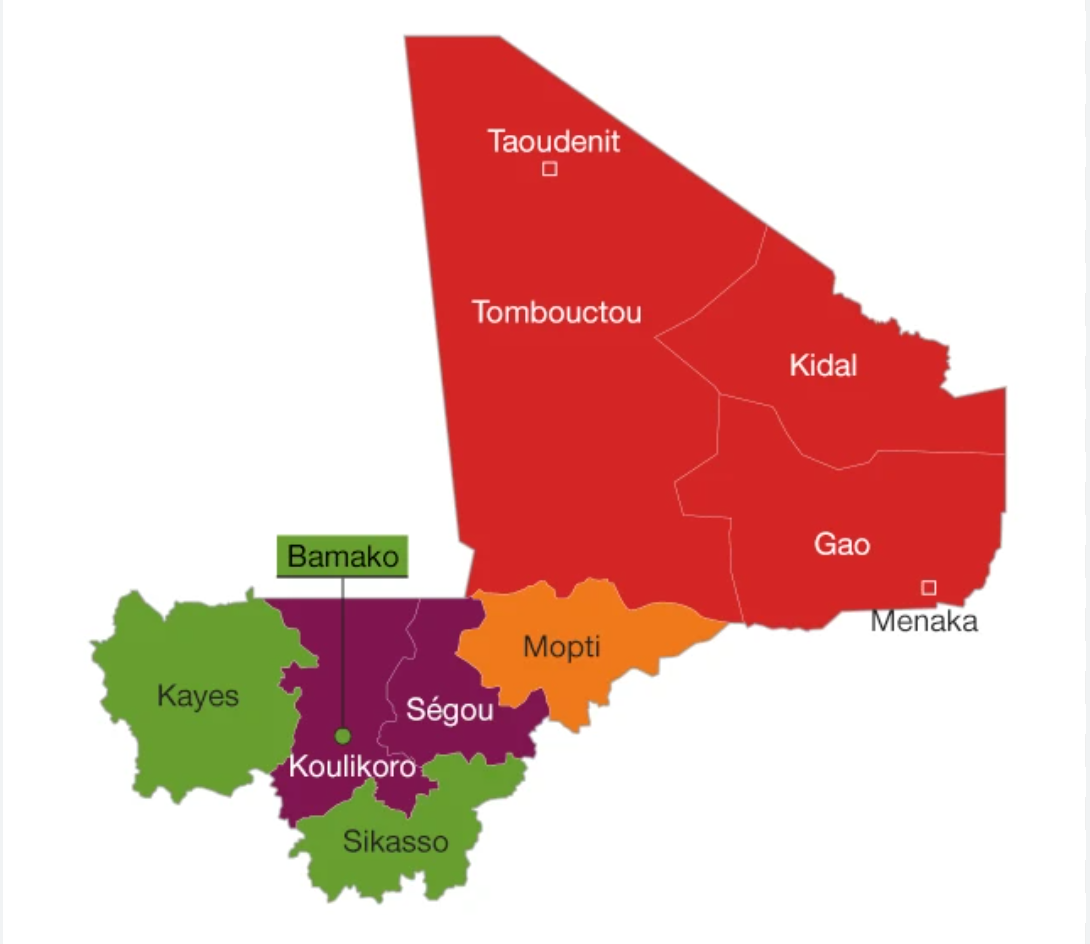
While Bamako breathes easier following the arrival of two critical convoys, the heart of Mali remains trapped in a tightening security crisis. The contrast is stark: on one side, the capital’s supply lines are stabilizing, yet on the other, the Centre region faces relentless attacks, forced displacements, and a shrinking government control.
Bamako’s lifeline: how new supply routes broke the siege
After weeks of anxiety over fuel and ammunition shortages, Bamako finally saw a breakthrough in late July. Two major logistical feats eased the pressure on the city’s economy and stability, proving that alternative supply routes can outmaneuver terrorist threats.
The first breakthrough came on July 24, when a massive convoy of fuel tankers entered Bamako without incident. These hundreds of vehicles traveled through Kayes, dodging JNIM-imposed blockades that typically cripple transit in the region. The successful delivery ensured that the capital’s essential services and markets could keep running, marking a tactical win against the insurgents’ chokehold.
A new military corridor reshapes West Africa’s supply game
The next day, July 25, brought another game-changer: a heavy military convoy arrived in Bamako, carrying advanced weaponry from Russia. The shipment, unloaded in Lomé (Togo) from the Russian cargo ship Mikhail Britnev, took an unconventional route—skirting Guinea to pass through Burkina Faso before entering Mali via Sikasso. This logistical maneuver signals the activation of a fresh West African supply corridor, one designed to bypass high-risk zones.
The delivery included a formidable arsenal to bolster the Malian Armed Forces (FAMa) and their Russian allies in Africa Corps: 3 BMP-2 infantry fighting vehicles, 8 BMP-3s, 14 mine-resistant ambush-protected (MRAP) vehicles, 4 BTR-82 armored personnel carriers, 2 anti-aircraft systems, and a fleet of tactical trucks and motorcycles. These assets aim to strengthen the government’s defensive and offensive capabilities in the face of persistent insurgent pressure.
Central Mali’s deadly trap: the RN16 under siege
Beyond Bamako’s relief, the broader security picture in Mali’s Centre remains dire. As distance from the capital grows, so does the insurgents’ grip. The national highway RN16, a critical artery between Mopti and Gao, has become a death trap.
On July 25 and 26, a joint FAMa and Africa Corps convoy, en route from Sévaré to Gao, faced coordinated attacks near Hombori. The JNIM deployed a barrage of improvised explosive devices (IEDs) along the Wami-Agoufou stretch, destroying or severely damaging several vehicles. The assault underscored the jihadist group’s deep territorial knowledge and the persistent challenge for government forces to secure secondary supply routes.
JNIM’s multifaceted pressure
The insurgency isn’t confined to the Sévaré-Gao axis. In the same period, the JNIM ambushed a FAMa convoy between Niafunké and Tonka, while also launching a counter-offensive north of Niono on July 26 to repel advancing Africa Corps units. These strikes highlight the group’s ability to exploit vulnerabilities across multiple fronts.
The humanitarian fallout: Kouakourou’s collapse and mass displacement
The most devastating consequence of the Centre’s insecurity is unfolding in the Djenné cercle, particularly around Kouakourou. On July 19, the local military camp fell to the JNIM, a symbolic and strategic loss for Mali’s territorial control. In response, the army launched heavy airstrikes on July 21, claiming to neutralize five motorized terrorists and destroy a logistics vehicle. Yet, despite the intensity of the aerial campaign, ground forces were unable to retake the town, which remains under full jihadist control.
The human cost is catastrophic. Thousands of residents, stripped of military protection and facing escalating violence, have fled their homes and farmlands. This exodus exacerbates the already strained displacement crisis in the Mopti region, overwhelming neighboring communities already struggling to absorb the influx.
A strategic stalemate with no clear resolution
Mali’s situation today exposes a glaring paradox. On one hand, the government is diversifying its alliances, opening new subregional supply routes, and equipping its forces with modern heavy weaponry. On the other, the JNIM’s asymmetric warfare continues to fragment the country, sever secondary supply lines, and inflict severe humanitarian crises in rural areas.
The question now is whether the influx of Russian combat equipment can shift the balance of power beyond protecting urban centers. The coming weeks will reveal whether FAMa and Africa Corps can translate these logistical gains into lasting territorial victories—or if the insurgents will further consolidate their hold in the Centre.