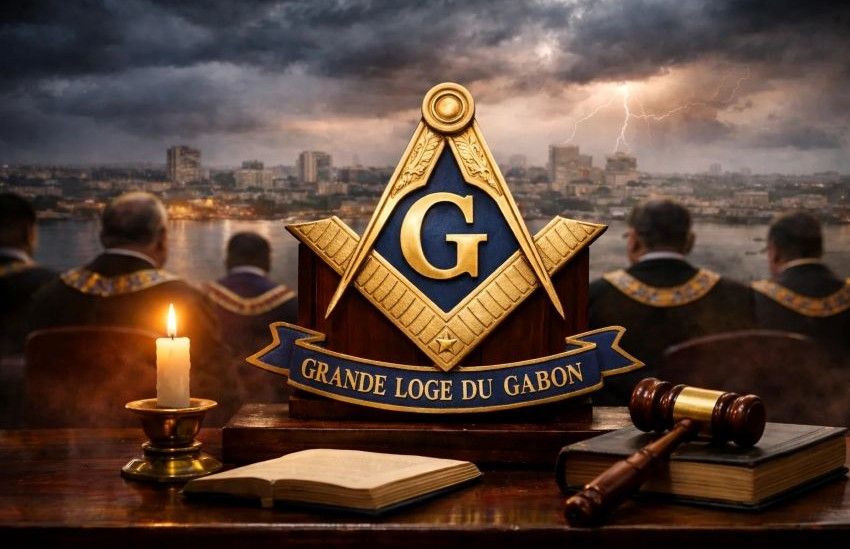
Libreville – For decades, the Grande Loge du Gabon (GLG) cultivated an aura of discretion and influence, projecting an image of an institution capable of navigating political turmoil without revealing its internal divisions. Today, this long-standing model appears to be crumbling.
Just months before a highly anticipated and crucial general assembly, the nation’s most influential masonic obedience finds itself embroiled in an open crisis. This turmoil is a complex mix of succession battles, challenges to authority, financial irregularities, and intense clan rivalries. Beneath the surface of these visible disputes lies a more profound transformation: the redefinition of a system that was once structured around a dominant figure, now forced to find its own new equilibrium.
Numerous accounts from within the organization indicate that the atmosphere within the Grande Loge du Gabon has never been more strained. An institution that champions values of fraternity, moral upliftment, and harmony is now exposed to divisions that extend far beyond the confines of its temples.
The end of an established order
To fully grasp the significance of the current crisis, one must revisit the recent shifts in Gabon’s power dynamics. For many years, political and masonic authority converged around a single individual. When the President of the Republic simultaneously held the position of Grand Master, individual ambitions, while present, remained contained by an almost unchallengeable hierarchy.
The pivotal shift occurred following the events of August 30, 2023. While many anticipated that the new head of state, Brice Clotaire Oligui Nguema, would assume leadership of the obedience, he instead chose not to seek the Grand Mastership. Subsequently, in February 2024, Jacques-Denis Tsanga was ultimately installed at the helm of the GLG.
This decision marked a clear break from a deeply entrenched tradition. For some observers, it signaled a deliberate effort to depoliticize the institution. For others, however, it primarily ushered in a period of uncertainty, where the absence of a unifying authority has created an environment ripe for long-suppressed rivalries to surface.
Succession reveals fractures
Three years into his tenure, Jacques-Denis Tsanga finds himself at the center of growing criticism. His supporters highlight reforms initiated in the organization of masonic provinces, patrimonial management, and the obedience’s international outreach. Conversely, his detractors accuse him of an excessive concentration of power, opaque governance, and controversial handling of several sensitive matters.
Figures cited by some members underscore the deep-seated unease. Temple attendance is reportedly in significant decline. Out of approximately six hundred recorded members, only about two hundred are said to participate regularly in activities. Expulsions, suspensions, and voluntary departures have collectively contributed to an unprecedented climate of mistrust.
Against this backdrop, the election scheduled for the upcoming general assembly takes on a strategic dimension. Several candidacies and aspirations are already emerging. Historical figures, high-ranking officials, and representatives from newer generations are appearing as potential contenders for the succession. This battle is no longer merely about a symbolic role; it concerns the very future of the organization.
Power seeks its new center of gravity
Beyond the realm of Gabonese Freemasonry itself, this crisis offers insightful commentary on the evolving centers of influence within the country. Long shielded by its close ties to the highest levels of state, the Grande Loge du Gabon is now experiencing the challenges that come with autonomy.
The paradox is striking. Those who once criticized the blurred lines between political and masonic power now observe that this very proximity also ensured a certain internal stability. Conversely, the gradual emancipation of the obedience is exposing deep fractures that a central authority previously managed to contain.
The issue thus extends far beyond the selection of the next Grand Master. It pertains to the institution’s capacity to establish an authority recognized by all within an environment that has become more competitive and fragmented. As in any organization, when the center of gravity becomes uncertain, ambitions cease to orbit around existing power and instead begin to clash in a bid to seize it.
The current crisis represents a significant test for the Grande Loge du Gabon. If it can transform this period of tension into an opportunity for renewal, it may emerge stronger. Otherwise, the disputes currently roiling its ranks risk paving the way for lasting fragmentation.
For an institution that has long leveraged secrecy as its strength, the spectacle unfolding today already serves as a powerful symbol. It reveals that even within the oldest and most influential structures, the fundamental question remains: how to preserve unity when authority is no longer undisputed.