Romuald Wadagni takes office as president of Bénin following landslide victory
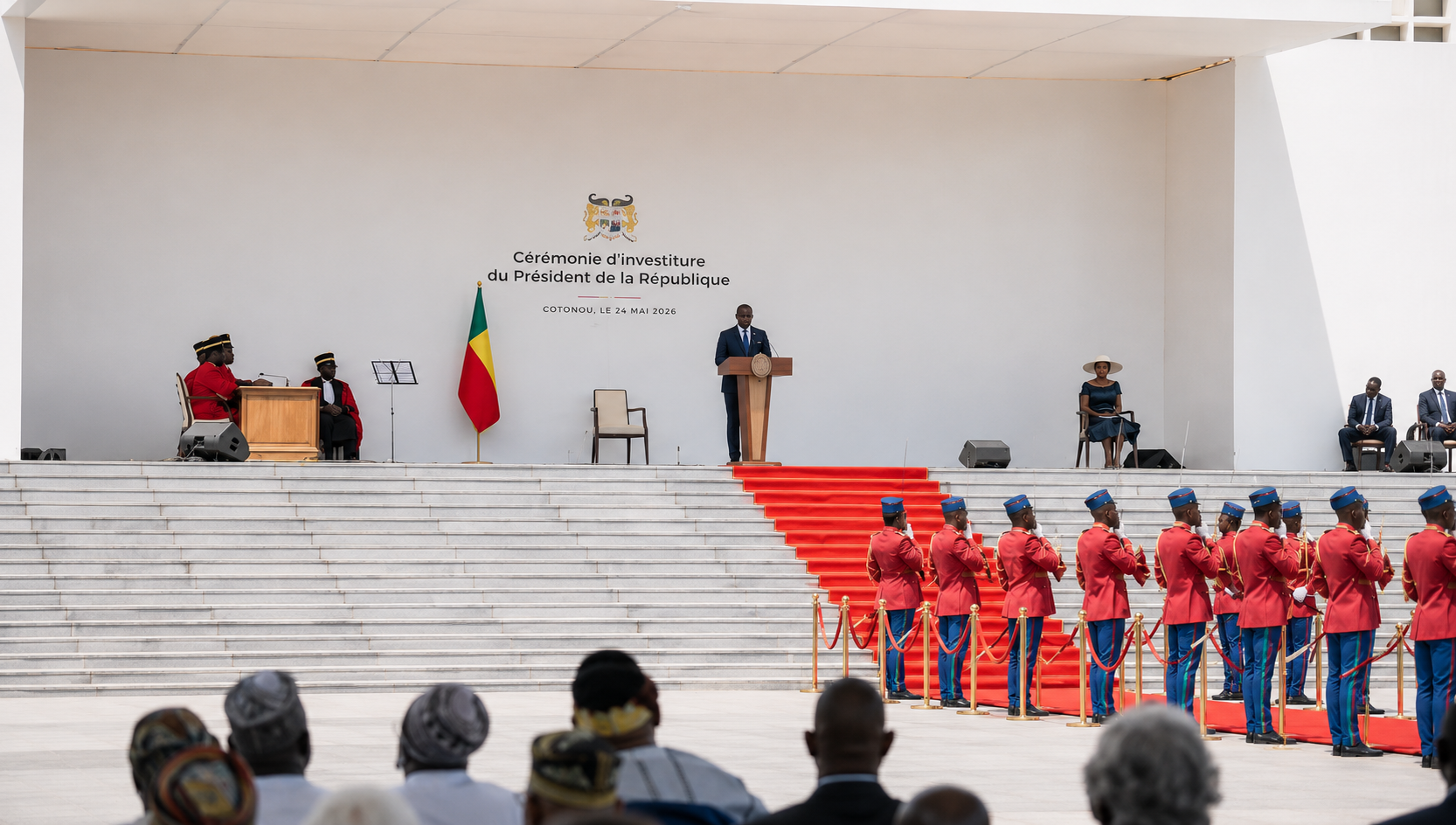
In a ceremony defined by themes of continuity and regional realignment, Romuald Wadagni officially began his seven-year term as the president of Bénin on Sunday, May 24, 2026. Taking the oath of office at the Palais des Congrès in Cotonou, the 49-year-old former Finance Minister succeeds Patrice Talon, who led the nation since 2016. The transition marks a pivotal moment for the country, following an election where Wadagni secured 94% of the vote in a contest that saw major opposition figures excluded.

The rise of a technocrat: from finance to the presidency
Romuald Wadagni represents the economic engine of the previous administration. A native of Lokossa and a veteran of the global firm Deloitte, he spent nearly a decade managing Bénin’s economy. His tenure as Minister of Economy and Finances was characterized by aggressive international fundraising and a focus on maintaining the nation’s creditworthiness. This background served as the foundation for his campaign, promising a steady hand on the nation’s financial tiller.
The April 12 election saw Wadagni and his running mate, Vice-President Mariam Chabi Talata, sweep the polls in the first round. His only challenger was Paul Hounkpè of the Forces cauris pour un Bénin émergent (FCBE). This election was the first to implement the seven-year presidential term, a change introduced by the 2025 constitutional revision which also decoupled the presidential race from legislative elections.
A meticulously orchestrated transition in Cotonou
The inauguration followed a strict protocol. After a private meeting at the Palais de la Marina, Patrice Talon handed over the symbols of state power to his successor. The formal swearing-in took place before the Constitutional Court, followed by the presentation of the Grand Collar of the National Order. The event was attended by over 6,000 guests, including former presidents Nicéphore Soglo and Thomas Boni Yayi, both of whom were acknowledged by Wadagni during his address.
Despite the smooth execution of the ceremony, the political environment surrounding the event remains a subject of intense scrutiny. The absence of the main opposition party, Les Démocrates, cast a long shadow over the democratic process. The party, led by Thomas Boni Yayi, saw its candidates disqualified in late 2025 due to a lack of parliamentary sponsorships—a requirement that has become a significant barrier for dissenting voices.
The challenge of political pluralism
The current political landscape in Bénin is characterized by a restricted space for opposition. High-profile figures such as Reckya Madougou and Joël Aïvo remain incarcerated, serving lengthy sentences for terrorism and conspiracy, respectively. Furthermore, the Court for the Suppression of Economic Crimes and Terrorism (CRIET) continues to face criticism from human rights organizations for its role in targeting political rivals.
Recent legislative reforms have also tightened the requirements for political participation. High registration fees and a new 20% representation threshold per constituency have effectively thinned the ranks of the opposition. In the January 2026 legislative elections, Les Démocrates failed to secure a single seat, leaving the parliament entirely in the hands of pro-government parties.
A new diplomatic direction toward the Sahel
Wadagni’s inaugural speech signaled a potential shift in foreign policy, particularly regarding Bénin’s northern neighbors. While maintaining a firm stance on domestic security against armed groups in the north, the new president extended a hand to the Alliance of Sahel States (AES). In a notable departure from previous diplomatic tensions, high-ranking officials from Mali, Burkina Faso, and Niger were in attendance.
The presence of Niger’s Prime Minister, Ali Mahaman Lamine Zeine, drew significant applause from the crowd. This reception suggests a desire to mend relations with Niamey, which have been strained since the 2023 coup. The closure of the border and disputes over oil transit through the Bénin-Niger pipeline have hampered both economies, and Wadagni’s softer tone may pave the way for renewed cooperation.
Domestically, the president promised that the nation’s economic growth would finally reach the average citizen. Addressing youth, women, and the diaspora, he emphasized that Bénin remains a “home of return” for those of African descent. The prominent role of Vice-President Mariam Chabi Talata further highlighted the administration’s focus on gender representation in high office.
A septennat of expectations
As Romuald Wadagni begins his seven-year mandate, several indicators will reveal the true nature of his presidency. The upcoming cabinet appointments will show whether he intends to move beyond the inner circle of his predecessor. Observers are also watching for any signs of a political amnesty law that could lead to the release of imprisoned opponents, a move that would signal a commitment to national reconciliation. For now, Bénin moves forward under a system that prioritizes economic stability and institutional continuity, even as questions about political pluralism persist.