Benin’s sovereign credit rating upgraded to ba3 by moody’s with stable outlook

Benin’s long-term sovereign credit rating has climbed another rung on the ladder. By raising the country’s debt assessment from B1 to Ba3, Moody’s now places Cotonou in the ‘BB/Ba’ sovereign ratings tier, one step closer to the highly coveted ‘investment grade’ threshold. The stable outlook attached to this upgrade signals confidence that no credit profile deterioration is expected over the next eighteen months. For a nation that regularly taps international and regional debt markets, the signal carries weight far beyond mere financial symbolism.
Economic growth hits 8.1% in 2025, highest in 35 years
The catalyst behind Moody’s decision is the country’s robust economic performance. Benin’s economy expanded by 8.1% in 2025, the strongest growth since 1990. This surge places the country among West Africa’s fastest-growing economies, propelled by the expansion of the Glo-Djigbé Special Economic Zone, rapid industrialization in the cotton sector, and the growing logistical corridor linking the Port of Cotonou to landlocked Sahelian nations.
This momentum has been matched by steady consolidation of public finances. Over recent fiscal cycles, Beninese authorities have pursued a rigorous budgetary cleanup aimed at bringing the deficit below the 3% of GDP ceiling set by the West African Economic and Monetary Union (WAEMU). Key tools include broadening the tax base, digitalizing revenue collection, and actively managing public debt—a strategy that has drawn praise from international financial partners.
A signal that investors have been anticipating
The upgrade arrives at a time when several African sovereigns face downgrades or negative outlooks, largely due to a stronger U.S. dollar and tighter access to international bond markets. Moving to Ba3 places Benin on par with, or even above, some regional peers, and should translate into lower risk premiums demanded by investors on upcoming government bond issuances.
On a practical level, a higher rating paves the way for more favorable financing terms. Since 2019, Benin has pioneered innovative debt instruments—euro-denominated eurobonds, sustainability-linked bonds, and existing debt refinancing—and can now leverage its improved standing to extend debt maturities and diversify its investor base. Public bond issuances on the WAEMU regional market are also poised to benefit from renewed investor appetite.
Persistent vulnerabilities warrant close monitoring
The stable outlook does not imply the absence of risks. Benin’s economy remains exposed to several key vulnerabilities closely watched by rating agencies. Heavy reliance on trade with neighboring Nigeria, exposure to global cotton price swings, and security tensions in northern departments bordering Burkina Faso and Niger are variables that could destabilize the fiscal trajectory.
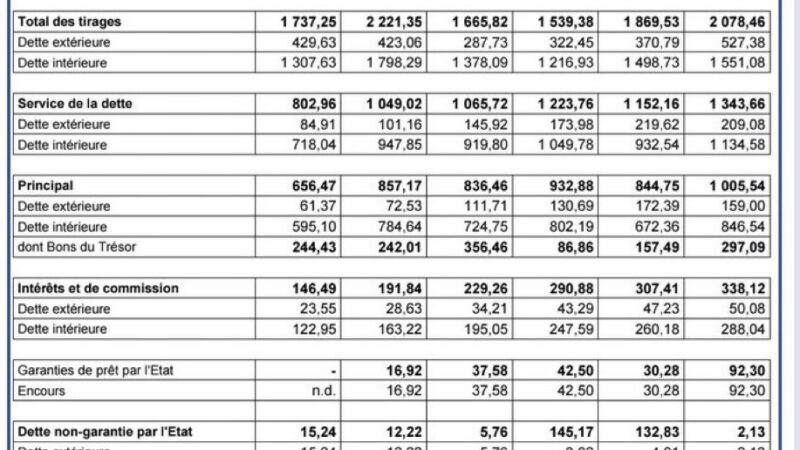
Public debt, while deemed sustainable by the International Monetary Fund (IMF) in its latest reviews under Benin’s program with the Fund, remains high relative to GDP. Debt servicing consumes a significant share of government revenue, limiting fiscal flexibility in the event of an external shock. Investors will be closely scrutinizing the government’s ability to maintain budget discipline while financing ambitious social and infrastructure programs.
Nevertheless, Moody’s decision validates, on the global stage, an economic policy strategy that Beninese authorities have pursued for years. It also reinforces Cotonou’s status as a benchmark credit in Francophone West Africa, alongside Côte d’Ivoire and Senegal, at a time when macroeconomic credibility has re-emerged as a critical geopolitical asset. Analysts do not rule out further positive revisions if current trends persist.