Togo education reform ends decades of sms result fee scams
End of an era: Togo dismantles state-sanctioned exam result extortion
The Togolese education system has, for generations, operated a financial extraction mechanism that directly targeted the most vulnerable households. With the abrupt termination of SMS-based exam result delivery, the recently appointed Minister of National Education, Mama Omorou, has exposed a systemic financial drain that persisted throughout Faure Gnassingbé’s administration.
Unveiling the scheme: When exam anxiety fueled a parasitic revenue stream
During an unannounced inspection on May 30, 2026, at the BAC I correction centers in Tokoin and Agoè-centre high schools, Minister Omorou delivered a scathing assessment of the SMS result consultation system. He condemned it as both a fraudulent scheme and a financial drain on families.
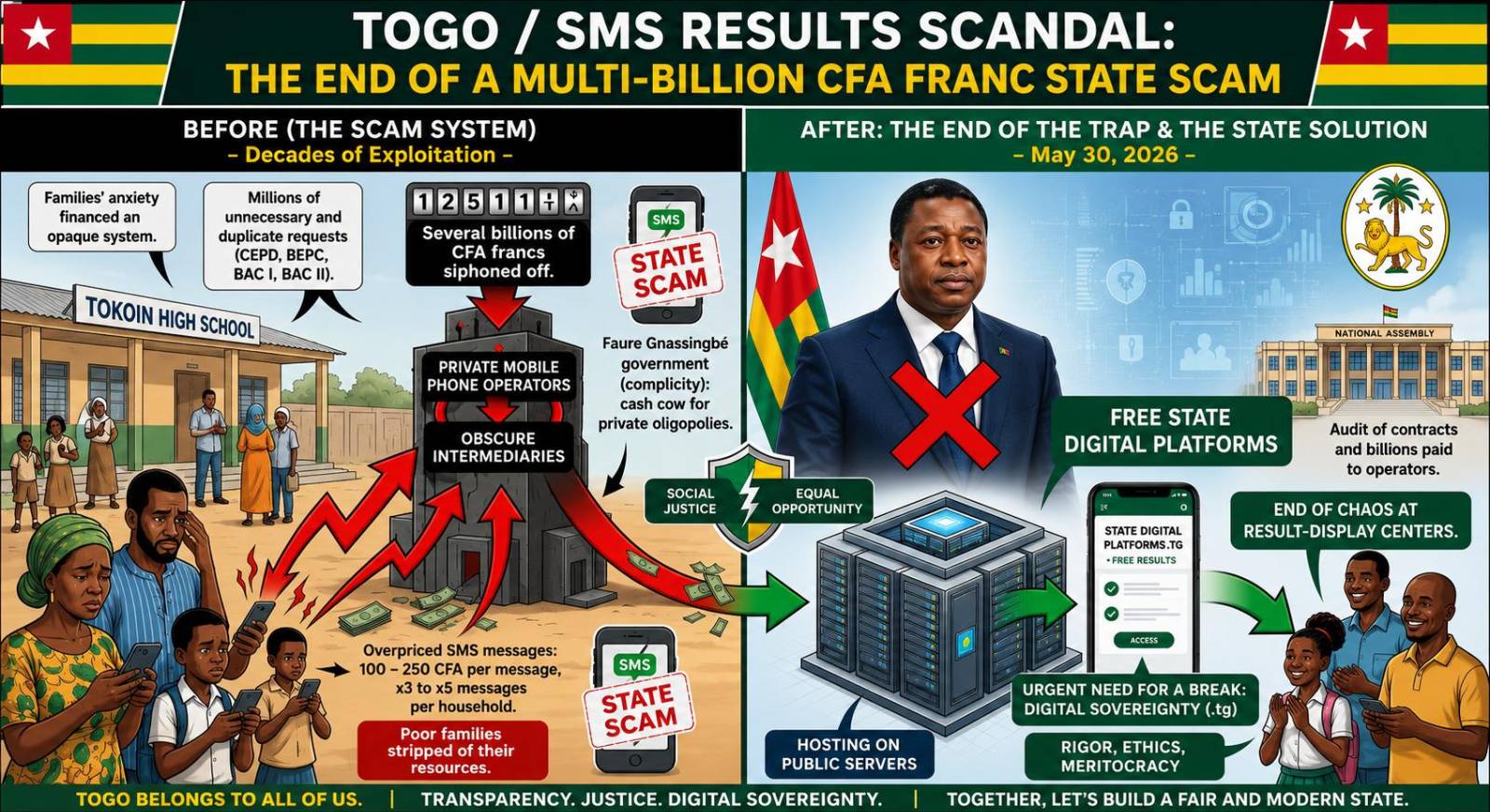
The mechanism operated with calculated cynicism. At every national examination cycle—CEPD, BEPC, BAC I, and BAC II—parents and guardians, gripped by anticipation, would send multiple high-fee SMS messages (each costing between 100 and 250 francs CFA) to retrieve identical results. This redundant volume of requests generated artificial revenue, siphoning funds from households struggling to cover basic needs.
Quantifying the theft: A multi-billion franc heist over decades
While the minister has not yet released detailed financial audits, demographic and transactional data reveal staggering losses.
By aggregating the number of candidates across all national examinations each year—estimated to reach several hundred thousand students—and applying the multiplier effect of multiple SMS messages per household (sometimes three to five per family), the total volume approaches tens of millions of messages per session.
Extrapolated over the past 15 to 20 years under the current governance structure, this practice has diverted billions of francs CFA from Togolese families into the coffers of private telecom operators and shadowy intermediaries. The funds were siphoned through state-granted concessions that remained unchallenged for decades, representing a scandalous wealth transfer from the public to private oligopolies, abetted by passive or complicit authorities.
A call for digital transformation and ethical governance
The minister’s decision to end SMS-based result delivery is a critical first step, but it introduces the urgent need for a robust, transparent alternative. Abolishing the system must not recreate the chaos of past practices—endless crowds forming outside exam centers, breeding disorder and heightened stress among families.
To align with Togo’s stated commitment to digital integration—evident in the work of the Ministry of Digital Economy—the government must immediately implement state-run, free, and secure digital platforms for result dissemination.
The new system should adhere to the following principles:
- Sovereign data hosting: Results must be stored on government-controlled servers under the .tg domain.
- Full transparency: Access must be universally free, funded through the national education budget to ensure equitable access.
- Modern delivery: Results should be published in waves via lightweight web portals or email, compatible with mobile devices—technology that is both affordable and accessible.
Beyond dismantling the financial racket, the minister used the inspection to reinvigorate the morale of examiners. He underscored that rigor, ethics, and meritocracy must once again become the guiding principles of Togolese education.
This announcement signals a profound ideological shift—one that seeks to protect families from institutionalized fraud and lay the foundation for a school system rooted in social justice. The critical question remains: Will the government demonstrate the resolve to follow through by auditing past contracts with telecom operators and exposing the full extent of the financial hemorrhage that has deprived Togo’s youth of vital resources for generations?