Senegal and Togo: contrasting visions of constitutional authority
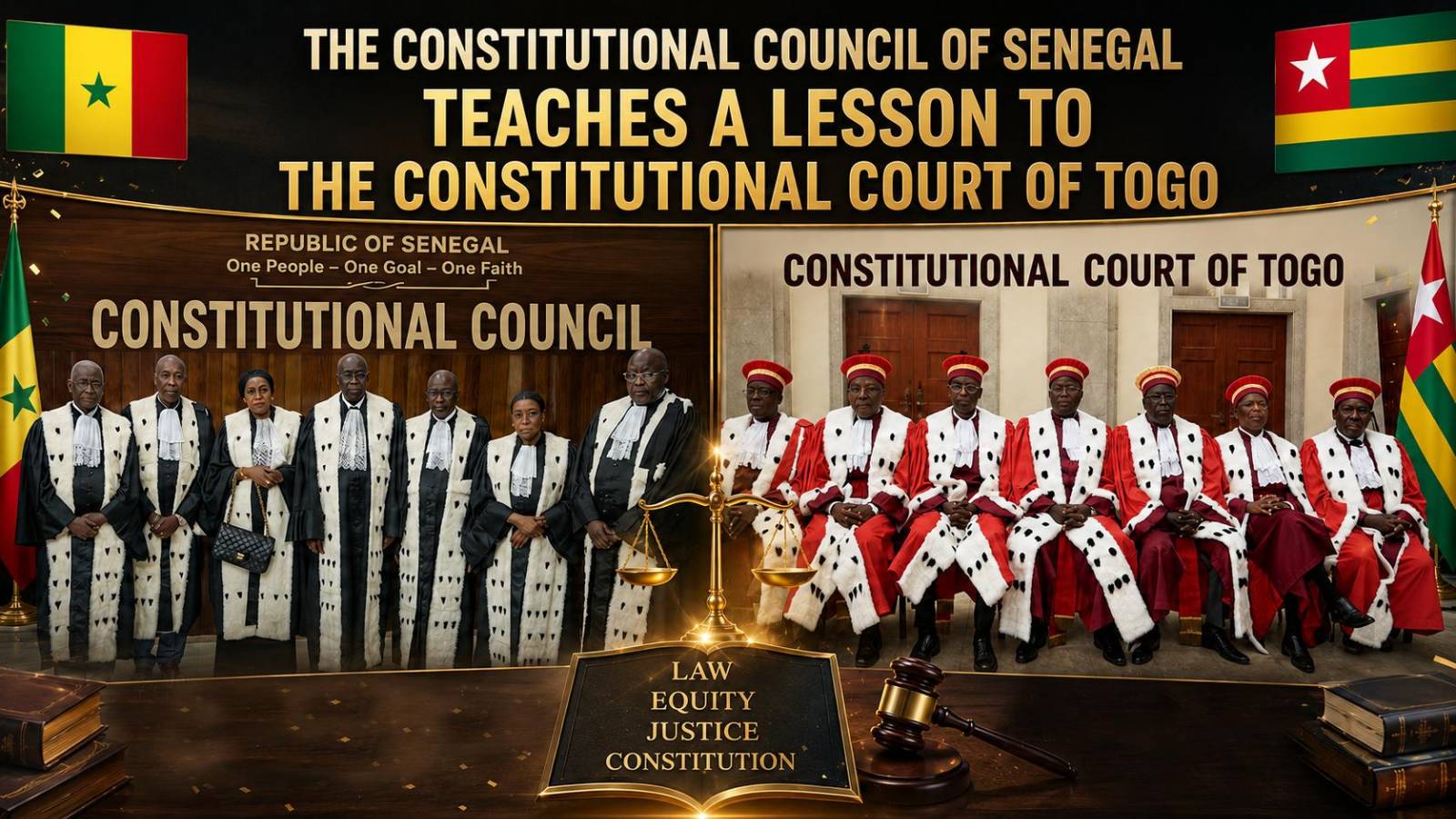
The constitutional paths taken by Senegal and Togo in recent months have laid bare two fundamentally different interpretations of the rule of law. While one country’s highest legal body has upheld the supremacy of constitutional principles, the other’s has seemingly accommodated political expediency—revealing stark contrasts in how justice and governance intersect.
Two Judiciaries, Two Philosophies
In Dakar, the Constitutional Council made a decisive intervention by striking down a constitutional amendment proposed by the government of Ousmane Sonko and endorsed by the parliamentary majority. The ruling sent a clear message: no electoral victory grants authority to override the nation’s foundational law. The decision underscored a fundamental truth—that even a sweeping mandate must yield to constitutional limits.
In Lomé, the Constitutional Court took a markedly different stance. Despite widespread political and legal opposition, it validated a sweeping overhaul of the country’s fundamental law. Critics argue the reform lacked broad national debate and was pushed through under pressure, raising concerns that the Constitution is increasingly viewed as a political tool rather than a unifying social contract. When constitutional amendments appear driven by short-term political convenience rather than collective consensus, their legitimacy inevitably erodes.
The Cost of Weak Institutional Guardians
A robust democracy depends not on the elegance of its constitutional text, but on the courage of its institutions to enforce it impartially. The Senegalese example demonstrates how an independent judiciary can act as a stabilizing force. By rejecting unconstitutional measures, the Constitutional Council not only preserves legal principles but also prevents political disputes from spiraling into institutional crises. Such judicial independence fosters public trust—a critical asset in maintaining stability, encouraging investment, and sustaining international credibility.
In contrast, when a constitutional court is perceived as an extension of executive power, it risks losing moral authority. Citizens may grow skeptical of domestic legal recourse, pushing disputes toward regional courts like the ECOWAS Court of Justice. This shift often signals a breakdown in domestic judicial credibility, where the promise of fair arbitration is overshadowed by institutional distrust.
Constitutions as Living Frameworks, Not Political Tools
A well-functioning democracy does not measure its strength by the frequency of constitutional changes, but by the restraint with which those changes are made. In mature democracies, constitutional reforms are preceded by inclusive consultations, rigorous debate, and a commitment to consensus. This caution stems from the realization that constitutions are not merely present-day instruments—they shape the rules for future power transitions.
When revisions serve immediate political goals, they set a dangerous precedent. Subsequent governments may feel emboldened to reshape institutions to their advantage, fostering chronic instability and concentrating power. The result is a Constitution that no longer unites, but becomes a perpetual source of contention—transforming once-neutral institutions into battlegrounds for power.
Learning from Africa’s Own Experiences
Officials in Togo have sought inspiration from constitutional models abroad, including parliamentary systems in India. While comparative studies can offer valuable insights, they cannot replace the lessons drawn from Africa’s own democratic experiments—each shaped by shared historical, political, and social realities.
The continent’s most resilient democracies are not built on imported blueprints, but on the consistent application of constitutional principles. Senegal offers a compelling case study: its Constitutional Council has earned its legitimacy not through rhetoric, but through decisive action—even when it challenges the ruling power. This is not a symbolic difference. It affects governance quality, public confidence, international standing, and economic attractiveness. A nation whose institutions appear stable and predictable commands greater trust than one where rules shift with political winds.
The Heart of the Matter
The divergence between Dakar and Lomé transcends legal technicalities. It reflects fundamentally different visions of constitutional purpose. In one case, the Constitution serves as a bulwark against power. In the other, critics contend, it risks becoming a malleable instrument for political convenience. A resilient democracy is not defined by the volume of constitutional amendments it adopts, but by the steadfastness of its institutions in protecting citizens from all forms of excess—executive, legislative, or otherwise.