May social unrest grips Senegal as protests escalate nationwide
Senegal braces for a turbulent may as unrest spreads across key sectors
May has long been a month of simmering discontent in Senegal, but this year, the social pressure cooker is reaching a boiling point. From university campuses to public transport corridors and state agencies, multiple fronts of protest are converging, creating a perfect storm of industrial action, administrative disputes and financial grievances.
The timing is far from coincidental. May 1st, International Workers’ Day, amplifies long-standing demands for better labor conditions, fair wages and transparent governance. Historical echoes of Mai 68 in France—where student uprisings sparked nationwide labor strikes—still resonate in Senegal, a former French colony where such movements have historically left deep ideological imprints.
transport workers strike paralyzes Dakar’s urban mobility
On May 1st, members of the Association de Financement des Professionnels du Transport Urbain (AFTU) launched a strike that severely disrupted urban transport in Dakar. The protest stems from a bitter dispute with a private transport operator over the implementation of electronic ticketing systems. A High Court ruling in Dakar temporarily blocked the deployment of new ticketing machines and ordered the seizure of those already installed, prompting AFTU workers to take to the streets in defiance.
Meanwhile, the Fondation Trade Point Sénégal held a press conference to expose what they described as a deplorable internal governance crisis. The allegations include widespread mismanagement, unjustified mass hiring and a deteriorating workplace environment.
ageroute hit by internal strife over leadership and human resource mismanagement
Tensions at the Agence des Travaux et de Gestion des Routes (Ageroute) have intensified after human resources director Cheikh Ahmed Tidiane Thiam publicly criticized the leadership style of the agency’s new director general. Thiam highlighted a lack of consultation, systematic marginalization of staff and the abrupt dismissal of 23 employees—measures he claims have eroded morale and productivity.
university students demand payment of outstanding scholarships
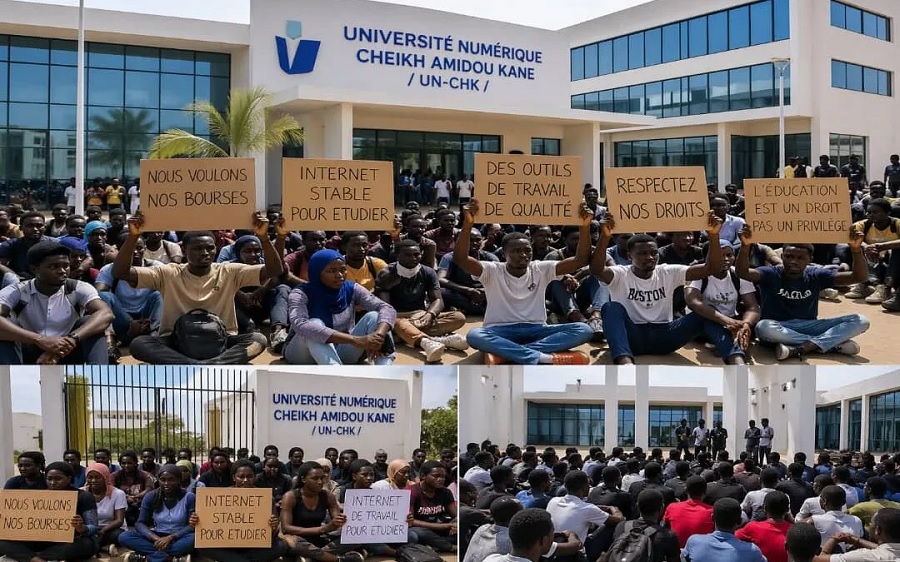
Students from the 10th cohort of the Université Numérique Cheikh Hamidou Kane (UN-CHK) have taken to the streets, demanding the full disbursement of their scholarship funds. They report receiving only two years of financial support out of the three years allocated for their bachelor’s degree program. The students have called on authorities to resolve this financial shortfall immediately.
These simultaneous crises paint a worrying picture. Workers, students, civil servants and transport operators are all raising their voices, each group amplifying the chorus of discontent. The convergence of these movements suggests that May 2024 is not just another month of protest—but a turning point in Senegal’s social and political landscape.