Diplomacy is not only measured by the number of official visits or international summits. It is also read in the signals that states send when they choose to establish, strengthen, or reactivate their representations in a country.
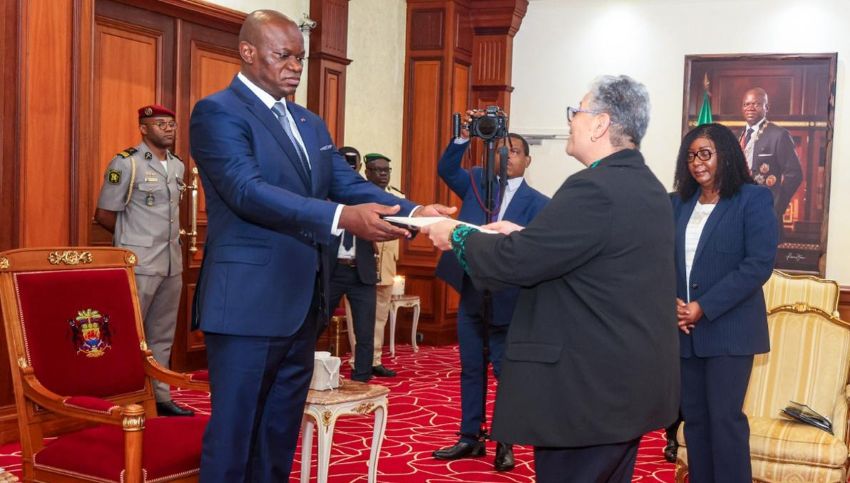
By receiving the letters of credence from five new ambassadors accredited to the Gabonese Republic, President Brice Clotaire Oligui Nguema presided over much more than a protocol ceremony. The event confirms a growing reality: Gabon is gradually reclaiming a central place in the diplomatic, economic, and strategic balances of the continent.
In an international context marked by competition for resources, investments, and influential partnerships, the simultaneous interest of the Holy See, Chad, Australia, Iran, and Djibouti is a telling indicator of how the country’s positioning has evolved since the political transition that began in August 2023.
Five ambassadors, five strategic messages
The new diplomatic representatives received Wednesday in Libreville each illustrate a particular dimension of Gabon’s foreign policy.
Monseigneur Relwende Kisito Ouédraogo, Apostolic Nuncio of the Holy See based in Brazzaville, embodies the continuity of a historic relationship between the Vatican and Gabon, built on dialogue, education, social peace, and humanitarian cooperation.
Chad’s ambassador, Fadoul Kittir Zakaria, based in Malabo, underscores the strength of ties between Central African states facing common challenges of stability, security, and regional integration.
The accreditation of Leilani Bin-Juda, Australian High Commissioner residing in Abuja, carries particular economic weight. It comes as the Australian group Fortescue plays a strategic role in developing the Belinga project and the accompanying logistics corridor. This mining and industrial project is considered one of the most ambitious on the African continent, with major implications for infrastructure, energy, employment, and local processing of natural resources.
The appointment of Seyed Gholamreza Mirmohammad Meigoni as ambassador of the Islamic Republic of Iran opens new prospects in industrial, technological, academic, health, and training fields. It aligns with Gabon’s desire to diversify its partners beyond traditional circles.
Finally, Mohamed Bourhan Ali, ambassador of Djibouti, brings a particularly strategic dimension. Djibouti’s model is studied worldwide for its expertise in port, logistics, and maritime sectors — areas that Libreville aims to develop in order to accelerate its economic transformation.
Economic diplomacy as a driver of development
Behind these accreditations lies a profound evolution in Gabon’s foreign policy. For a long time, African diplomacy was often seen as a largely ceremonial exercise. The new direction taken by Gabonese authorities instead seeks to make every international relationship a direct lever for economic development.
The major projects underway for several months play a central role in this renewed attractiveness. Development of the Belinga corridor, investments in infrastructure, industrial ambitions, local processing of raw materials, and the search for new financial partners are gradually changing the international perception of the country.
This evolution is all the more important as competition among African states for foreign capital intensifies. In this context, Gabon’s ability to simultaneously attract interest from actors as diverse as Australia, Iran, and Djibouti reflects a diplomatic diversification rarely seen in recent years.
A test for Gabon’s international credibility
The significance of this ceremony goes beyond the diplomatic register. It also represents a test of credibility.
The interest shown by these partners rests largely on the reforms undertaken, the restored institutional stability, and the promise of sustainable economic transformation. This confidence remains a precious but fragile asset.
Recent history shows that international investments follow concrete results more than speeches. The announced partnerships must therefore translate into visible projects, operational infrastructure, created jobs, and real opportunities for the populations.
It is precisely at this level that the true success of this new diplomacy will be determined.
By receiving five new ambassadors from different geographical and strategic horizons, Gabon sends a clear message to the rest of the world. The country no longer wishes to be merely an exporter of natural resources. It intends to become a regional platform for investment, industrialization, and international cooperation.
This ambition is now visible in chancelleries. The challenge remains to turn it into lasting economic reality. Because the most effective diplomacy is not the one that accumulates foreign representations. It is the one that transforms international relations into national prosperity.