Burkina Faso: captain Traoré’s security strategy faces intense scrutiny amidst escalating militant activity
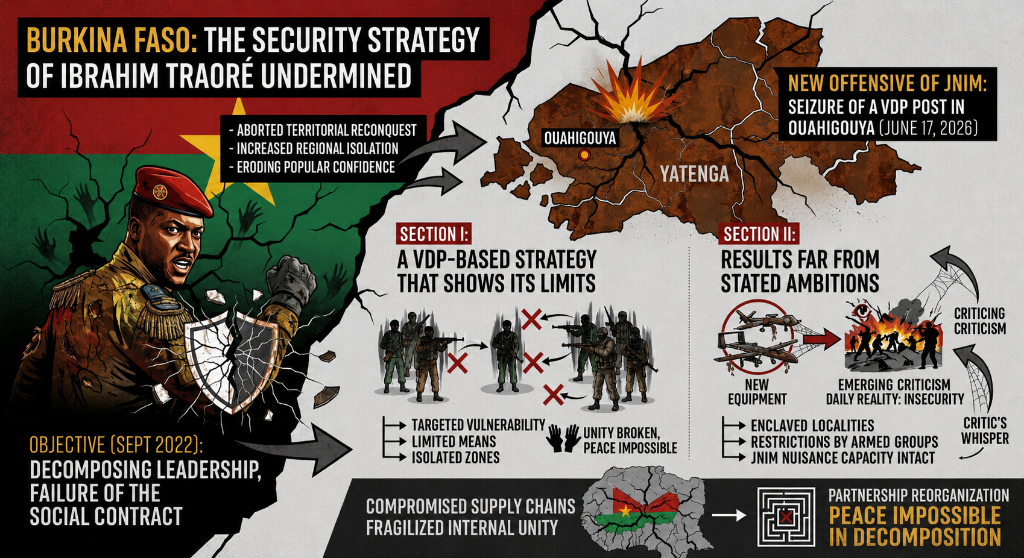
The security landscape across Burkina Faso continues to deteriorate significantly. The Group for the Support of Islam and Muslims (JNIM), an organization aligned with Al-Qaeda in the Sahel, has asserted responsibility for the capture of a Volunteers for the Defense of the Homeland (VDP) outpost. This incident occurred during an assault on June 17, 2026, within the Ouahigouya area, which serves as the provincial capital of Yatenga in the northern reaches of the nation.
This latest offensive represents a considerable setback for the territorial reconquest strategy championed by the transitional authorities. Captain Ibrahim Traoré, who assumed leadership in September 2022 with a firm commitment to restoring national territorial integrity, is now confronting an increasing wave of questions regarding the efficacy of his current security methodology.
A VDP-centric strategy revealing its limitations
In an effort to compensate for the numerical shortfalls within the regular armed forces, the authorities have placed substantial reliance on the Volunteers for the Defense of the Homeland. However, these civilian units, frequently deployed to remote locations and operating with restricted resources, have progressively become primary targets for armed factions.
The assault in Ouahigouya is one in a series of reversals documented over recent months. Despite ongoing military operations conducted on the ground, numerous positions prove challenging to secure on a sustainable basis. Many experts specializing in the Sahel region contend that the JNIM maintains a substantial capacity for disruption and enjoys considerable operational latitude within the northern and eastern provinces.
Outcomes fall short of stated ambitions
The transitional government regularly highlights perceived advancements and the acquisition of advanced equipment, including surveillance and combat drones. Nevertheless, for a significant segment of the population, pervasive insecurity remains a daily reality. Several communities endure isolation, and certain territories continue to experience restrictions imposed by armed groups.
Within this challenging environment, critiques regarding the effectiveness of the prevailing security policy are intensifying. The fundamental rationale that underpinned the overthrow of civilian rule in 2022—the perceived inability to guarantee the protection of citizens—is once again at the forefront of public discourse.
While Ouagadougou proceeds with the realignment of its partnerships within the Confederation of Sahel States (AES) and plans to intensify its operational tempo throughout 2026, the Yatenga attack serves as a stark reminder of the inherent difficulties in resolving an asymmetric conflict solely through military intervention.