Burkina Faso’s justification strategy over RSF allegations raises concerns
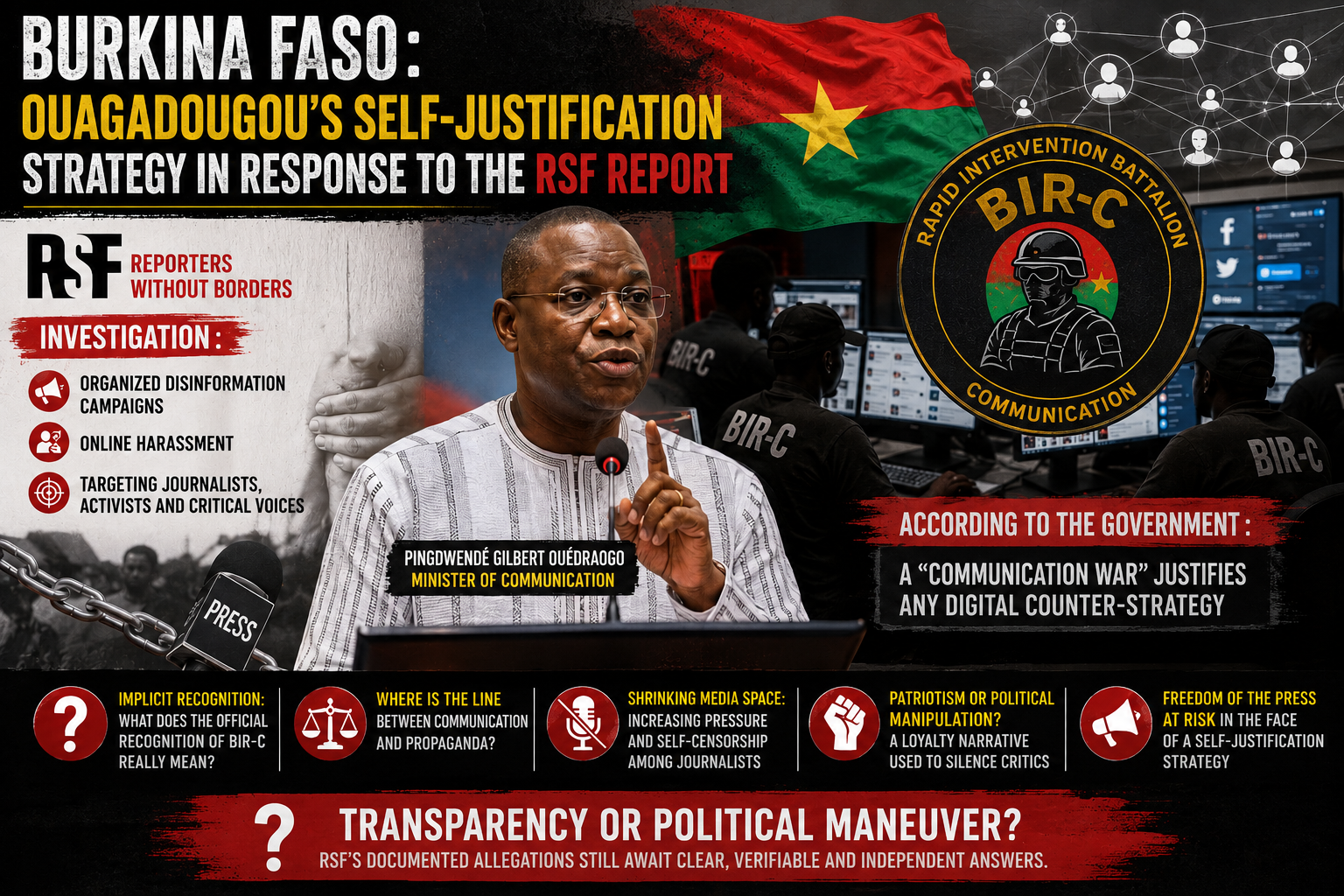
Ouagadougou’s response strategy under scrutiny
The Burkinabè authorities appear to be doubling down on a pattern of justification rather than embracing genuine transparency when confronted with criticism. During a public address on August 3, during the flag-raising ceremony, Minister of Communication Pingdwendé Gilbert Ouédraogo attempted to counter allegations made by Reporters Without Borders (RSF). His public tribute to the ‘Rapid Intervention Battalion – Communication’ (BIR-C), framed as a tool for information defense, seems more like a move that deepens doubts than one that provides clarity.
By officially acknowledging the existence and role of this structure within Burkina Faso’s digital ecosystem, the government implicitly validates concerns. This recognition comes at a time when an RSF investigation exposes a coordinated network accused of orchestrating disinformation campaigns, online harassment, and systematic targeting of journalists, activists, and critics of the military transition. Instead of launching an independent inquiry or systematically refuting the documented claims, the authorities chose to publicly endorse the BIR-C, further fueling questions about its true purpose.
Coordinated digital campaigns under the spotlight
The RSF investigation outlines a modus operandi centered on the synchronized mobilization of social media accounts. These accounts are allegedly deployed to impose specific narratives, discredit dissenting voices, and exert constant pressure on media professionals. While the government dismisses these accusations, its decision to publicly defend the BIR-C rather than address the documented evidence intensifies debates about the line separating institutional communication from political propaganda.
The official narrative frames Burkina Faso as facing a ‘communication war’ waged by external actors seeking to destabilize the country. In this context, any digital strategy aimed at defending the authorities is framed as a patriotic act. Yet this argumentation raises a critical question: where does legitimate crisis communication end, and where does the suppression of information pluralism begin?
Balancing security and press freedom
In a climate marked by deep political and security polarization, combating manipulation campaigns is a legitimate concern for any state. However, international principles on freedom of expression underscore that such efforts cannot justify targeted harassment, smear campaigns, or intimidation tactics against journalists. When dissent is systematically equated with national betrayal, public debate risks being severely curtailed.
This controversy unfolds against a backdrop of suspended international media outlets, mounting pressure on journalists, and a shrinking Burkinabè media landscape. Observers warn that these developments foster a climate where self-censorship becomes a survival strategy for information professionals. Against this backdrop, the existence of an organized digital communication structure—if its role extends beyond mere government communication raises pressing questions about balancing national security with fundamental freedoms.
A political counter-offensive
The minister’s communication strategy appears less like an exercise in transparency and more like a political counter-offensive. By emphasizing the patriotism of BIR-C members, the authorities shift the debate from factual scrutiny to national loyalty. This approach reframes criticism not as legitimate inquiry but as attacks on the state itself.
Yet a democracy, even under severe security threats, is also measured by its ability to tolerate scrutiny from the press and civil liberties organizations. Responding to an investigation with public support for the accused structure does not dispel doubts. On the contrary, it may be interpreted as political endorsement of its role within the government’s communication apparatus.
Beyond the BIR-C: the future of digital information governance
The stakes now extend far beyond the BIR-C case. They concern how Burkinabè authorities conceptualize information management in the digital age. As social media become a new battleground for political confrontation, any use of these platforms by power-aligned structures must operate within a framework that is transparent, rights-respecting, and compatible with press freedom principles.
This episode reveals a clear political choice: responding to criticism through patriotic mobilization rather than engaging in factual debate and verifiable clarification. Until the documented allegations are addressed with precision, verifiability, and independence, official statements risk being perceived not as refutations but as attempts at self-justification by a communication system whose contours continue to fuel concerns about press freedom in Burkina Faso.