Niger leads uemoa in bad loans as regional banking risks surge
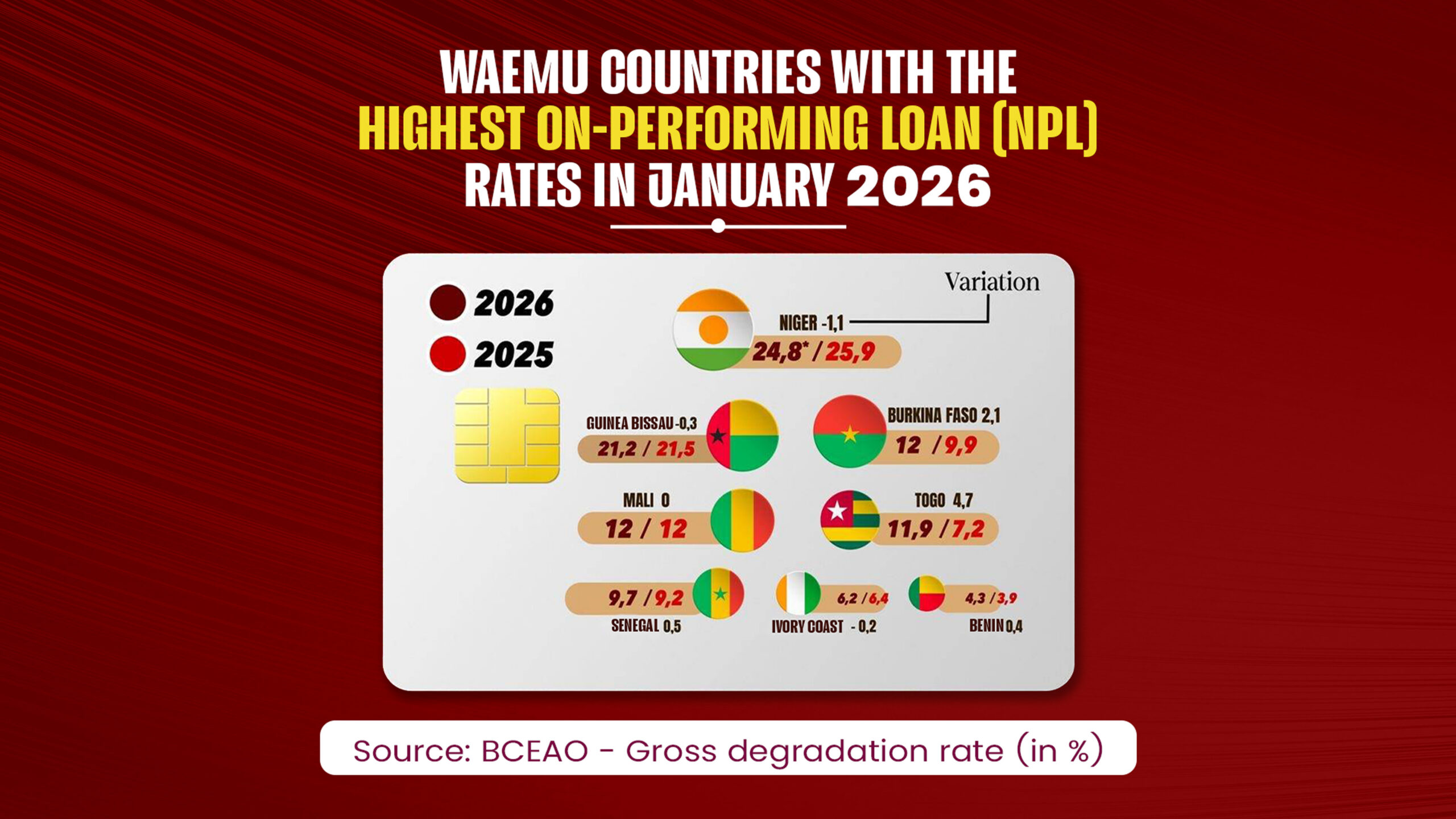
The latest economic outlook report reveals a stark reality: while the banking sector of the West African Economic and Monetary Union (WAEMU) reaches symbolic milestones, it is increasingly undermined by a growing wave of financial risks. At the epicenter of this turbulence, Niger stands out with an unparalleled rate of non-performing loans, highlighting a deepening regional divide that threatens the bloc’s stability.
The Niger Paradox: A Financial Outlier in the WAEMU
As WAEMU member states strive to stabilize their financial systems, Niger’s performance remains a cause for concern. Despite marginal improvements, the country continues to lag far behind its peers, representing the weakest link in the regional banking network.
Niger holds the unenviable title of worst performer in the union, with a staggering 24.8% non-performing loan (NPL) rate in January 2026. This means nearly one in four loans disbursed in Niger is now in default—a figure that, though slightly improved from 25.9% in 2025, remains alarmingly high compared to the regional average.
The country’s structural vulnerabilities are further exposed by persistent security challenges and political instability, which have eroded investor confidence and weakened the repayment capacity of borrowers.
A Tale of Two Blocs: Coastal Resilience vs. Sahelian Struggles
The January 2026 data underscores a widening gap between the economically robust coastal states and the crisis-plagued Sahelian nations, where Niger serves as a cautionary example of financial fragility.
The Sahelian Bloc: A Region Under Strain
Beyond Niger, other Sahelian members are also grappling with soaring NPL rates:
- Mali and Burkina Faso: Both nations have reached a 12% NPL rate, with Burkina Faso experiencing a sharp year-on-year increase of 2.1 percentage points.
- Guinea-Bissau: The country remains mired in a critical financial situation, with 21.2% of loans in default.
The Coastal Bloc: Relative Stability with Notable Exceptions
In contrast, coastal states demonstrate greater financial resilience, though not without their own setbacks:
- Benin: The regional standout with the lowest NPL rate at 4.3%.
- Côte d’Ivoire and Senegal: These nations maintain stable figures, recording 6.2% and 9.7% respectively.
- Togo: The exception in this group, with a dramatic surge in NPLs, jumping from 7.2% to 11.9%—a 4.7 percentage point increase.
A Credit Boom Overshadowed by Rising Defaults
The WAEMU’s total credit portfolio has surpassed 40.031 trillion CFA francs, marking a 4.7% annual increase. However, this growth is increasingly overshadowed by a troubling rise in bad loans.
Total non-performing loans have ballooned to 3.631 trillion CFA francs, while the coverage ratio has plummeted to 59%. This means banks are struggling to set aside sufficient provisions to absorb losses at the same pace as defaults are accumulating.
Banks Tighten the Screws: A Shift in Lending Strategy
Faced with deteriorating credit quality—particularly in high-risk nations like Niger—financial institutions are adopting a more cautious approach:
- Stricter lending criteria, including higher personal contributions and collateral requirements.
- Reduced appetite for risk, prioritizing balance sheet safety over the expansion of credit to local SMEs and SMBs.
While the WAEMU’s overall financial system has not yet reached a crisis point, the precarious situation in Niger and the spillover effects in the Sahel demand heightened vigilance to prevent a potential liquidity crunch from spreading across the region.