Morocco and uae strengthen atlantic-gulf axis amid rising middle east tensions
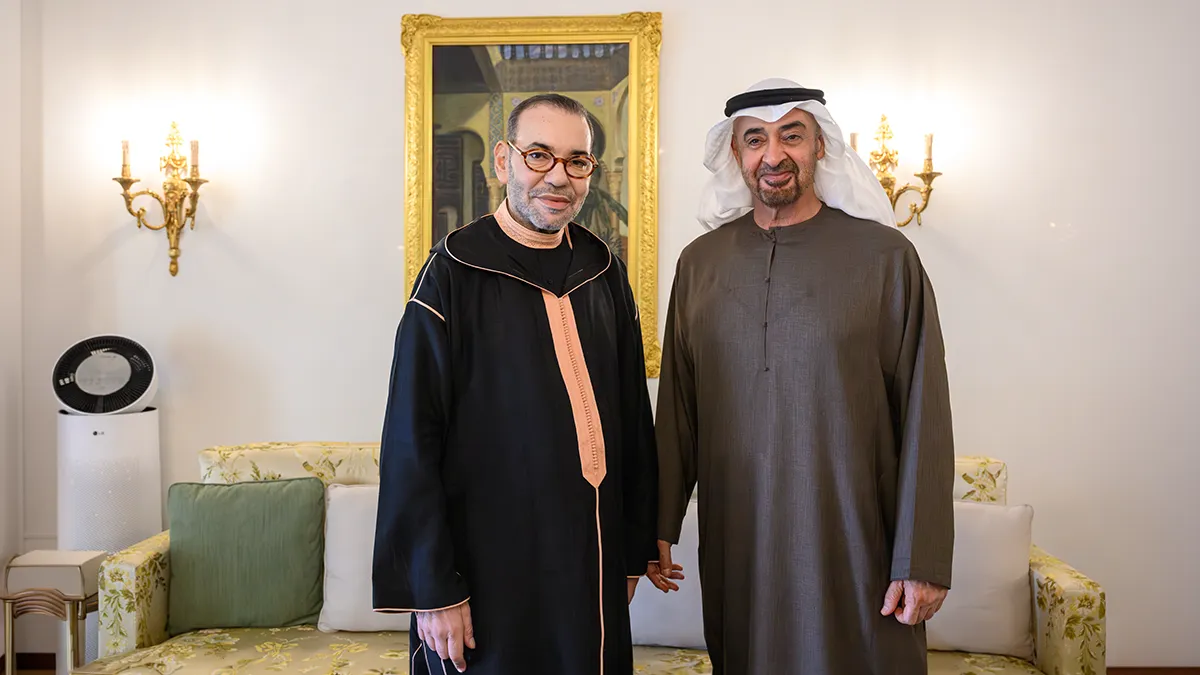
Morocco and UAE deepen Atlantic-Gulf alliance amid Middle East crisis
Morocco’s King Mohammed VI and UAE President Sheikh Mohamed bin Zayed Al Nahyan solidify a strategic partnership rooted in massive infrastructure investments and shared maritime security interests.
The Royal Palace in Rabat has once again become the epicenter of a new diplomatic momentum uniting North Africa with the Gulf. This meeting between King Mohammed VI and UAE President Sheikh Mohamed bin Zayed transcends protocol—it signals a decisive response to escalating tensions in the Middle East that threaten global trade and energy corridors.
As geopolitical friction between Iran, Israel, and Western powers intensifies, Rabat and Abu Dhabi are reinforcing a long-standing political and intelligence partnership. This alliance demonstrates that North Africa is no longer isolated from Gulf security challenges.
economic and strategic pillars of a deepening alliance
The collaboration between Morocco and the UAE rests on three key pillars: massive financial investments, joint infrastructure projects, and synchronized diplomatic positioning.
Financial engagement is the most visible aspect. The UAE has become Morocco’s top Arab investor, with over $30 billion in committed capital. This economic synergy was formalized through the Comprehensive Economic Partnership Agreement (CEPA), which has accelerated joint ventures.
energy and infrastructure mega-projects
Energy security tops the agenda. The Africa-Atlantic Gas Pipeline (AAGP)—a $25 billion initiative to transport Nigerian gas to Europe via a 5,600 km route—is set to receive significant UAE backing. Meanwhile, the Al Boraq high-speed rail network, currently linking Tangier and Casablanca, is being extended to Marrakech under new funding agreements. UAE investments are also transforming Morocco’s airports, with strategic terminals in Casablanca, Nador, and Dakhla receiving modernization funds.
counterbalancing geopolitical moves
The alliance operates on clear geopolitical reciprocity. The UAE was among the first to open a consulate in Laayoune, supporting Morocco’s stance on the Western Sahara. In return, Morocco is aligning more closely with Gulf security priorities, particularly in countering Iranian influence in the region.
a strategic axis for the atlantic and the gulf
In a world where Western powers appear increasingly divided, the Rabat-Abu Dhabi axis is emerging as a stable force in the Arab world. This partnership provides both nations with strategic autonomy by securing access to the Atlantic and Mediterranean while strengthening their positions on the African continent.
Diplomatic coordination is not just reactive—it is preemptive. Both leaders are focused on preventing crises in the Levant or Red Sea from escalating into regional conflicts. Behind closed doors, intelligence-sharing agreements and joint security protocols are being implemented to monitor extremist movements and armed conflict zones.
Public statements emphasize dialogue, but behind-the-scenes actions reveal a pragmatic approach: direct cooperation between intelligence services and enhanced maritime security measures to protect vital trade routes.
The simultaneous communiqués from Morocco’s Foreign Ministry and the UAE’s official news agency confirm a shared vision: security is no longer regional but interconnected. As global powers navigate internal divisions, the Morocco-UAE axis offers a reliable pole of stability in the Arab world.