How Moscow’s trap ensnared Mali’s military rulers
The rapid unravelling of a political strategy is often measured by the speed at which its backers cut their losses. In Mali, the latest military setbacks against coordinated offensives by the Azawad Liberation Front (FLA) rebels and the Support Group for Islam and Muslims (GSIM) have exposed the systemic failure of the ruling junta. By blindly entrusting national security to foreign paramilitary forces, Bamako has sealed its own fate.
Kidal: the symbol of a negotiated surrender
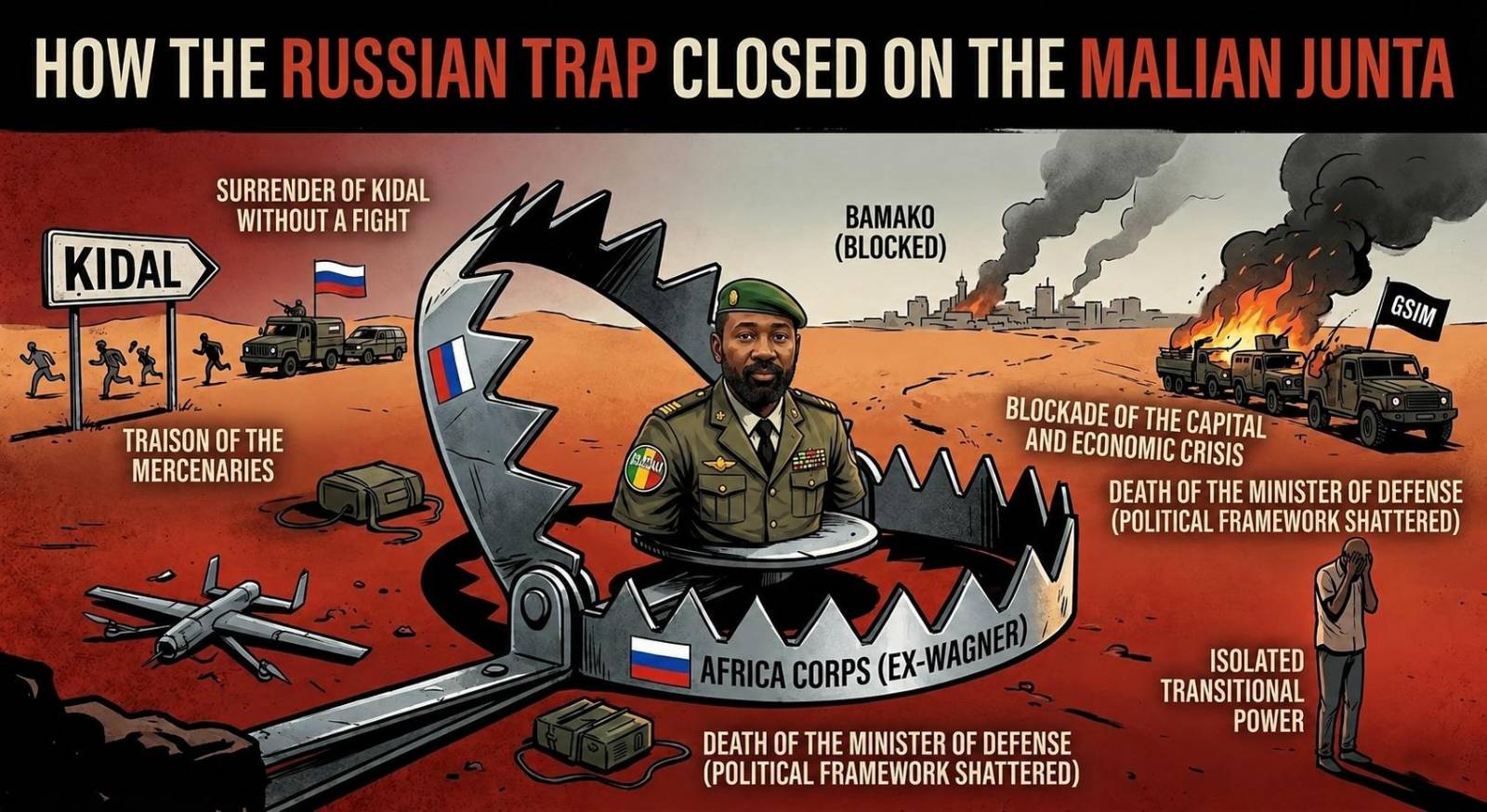
April 2026 marked a turning point in Mali’s crisis. Kidal, a northern city recaptured in 2023 with much fanfare by Malian forces and their Russian auxiliaries, fell like a house of cards. The humiliation for Bamako was complete: the Africa Corps fighters did not retreat after a heroic last stand; they negotiated their own evacuation with the rebels, abandoning positions without resistance and even leaving behind heavy weaponry to secure safe passage.
A senior Malian official, speaking on condition of anonymity, summed up the mood in Bamako: « The Russians abandoned us in Kidal. » The pragmatic retreat from Moscow underscores a harsh geopolitical truth: mercenary forces serve only their own financial and strategic interests. They do not die for another nation’s sovereignty. By prioritising survival over Mali’s territorial integrity, Russia has exposed the limits of its West African ambitions.
Collapse reaches the capital and claims a key figure
The failure of this « blind security » strategy is no longer confined to the Sahara’s fringes. The shockwave hit the heart of the state. April’s major offensive extended to Kati and Bamako, culminating in the death of General Sadio Camara, Defence Minister and the architect of Bamako’s alliance with the Kremlin.
With its political backbone severed, the junta now faces decapitation amid total economic and humanitarian collapse. For months, the GSIM has imposed a crippling blockade on fuel, food and goods entering the capital. Schools have closed, electricity is a rare luxury, and the economy lies in ruins. The Russian shield promised to shield Bamako from siege and infiltration—and failed on both counts.
The drone illusion and the cost of impunity
To justify the expulsion of traditional international forces like MINUSMA and Barkhane, the junta pledged a « surge » in Malian Armed Forces (FAMa) capabilities, backed by Russian technology and surveillance drones. While drone strikes multiplied, they also deepened the junta’s isolation by frequently hitting civilians, fuelling local anger without ever stabilising the territory.
As Moscow now claims to have « foiled a coup », the reality on the ground tells a different story: Africa Corps is hunkering down to protect the regime in Bamako, abandoning any hope of reclaiming or pacifying the rest of the country.
An alliance in freefall and an endgame in sight
The Alliance of Sahel States (AES) was touted as a new regional solidarity bloc, yet its silence and impotence speak volumes. Abandoned by its Russian partner seeking an honourable exit, rejected by regional bodies like ECOWAS, and undermined by a population suffocating under blockades, the Bamako junta appears to have entered its terminal phase.
The gamble on imported « blind security » from Moscow has become Mali’s greatest strategic blunder in modern history. By sacrificing diplomacy, national dialogue and regional alliances for a private security contract, the military regime has dug its own grave. In Bamako, the question is no longer whether power will fall—but how many weeks or months it can cling on before the security vacuum it created consumes it entirely.