Eu invests 348 million euros to boost Morocco’s water strategy
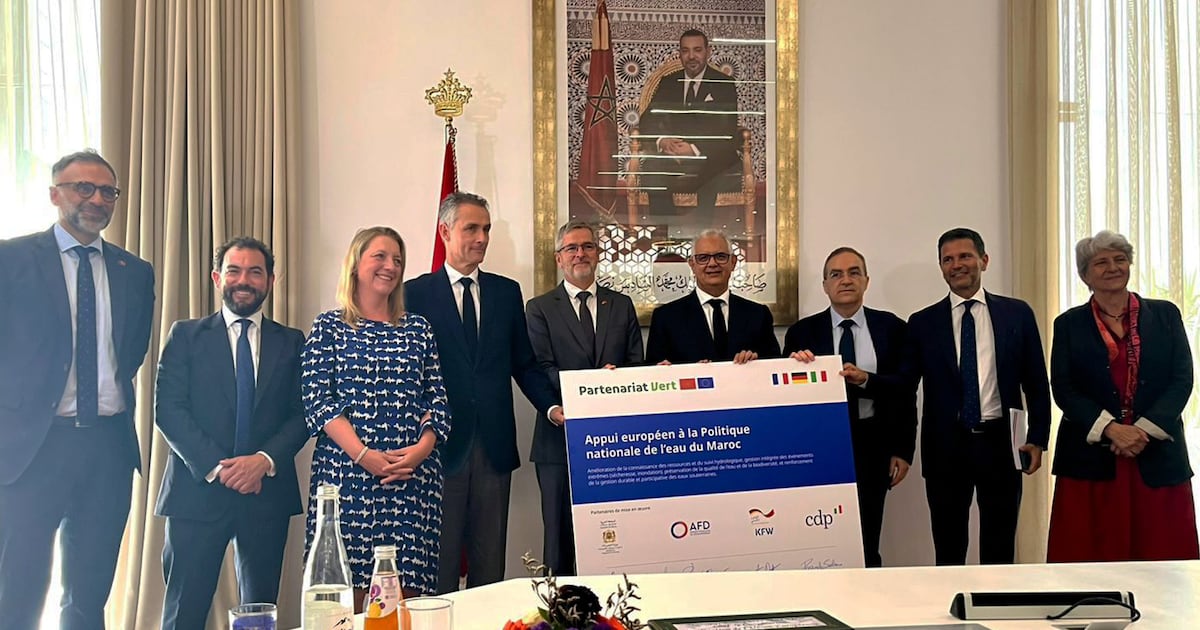
In a landmark agreement signed in Rabat, the European Union and key European development agencies have pledged 348 million euros—equivalent to 3.7 billion Moroccan dirhams—to support Morocco’s ambitious water initiatives. The funding, formalized at the Ministry of Equipment and Water, underscores a three-year commitment to address the Kingdom’s pressing water challenges.
The landmark deal was sealed by Nizar Baraka, Morocco’s Minister of Equipment and Water, alongside the ambassadors of the European Union, France, Germany, and Italy. This initiative builds on a prior agreement inked in November 2024, during a high-profile meeting between King Mohammed VI and French President Emmanuel Macron.
Key European development agencies are playing pivotal roles in this partnership. The French Development Agency (AFD), leading the project, has been instrumental in advancing the program, supported by Germany’s KfW Group and Italy’s Caisse des Dépôts et Prêts (CDP). Philippe Lalliot, France’s incoming ambassador to Morocco, marked his first official engagement by highlighting France’s cumulative contribution of 1 billion euros to Morocco’s water sector. He praised the collaborative efforts of the European Union and its partners in driving this initiative forward.
Speaking on behalf of the European Union, Ambassador Dimiter Tzantchev emphasized the bloc’s unwavering commitment to water security, particularly amid the challenges posed by climate change. He noted that the 348 million euro investment will prioritize rural communities, ensuring access to clean drinking water and enhancing agricultural irrigation. “Water remains a top priority for the EU, especially in the context of climate resilience,” Tzantchev stated.
During the ceremony, Nizar Baraka outlined Morocco’s National Water Strategy, a visionary plan spearheaded by King Mohammed VI. “Our strategy is anchored in 26 operational dams, enabling us to irrigate 1.5 million hectares of farmland,” he explained. Morocco is also accelerating efforts to meet 60% of its potable water needs through desalination plants by the end of this decade. “A nation that does not control its water supply cannot secure its future,” Baraka asserted.
The minister reaffirmed the government’s dedication to implementing this program with a results-driven governance model. Expressing gratitude to the ambassadors, he underscored the transformative potential of this funding in bolstering water security across the Kingdom.
Germany’s outgoing ambassador also reflected on the robust Morocco-Germany cooperation, particularly through the KfW Group, which has been a critical player in a sector as vital as water. The diplomat, nearing the end of his tenure, highlighted the strategic importance of this partnership in tackling Morocco’s water scarcity issues.
This European funding injects fresh momentum into Morocco’s fight against water stress, accelerating the implementation of its National Water Strategy. From desalination projects to dam construction, irrigation expansion, and rural water supply, the stakes are high—impacting not just infrastructure but the very fabric of Morocco’s hydrological, agricultural, and social stability.