Burkina Faso’s ban on beauty pageants: authoritarianism in disguise
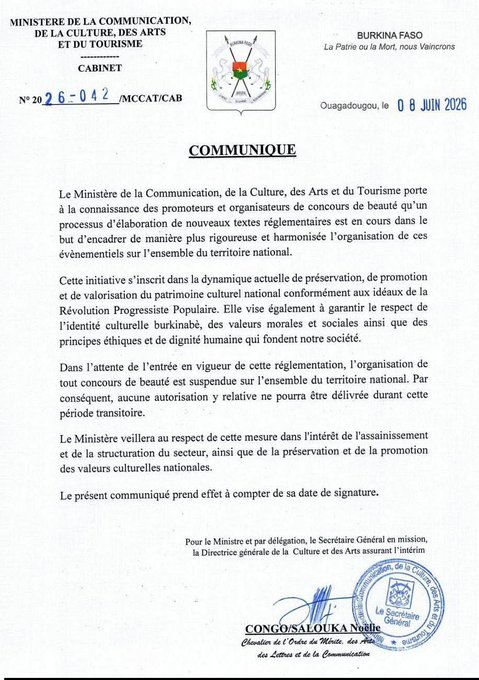
A government directive has effectively halted all beauty pageants across Burkina Faso indefinitely. While officials claim the move aims to safeguard cultural values and honor the nation’s ongoing security challenges, a deeper examination suggests a more troubling trend: the steady entrenchment of veiled authoritarianism.
The political diversion tactic
Burkina Faso faces severe security threats and persistent humanitarian crises. Why would the government target beauty pageants when territorial reconquest should be the priority? Many regional analysts view this interference in cultural and entertainment spheres as a classic political diversion strategy. By shifting public debate toward morality and social mores, the transitional authorities attempt to draw attention away from unfulfilled promises of stabilization and a return to constitutional order.
State puritanism as a tool of social control
The ban on beauty contests is not an isolated incident; it fits into a broader pattern of systematic state intrusion into private life and individual freedoms. Under the guise of a moral realignment, the regime is laying the groundwork for a strict moral order. “Today they ban a beauty contest in the name of values. Tomorrow, what will be banned? A style of dress? A work of art? A line of thought?” asked a human rights activist speaking on condition of anonymity. This tendency to regulate bodies, leisure activities, and cultural expressions is a hallmark of autocratic regimes. The method is subtle: it does not yet use weapons, but rather restrictive decrees that infantilize a population by dictating what is worthy of celebration.
A democracy slowly suffocated
What is unfolding in Burkina Faso extends far beyond a fashion show. It represents the continuous shrinking of civic and democratic space. After the suspension of political parties, the muzzling of independent media, and the arrest of dissenting voices, the assault has now turned against cultural industries. A disguised dictatorship reveals itself through its ability to infiltrate every domain, to render arbitrariness legal, and to turn puritanism into state doctrine. By depriving youth and cultural actors of their spaces for expression and entertainment, the transitional government sends a clear signal: ideological alignment must be total, and dissent—even aesthetic—is no longer tolerated. Behind the sovereignist and moralizing rhetoric, Burkina Faso is dangerously sliding toward social monolithism where the state decides everything for everyone. A drift that, under a protective facade, bears a name well known in political history: authoritarianism.