Burkina Faso trades gold for Russian wheat amid humanitarian crisis
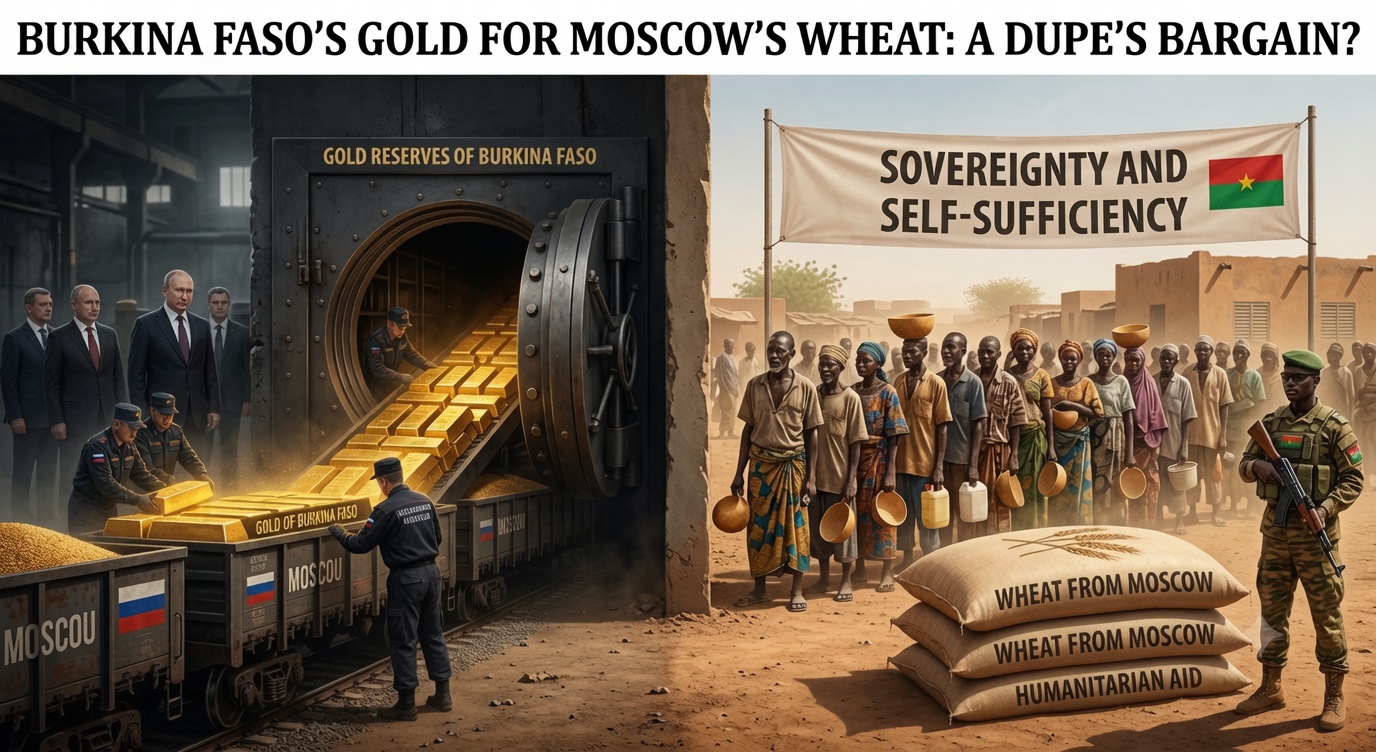
Between economic contradictions and political cynicism
The capital Ouagadougou is sending a clear, if paradoxical, message about its priorities. While state authorities proudly declare a commitment to sovereignty and self-reliance, they simultaneously rely on foreign aid to meet the most basic food needs of their people. The recent visit of a high-ranking Russian diplomat has laid bare the harsh reality behind this duality, revealing a transaction that raises serious questions about economic independence and national dignity.
A fragile sovereignty exposed
Since seizing power, the transitional authorities have repeatedly emphasized their determination to break away from external influence and rebuild Burkina Faso on its own terms. Yet the decision to transfer the country’s gold reserves to Moscow’s central bank for safekeeping—announced during the visit—contradicts this narrative. For a nation that has positioned itself as a champion of anti-neocolonialism, entrusting its most valuable national asset to a foreign power amounts to a symbolic surrender of economic autonomy.
This move comes at a time when the country’s food security is increasingly fragile. Despite the government’s insistence on local resilience, the population continues to depend on emergency wheat shipments from abroad. The irony is stark: the same authorities that restrict local initiatives and NGOs from distributing aid to vulnerable communities are now pleading for foreign grain deliveries to prevent mass hunger.
Gold for grain: a one-sided bargain
Burkina Faso stands among West Africa’s top gold producers, a resource that could, in theory, fund agricultural development, infrastructure, and long-term food security programs. Instead, the state is pledging its gold as collateral in exchange for Russian wheat—a stopgap measure that does little to address structural weaknesses in food production and distribution. The agreement effectively transforms a sovereign asset into a short-term lifeline, reinforcing a cycle of dependence rather than breaking it.
Analysts argue that this arrangement does not strengthen Burkina Faso’s position but rather deepens its vulnerability. By mortgaging its future wealth for immediate relief, the government risks undermining its own development agenda. The contrast between bold political declarations and the reality of persistent hunger and aid dependency only fuels public skepticism about the regime’s economic priorities.
The humanitarian paradox: aid as a tool of control
The contradictions extend beyond economics. While the state monopolizes international aid flows, local solidarity efforts—such as community food drives and grassroots support networks—face increasing restrictions. Officials have warned against unauthorized humanitarian assistance, framing it as a threat to national security. Yet in regions where state presence is weak and insecurity high, such initiatives often provide the only lifeline for isolated communities.
By centralizing aid distribution, the authorities may be seeking to reinforce their control over public perception. Every sack of grain that reaches a hungry family is presented as a gift from the state, not as a right or a collective effort. This politicization of humanitarian aid risks eroding public trust and deepening social divisions, as citizens come to associate survival with the regime’s generosity rather than their own resilience.
What sovereignty really means
The current crisis underscores a fundamental truth: sovereignty is not merely a matter of rhetoric or geopolitical alignment. It is measured by a state’s ability to protect and sustain its people. Burkina Faso’s leaders have repeatedly called on citizens to endure hardships in the name of national pride and anti-terrorism efforts. Yet when basic needs remain unmet and external aid becomes indispensable, the legitimacy of such appeals grows increasingly hollow.
The transfer of gold reserves to Moscow and the reliance on Russian wheat shipments reveal a troubling pattern. The government appears willing to sacrifice long-term economic stability for short-term gains, all while restricting the very mechanisms that could build real resilience. The result is a paradox: a nation that claims to be free is, in practice, trading one form of dependence for another—at a price that may ultimately be paid by its citizens.
In the end, Burkina Faso’s choices reflect a deeper question: Can a state claim true independence when its survival depends on foreign goodwill and its own resources are pledged to foreign powers?