Burkina Faso: escalating rights violations two years after military takeover
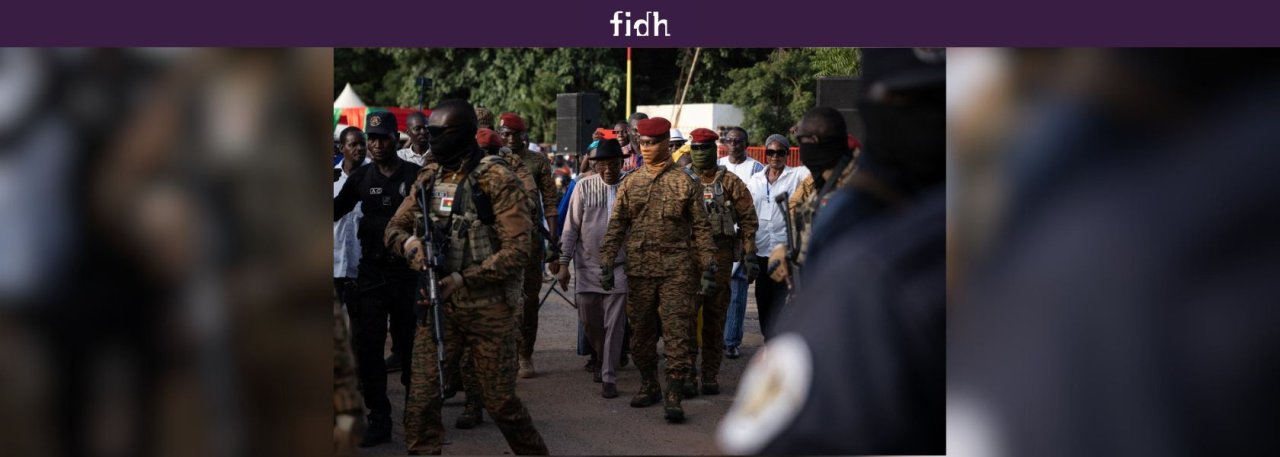
Two years after Burkina Faso’s military coup of September 30, 2022, the transitional government has entrenched a repressive system that systematically silences dissent and erodes fundamental freedoms. The International Federation for Human Rights (FIDH) warns of a dramatic surge in human rights abuses and calls for an immediate restoration of constitutional order.
Systematic repression of critics and civil society
Ouagadougou, Dakar, Paris, September 2024. The authorities installed by the coup have established a climate of fear targeting journalists, human rights defenders, and political opponents. Violence, arbitrary arrests, enforced disappearances, forced conscription, and threats against families have become routine. This repression is fueled by hate speech and incitement to violence on social media by pro-government activists.
The FIDH demands the immediate cessation of these attacks and the unconditional release of all arbitrarily detained individuals. Authorities are also urged to honor their national, regional, and international human rights obligations.
«Silencing civil society and persecuting human rights defenders, journalists, and political opponents is unacceptable, especially during a transition that claims to rebuild the state and improve governance», declared Drissa Traoré, FIDH Secretary General. «Civil society must be protected. Freedom of expression, opinion, association, assembly, and press must be guaranteed without restriction».
Intensified violence against civilians amid ongoing conflict
Despite the junta’s pledge to prioritize resolving the armed conflict, violence has escalated against civilians. On August 24, 2024, an attack attributed to the Group for Support of Islam and Muslims (JNIM) killed dozens of civilians, security forces, and pro-government militias (VDP). The FIDH and the Sahel Peoples Coalition condemned these grave violations.
Forced conscription of dissenters
Since November 2023, the regime has systematically conscripted human rights defenders, journalists, and political opponents into the military as retaliation for their criticisms. Ten individuals, including prominent activist Daouda Diallo and politician Ablassé Ouédraogo, were forcibly sent to the front under the General Mobilization Decree (April 2023).
Judges and prosecutors are also targeted. In August 2024, at least five magistrates—including prosecutors from Ouagadougou, Boromo, Bobo-Dioulasso, Gaoua, and Ziniaré—were forcibly conscripted after ruling on cases involving regime allies. This practice violates the separation of powers and judicial independence.
«Deploying judges and law enforcement to the frontline as punishment for rulings unfavorable to the regime is outrageous», stated Alice Mogwe, FIDH President. «Burkina Faso’s actions flagrantly violate its Constitution, the African Charter on Human and Peoples’ Rights, and international treaties protecting human rights defenders».
Erosion of press freedom and targeted attacks on journalists
The government has progressively restricted press freedom, censoring local media and banning international outlets. Journalists are forced to adopt a «patriotic» editorial stance favoring the regime, facing constant harassment and threats. Self-censorship is rampant.
Atiana Serge Oulon, investigative journalist and editor of L’Événement, was abducted from his home by the National Intelligence Agency (ANR) on June 24, 2024. His newspaper was suspended days earlier. In June, two BF1 TV commentators, Kalifara Séré and Adama Bayala, were kidnapped after the cancellation of their program 7 Infos. The African Commission on Human and Peoples’ Rights (ACHPR) expressed «grave concern» over these attacks on press freedom.
Families of exiled opponents under siege
Relatives of former officials are increasingly targeted. Between September 11–16, 2024, two family members of Djibril Bassolé, former Foreign Minister under Blaise Compaoré, were assaulted and abducted in Ouagadougou—incited by regime-aligned activists.
«We urge the African Union and the United Nations to coordinate efforts to stop the violence, secure the release of abducted individuals, and protect their physical and moral integrity», pleaded Professor Mabassa Fall, FIDH Representative to the African Union.