Benin’s transition power: Talon as facilitator, Wadagni as guarantor in church reunification
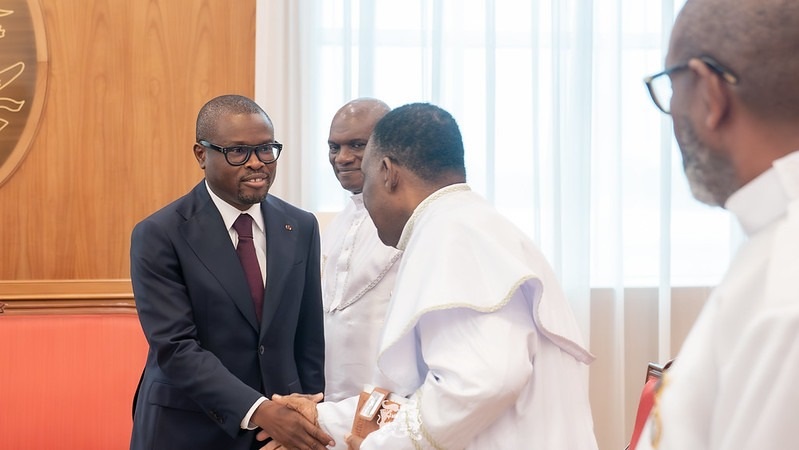
The audience granted on June 4, 2026, by President Romuald Wadagni to a delegation from the Celestial Church of Christ offers an unexpected political reading: that of an exemplary state transition, where two presidents clearly share roles in service of a peace process that extends beyond Benin’s borders.
Some matters, by their very nature, reveal the quality of governance. The reunification process of the Celestial Church of Christ is one such case. Not because it is spectacular—it unfolds in meeting rooms, theological consultations, and internal deliberations—but because it demands flawless continuity from political authorities. Any break in state commitment would signal to the church’s branches that the process is fragile, exposed to electoral calendar uncertainties. This risk appears to have been fully anticipated.
The opening scene: two presidents, one dossier
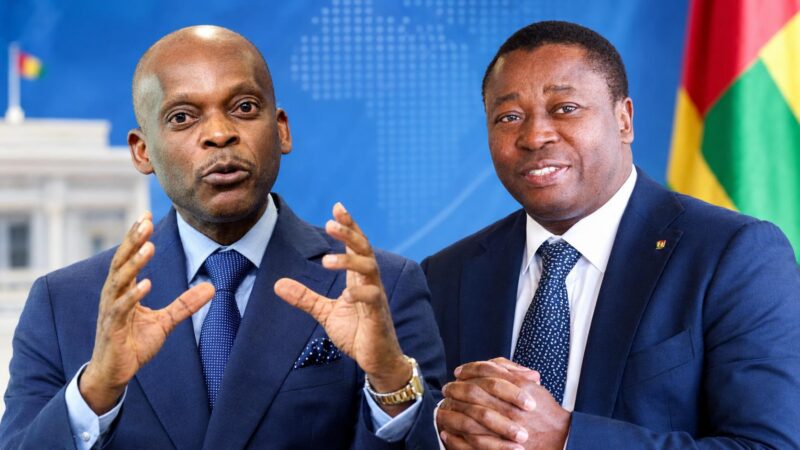
To grasp the uniqueness of the moment, one must go back to the ceremony where the conclusions and recommendations of the High Labor Council (CST) were handed over. That day, Patrice Talon and Romuald Wadagni stood side by side. The first was still the sitting president; the second was president-elect but had not yet been sworn in. This co-presence was not merely protocol—it was political. It signified that this dossier had been explicitly transmitted, with a tacit agreement between the two men on the need to ensure continuity.
“It is rare to see an outgoing president involve his successor so early in such a sensitive matter. It says much about how they managed transition in depth.” This sentiment, shared by many in political circles, captures the significance of their cooperation.
June 4, 2026, offers a second illustration of this well-oiled mechanism. In the morning, Patrice Talon officially installed the High Council tasked with implementing the CST recommendations. A few hours later, in the evening, Romuald Wadagni received the delegation from that same council. The sequence is almost choreographed in its precision: one installs, the other welcomes; one legitimizes the framework, the other animates it.
The division of roles: a deliberate political architecture
What emerges from this sequence is a thought-out governance architecture. Patrice Talon takes on the role of facilitator—a term that, in mediation vocabulary, designates the one who creates the conditions for dialogue without being the arbiter. His legitimacy on this dossier is historical: under his mandate, the process was launched, structured, and the CST delivered its conclusions. He is the guarantor of the approach in the eyes of church actors.
Romuald Wadagni, for his part, embodies active republican continuity. By reaffirming his support and encouragement to the delegation, he signals that the state does not merely hand over the dossier—it takes ownership. The nuance is important. A simple transfer would have sufficed to guarantee the transition. Wadagni goes further: he engages, shows personal interest, and reassures.
“He didn’t just listen. He asked questions. We could tell he had been briefed and knew the dossier in detail. This was no courtesy audience,” a member of the delegation remarked after the meeting.
A real-life test of cohesion at the top
Beyond the Celestial Church of Christ itself, this dossier functions as a revealer of the quality of relations between the two presidents. In many African transitions, matters left pending by an outgoing president end up in an institutional purgatory: neither officially abandoned nor fully carried forward by the new government. The temptation to start from scratch, or simply let prior dynamics fizzle out, is real.
Here, the signal is the opposite. By actively involving himself in a dossier initiated by his predecessor within the first weeks of his mandate, Wadagni establishes a governance principle: state continuity takes precedence over agenda disruption. If confirmed in other areas, this principle could become a hallmark of this early term.
“What we see on the Celestial Church, we hope to see on other major projects. That is the real test of the transition,” noted a governance analyst based in Cotonou.
A stake that extends beyond national borders
It would be reductionist to confine this dossier to its Beninese dimension. The Celestial Church of Christ is a global organization with followers on every continent. If its reunification process succeeds, it will be an international event—and Benin, as the founding country, will be its center of gravity.
The commitment of both Beninese presidents to this dossier thus carries diplomatic and symbolic weight that goes beyond Cotonou. It positions Benin as the space for resolving a global religious fracture, and its leaders as responsible actors in a peace process concerning millions of believers. In a different register from classical diplomacy, this is a form of deliberate soft power: the ability to exert positive influence through mediation rather than coercion.
In this sense, the audience of June 4, 2026, is not a religious sidelight. It is an act of foreign policy combined with an act of national cohesion—and a concrete illustration, for those who still doubted, that the handover of power between Patrice Talon and Romuald Wadagni was carried out in depth, not just in form.