West Africa is currently experiencing significant political turbulence, marked by numerous coups d’état across the region since the start of the decade, impacting nations in the Sahel, Guinea, and most recently, Guinea-Bissau.
In several countries, including Burkina Faso, Niger, and Mali, military juntas have seized power, advocating for policies that signal a clear departure from France, their former colonial power.
Beyond providing direct support to the Beninese army, the Elysée Palace confirmed that President Emmanuel Macron undertook a “coordination effort” involving “information exchange with regional countries.”
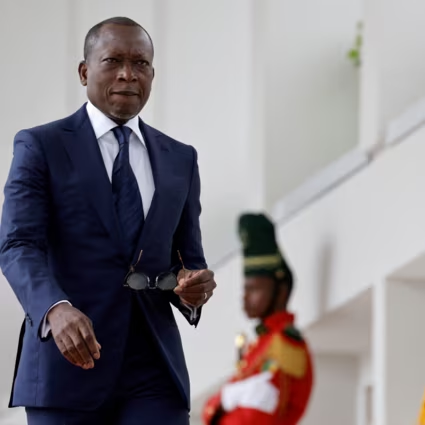
On Sunday, President Macron also engaged in discussions with his Beninese counterpart, Patrice Talon, who was the target of the putschists’ attempt to overthrow him. He also spoke with the presidents of Nigeria and Sierra Leone, with the latter currently holding the chairmanship of ECOWAS.
A presidential advisor informed journalists that “France extended its full political backing to ECOWAS, which made substantial efforts this past weekend.”
On Sunday morning, eight military officers appeared on Beninese television, declaring they had deposed President Patrice Talon.
Following a day of considerable uncertainty in Cotonou, the head of state asserted that the situation was “totally under control.” Subsequently, Beninese authorities reported “several casualties,” particularly from clashes between the mutineers and loyalist forces.
To regain command, Benin received assistance from neighboring Nigeria, which conducted airstrikes on Sunday targeting the Togbin base in the economic capital. This base was where the mutineers had entrenched themselves after their televised announcement.
Abuja further dispatched ground troops, who played a crucial role in securing the base during the night between Sunday and Monday.
“Electoral Inclusivity” Concerns
For its part, ECOWAS announced on Sunday evening that it would send military reinforcements from four member states, though the precise number of personnel was not disclosed, with the stated aim of “preserving constitutional order.”
Omar Alieu Touray, President of the ECOWAS Commission, declared on Tuesday that “Our community is in a state of emergency,” highlighting both the escalating jihadist threat and the wave of coups across the region.
While approximately a dozen military personnel have been apprehended, several coup plotters, including their leader, Lieutenant-Colonel Pascal Tigri, remain at large.
These individuals had managed to take two senior army officers hostage: Army Chief of Staff Abou Issa and National Guard Chief of Staff Faïzou Gomina, both of whom were liberated on Monday.
Life quickly returned to normal in Cotonou, the economic hub of this small West African coastal nation, which Patrice Talon has governed since 2016.
President Talon is constitutionally mandated to step down in April, coinciding with the presidential election, as he concludes his two-term limit.
While widely recognized for fostering Benin’s economic development, Talon has also faced consistent criticism from detractors who accuse him of steering the country towards authoritarianism, a stark contrast to its past reputation for democratic vitality.
His chosen successor, Finance Minister Romuald Wadagni, is considered the overwhelming favorite in the upcoming election. However, the main opposition party, Les Démocrates, has been barred from participation due to an insufficient number of endorsements.
On Tuesday, former President Thomas Boni Yayi (who served from 2006 to 2016) and now a leader of Les Démocrates, strongly condemned the attempted coup.
He stated, “I condemn with the utmost rigor and firmness this bloody and ignoble attack that our country has endured,” while also advocating for “free and transparent elections.”
Omar Alieu Touray, reflecting on the broader regional context, observed that “Elections have become a major trigger of instability” in West Africa, further noting a “growing erosion of electoral inclusivity in several ECOWAS states.”