Sahel juntas struggle as terror group tightens grip across region
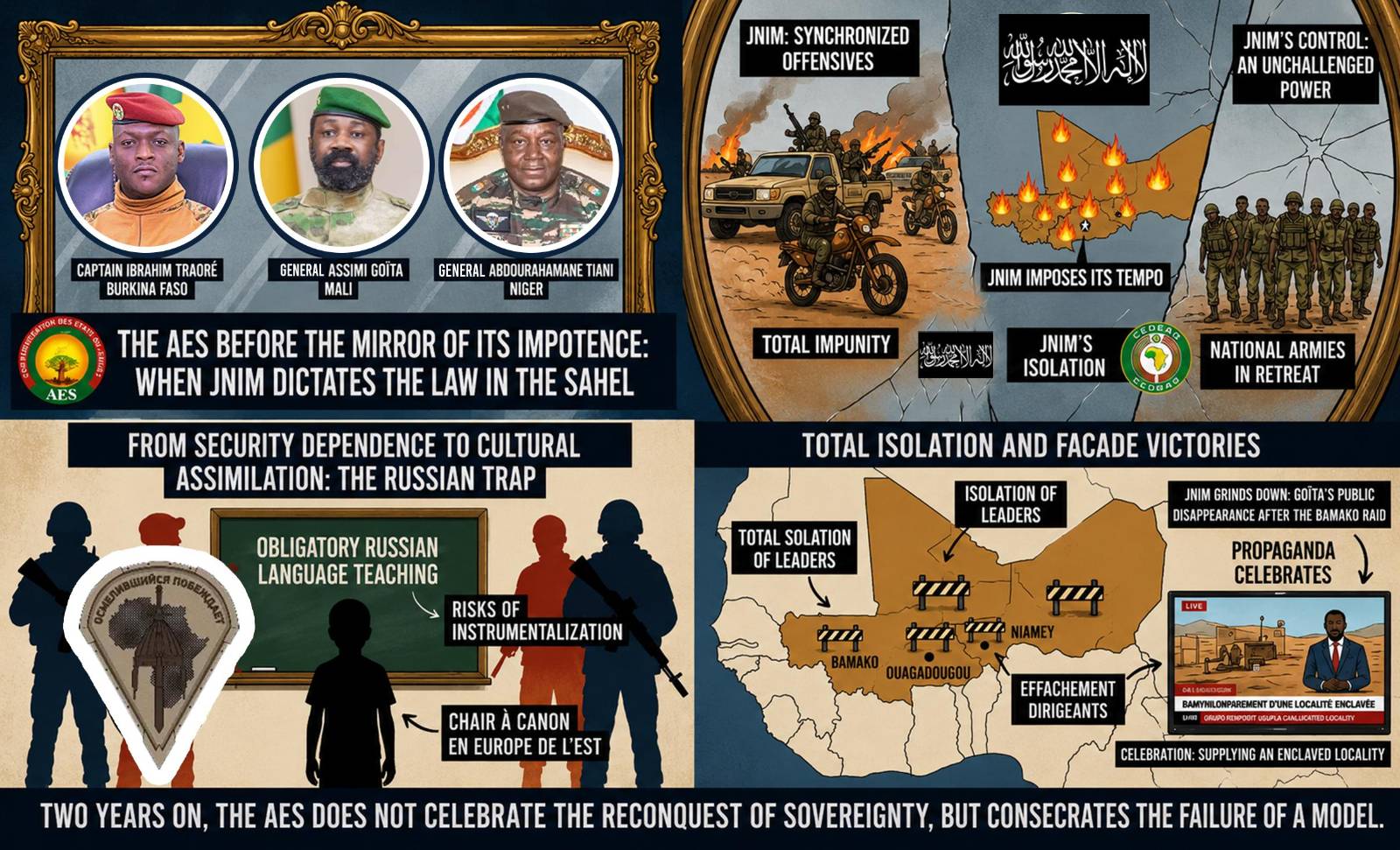
Two years after the Alliance of Sahel States (AES) was hailed as a bold new chapter in regional sovereignty, the alliance’s facade is rapidly crumbling. Behind the defiant rhetoric of the military regimes in Bamako, Ouagadougou, and Niamey lies a harsh truth: the only truly coordinated armed force dictating the pace and striking at will remains the Group for the Support of Islam and Muslims (JNIM).
The political amateurism and bombastic declarations of these military governments are now colliding head-on with the JNIM’s devastating efficiency. The jihadist network orchestrates large-scale, meticulously synchronized offensives, striking multiple strategic regions simultaneously and overwhelming even well-equipped national armies. Neither the theoretical pooling of intelligence resources within the AES nor the full geopolitical alignment with Moscow has succeeded in halting the hemorrhage of territorial losses.
From security dependency to cultural assimilation: the Russian trap
The capitaines Ibrahim Traoré, Assimi Goïta, and Abdourahamane Tchiani have sought to fill the void left by Western disengagement by forging an alliance with Russia. Yet what began as a military partnership—or the deployment of Wagner-affiliated mercenaries (now rebranded as Africa Corps)—has evolved into something far more insidious. The announcement that Russian will be introduced into Burkinabè school curricula starting next academic year signals a profound ideological shift, one that transcends mere strategic convenience.
Officially framed as an act of cultural decolonization, this move appears to be a calculated effort to condition the minds of future generations. By embedding the Russian language in classrooms, the regime is laying the groundwork for deeper ideological integration. Analysts warn that this could pave the way for young Burkinabè students to be sent to Russia under the guise of education or training—only to be exploited in a broader geopolitical game. With global tensions escalating, the fear is that these youths could be deployed as cannon fodder or human shields in conflicts far removed from the Sahel, effectively paying the price for Moscow’s military backing of the juntas.
A spiral of isolation and hollow victories
As the cultural transition accelerates, the JNIM continues to tighten its stranglehold. By paralyzing the three regimes, the armed group has confined their leaders to a state of near-total isolation. In Mali, the prolonged public absence of transitional leader Assimi Goïta—following the deadly Bamako raid that reportedly claimed the life of the Defense Minister—stands as a stark illustration of this predicament.
The reality on the ground tells a damning story: while terrorists steadily expand their territorial control, the juntas’ military command structures are drowning in political absurdity. Official propaganda channels now reserve their most triumphant rhetoric for trivial logistical victories, such as the resupply of a remote outpost or a defensive counterattack. This desperate celebration of minimal gains only underscores the depth of their failure.
At the two-year mark, the AES is not celebrating the reclaiming of sovereignty but rather confronting the collapse of its own model. By equating war propaganda with military strategy—and by swapping Western dependency for cultural and military subjugation to Moscow—the juntas have ceded control to the JNIM. The Sahel has not been liberated; it has merely traded one master for another, with its youth bearing the heaviest burden.