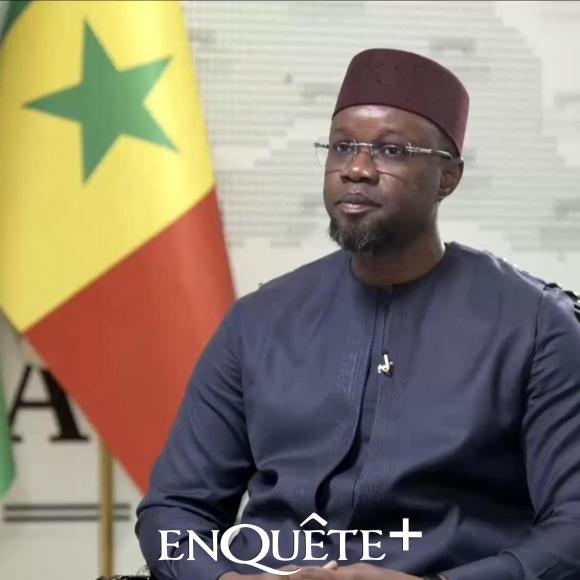
Since his departure from the role of Prime Minister, Ousmane Sonko has significantly recalibrated his public discourse. Now more measured, nuanced, and less confrontational, the leader of Pastef appears to embrace the mantle of a peacemaker, seeking to distance himself from his previously perceived combative stance.
“Pastef has matured as a political party.” This declaration by Ousmane Sonko, made recently in Diamniadio during the party’s congress, served as an overture to his often-ardent and assertive militants, urging them to refine their conduct in the public sphere. “We must reconsider our manner of speaking, as we are observed by everyone, including religious leaders and family patriarchs… Taunts, insults, and derogatory remarks do not elevate us,” he emphasized to an audience fully supportive of his vision. Conscious of the imperative to lead by example, the former Prime Minister has adopted a notably more temperate approach in his recent public engagements. An observer of African politics pondered whether this marked a true transformation for the Pastef president, especially following a recent interview with international media.
According to this analyst, the former Prime Minister not only defended his track record and commented on his separation from President Bassirou Diomaye Faye but also began to delineate the contours of a new political persona. This emerging figure, the analyst noted, intends to exercise power differently, potentially from the National Assembly’s rostrum, effectively transforming a political setback into a fresh launching pad for influence in governance Africa.
Known for his typically confrontational style, Ousmane Sonko has indeed substantially altered his rhetoric since stepping down from the Executive branch. The analyst raised pertinent questions: “Is the man of mass rallies evolving into a figure of equilibrium? Is the orator gradually transforming into an arbiter? Does this shift represent political maturation or merely a strategic phase on the road to 2029?” The answers, as the analyst suggested, largely lie in the unfolding future of society Africa.
One certainty remains: the Pastef leader has not always been a paragon of discursive consistency or coherence. He has demonstrated an ability to articulate one position in the morning and seemingly contradict it by evening, with his rhetoric often tailored to the immediate objective and the specific audience. During his recent interview with international journalists, he appeared exceptionally composed and measured, carefully weighing each word. Previously unyielding and categorical on issues such as debt restructuring, he exhibited a much more nuanced perspective this time. When questioned about his stance should the executive decide to restructure the national debt, he responded, “Our positions are not absolutely fixed. We will examine the situation with lucidity.”
The nuances and contradictions in his public statements
The crucial factor, according to Sonko, will be the specifics of any proposal. “We did not desire a savage restructuring. As Prime Minister, I always opposed it because conditions did not warrant it… As the outgoing Prime Minister, I recognize we are experiencing a unique period of tension. We will assess; we are not here to obstruct. However, if solutions do not serve Senegal’s interests, we will not accept them,” he added. When a journalist reminded him of past declarations advocating for debt cancellation, Sonko initially backtracked before becoming somewhat entangled in his explanations. “You refer to odious debt. I used that term once or twice. It involves an entire process.” He continued, somewhat more ambiguously: “I did not have all the levers. When I spoke on certain occasions, it was as a party leader offering an opinion. Do not forget that I was merely Prime Minister, and the powers of the Prime Minister are extremely limited in this country.” Asked if he had discussed this with the President, he retorted, “We never discussed it. We were always aligned on the debt issue, right up to our last conversation. He reaffirmed that the position had not changed.” He then seemed to revert, embracing his prior stance on odious debt.
“Indeed, part of this debt is odious. It requires political courage to advance this debate. As a political figure, I have stated this repeatedly. I hope the current executive will assume its responsibilities in this regard and engage in discussions for the cancellation of a portion of the debt…” The journalist interrupted him again, inquiring why he did not pursue this as Prime Minister. Sonko’s response was terse and unconvincing: “It was proposed, it was proposed.” It is noteworthy that the last time Ousmane Sonko publicly addressed odious debt was during his appearance before the National Assembly on May 22, during a current affairs session. At that time, he was acting in his capacity as Prime Minister, not solely as a party leader.
Furthermore, for what may be a rare, if not the first, instance, the President of the National Assembly spoke of “savage restructuring.” He had frequently limited himself to categorically rejecting any notion of restructuring. What, then, has prompted this shift? Is the leader concealing his true intentions? This question holds considerable weight. On the issue of homosexuality, the President of the National Assembly articulated a much more precise stance. While affirming his positions, he also reiterated certain realities he had previously seemed to overlook. The former Prime Minister recalled that the criminalization of homosexuality has existed since the Senghor era and that arrests occurred before Pastef’s time. More significantly, Ousmane justified his position with arguments that appear to contradict his earlier communications. Responding to journalists, he declared, “Here, arrests occurred before the vote on the toughening law. It stemmed from two factors: the practice of homosexuality combined with the voluntary transmission of HIV. Western media often seems to obscure this second, extremely important aspect.” However, only days prior in the Hemicycle, he recounted discussions with one of his ministers in which he appeared to fully endorse the crackdown. “The other day, I spoke with one of my ministers. He said: yes, the goal is to break the chain of HIV transmission. I told him no. The primary objective is to put an end to the proliferation of the phenomenon,” he had vehemently stated. These remarks, it should be noted, were widely amplified by his political adversaries.
Advocating for peace
On a different note, when discussing President Bassirou Diomaye Faye, the Pastef leader has consistently avoided inflammatory statements, a pattern observed for some time. He even rejects the term “betrayal,” deeming it a matter of affection and morality. Sonko now aims to embody “political correctness.” He also dismisses the idea of a personal feud between himself and the Head of State, categorizing their differences as purely political.
Ousmane had already laid the groundwork for this shift in trajectory and communication strategy in Diamniadio. For him, Pastef, now a mature party, must be exemplary in all respects. “Pastef is a party of ideas, a party of science, a party of programs… Demonstrate that you are a well-trained youth, an intellectual youth, an intelligent youth, a civically engaged youth. Do not succumb to provocation. The only strategy left for them [opponents] is to ensure that what happened in 2021-2024 is repeated…” According to Ousmane Sonko, the opposing camp, lacking legitimacy, simply seeks to provoke them into street protests, thereby portraying them as a belligerent, conflict-driven party. “Do not fall into that trap,” he cautioned.