New era in french-moroccan relations as ambassador philippe lalliot assumes post
France and Morocco enter a new strategic chapter with ambassador Philippe Lalliot’s official arrival
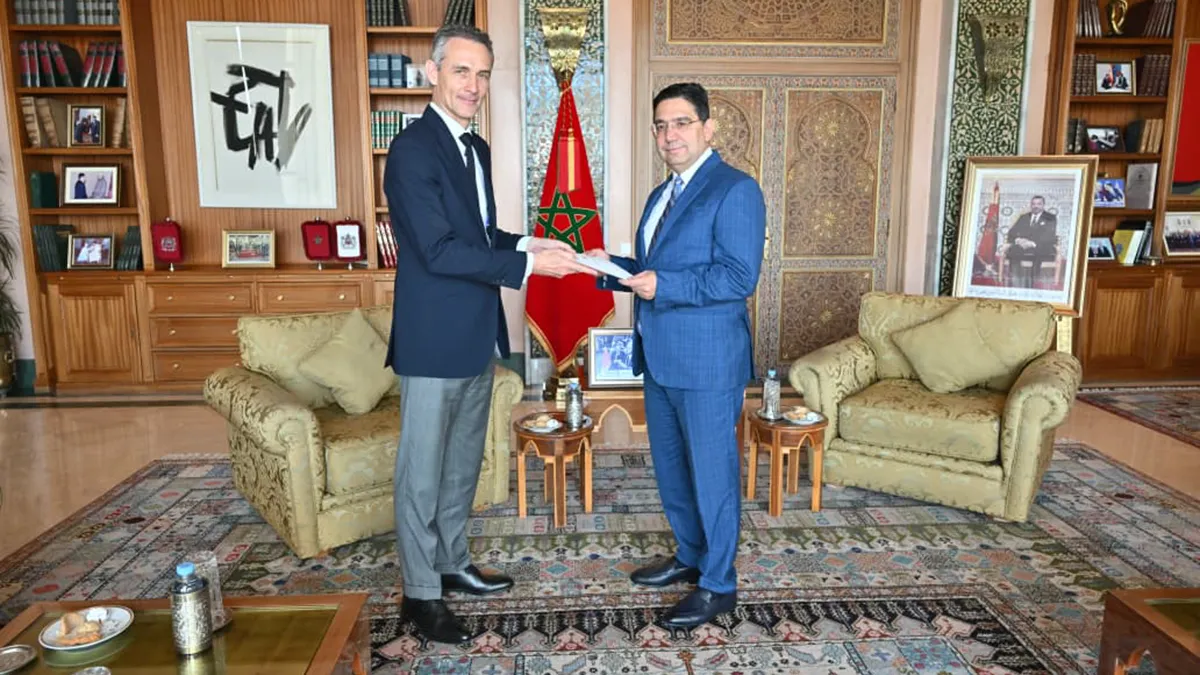
The newly appointed French envoy formally presented his credentials to Moroccan Foreign Minister Nasser Bourita following his May appointment, initiating a mandate focused on strengthening the strategic trajectory outlined by Macron and safeguarding French investments ahead of the 2030 World Cup.
- The Sahara factor and the strategic shift in relations
- Investments, infrastructure, and focus on 2030
- Challenges of a new bilateral framework
The appointment of Philippe Lalliot as France’s ambassador to Morocco marks more than just a routine diplomatic transition. His formal credential presentation to Moroccan Foreign Minister Nasser Bourita signals the launch of an ambitious bilateral agenda designed not only to mend strained relations but to redefine power dynamics across the Mediterranean and African spheres.
This diplomatic reset follows years of friction that culminated in Paris drastically reducing visa issuance to Moroccan citizens—a move that, coupled with perceived French detachment from Morocco’s national priorities, effectively froze high-level dialogue between the two nations.
During this period, bilateral engagement dwindled to formalities, with no significant official visits and a noticeable decline in French influence over Morocco’s external agenda. The historical camaraderie gave way to a series of distancing gestures, leaving both sides to navigate a relationship strained by mutual misunderstandings.
The Sahara factor and the strategic shift in relations
A defining turning point emerged in 2024 when discreet diplomacy paved the way for a historic French policy reversal. In an official communication to King Mohammed VI, President Emmanuel Macron aligned France with Morocco’s position on the Western Sahara conflict, endorsing the Moroccan autonomy plan as the only viable foundation for resolving the dispute.
For Morocco, this represented a geopolitical triumph of the highest order—not merely diplomatic support but recognition from a permanent UN Security Council member and a key European Union player. The move significantly recalibrated regional power balances, offering Morocco substantial leverage in shaping its international standing.
Post-announcement, diplomatic paralysis gave way to renewed bilateral momentum. High-level ministerial exchanges, joint economic missions, and the unblocking of stalled projects revitalized communication channels between the two nations. The culmination of this process was Macron‘s state visit to Morocco, a symbolic gesture that sealed the end of distancing.
During the visit, Macron emphasized adapting bilateral ties to Africa’s evolving realities, while Bourita framed the new understanding on principles of mutual trust and shared strategic interest. Behind this rapprochement lay pragmatic considerations: as tensions with France escalated, Morocco diversified its alliances with the United States, Gulf monarchies, and African governments, broadening its international maneuverability.
With a rapidly shifting regional landscape, Paris recognized that maintaining a strained relationship with Rabat carried increasing political and economic costs difficult to justify.
Investments, infrastructure, and focus on 2030
Ambassador Lalliot steps into a role defined by opportunity and challenge. Economic cooperation stands as a top priority, with French enterprises maintaining dominant positions in Morocco’s key sectors—automotive, rail infrastructure, banking, energy transition, and public works. Additionally, Morocco serves as a critical gateway for French businesses expanding into Sub-Saharan Africa.
His predecessor, Christophe Lecourtier, transitioned to lead the French Development Agency (AFD) in Morocco, underscoring Paris’s commitment to the economic dimension of this reset. The AFD plays a central financial role as Rabat accelerates public investment and infrastructure projects ahead of the 2030 FIFA World Cup, a tri-nation initiative shared with Spain and Portugal that presents lucrative opportunities for French contractors and engineering firms.
Challenges of a new bilateral framework
While institutional normalcy appears restored, deeper power dynamics are being redefined. France seeks to rebuild its African presence after setbacks in traditional spheres of influence, while Morocco advances an ambitious foreign policy centered on its Atlantic and Mediterranean prominence.
Ongoing cooperation in regional security, migration management, Sahel stability, and trade will continue shaping the daily agenda of both nations. These areas offer clear convergence but are not immune to potential friction. The true test for Ambassador Lalliot will not be maintaining current goodwill but proving the alliance’s resilience when inevitable strategic divergences arise.
Past crises between Paris and Rabat revealed that commerce alone cannot prevent fractures—these emerge when one party believes the other no longer understands or respects its core priorities.