Recent coordinated attacks by the JNIM and FLA on April 25, 2026, mark a pivotal shift in Mali’s security landscape. Striking Bamako, Kati, Kidal, Gao, and Sévaré simultaneously, these offensives exposed critical weaknesses in a security model overly reliant on external partners. The loss of Kidal—retaken by rebels after a 2023 government offensive—undermines the junta’s legitimacy and highlights the limitations of Russian-backed forces like Africa Corps in countering jihadist expansion.
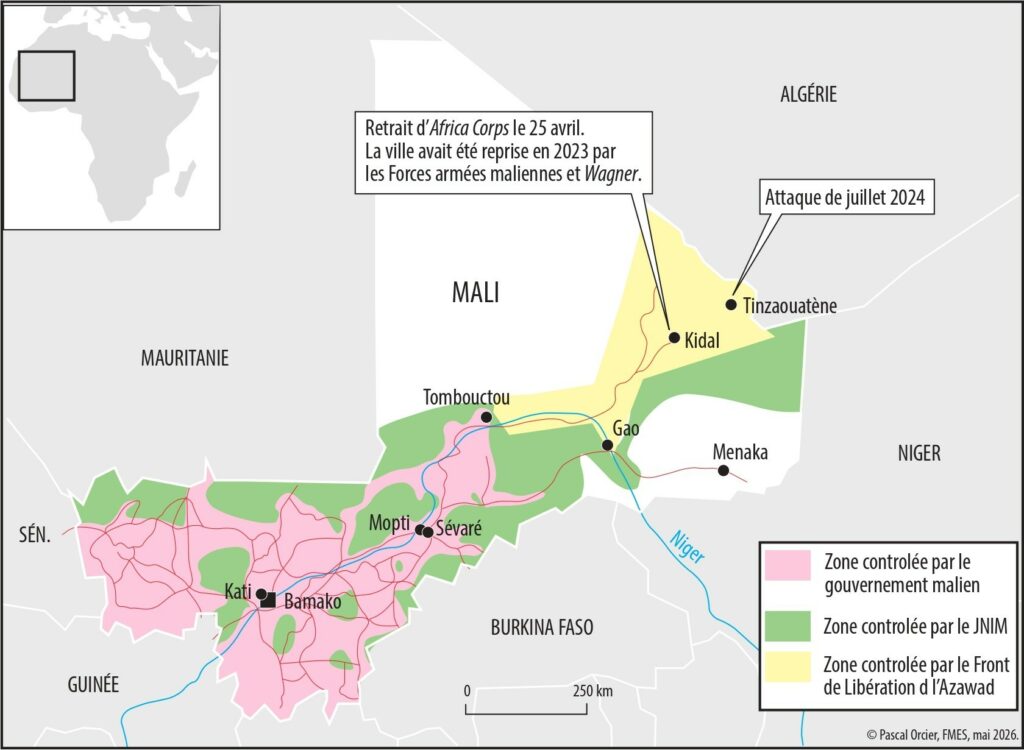
Bamako under siege: a battle for legitimacy
The JNIM’s modus operandi has evolved dramatically. Once confined to northern Mali’s rural hinterlands, the group now conducts high-intensity operations across the country, including regions previously considered stable. Its reach extends into neighboring Burkina Faso, Niger, and coastal nations like Benin and Togo, signaling a regionalization of its insurgency. Attacks on military bases—from Tombouctou in the north to Bamako and Kayes in the west—demonstrate its growing operational capacity, compounded by the Malian Armed Forces (FAMA)’s struggles despite support from Turkish drones.
A key component of the JNIM’s strategy is the economic strangulation of Bamako, a city of 3.2 million. By disrupting fuel supply routes and targeting logistics hubs, the group aims to erode public trust in the junta. Rising fuel prices and shortages directly impact daily life, positioning the JNIM as a shadow governance alternative in areas it controls. While a direct assault on the capital remains unlikely—given the city’s fortified defenses and the group’s limited urban support—the psychological warfare is intensifying. The JNIM’s stated goal isn’t conquest but demonstrating the state’s incapacity to protect its citizens.
Despite tactical successes, the group faces challenges. Its forces, estimated at 5,000–6,000 fighters, lack the manpower for sustained urban warfare. However, attacks on the Modibo Keita International Airport—home to Africa Corps’ Bamako base—could escalate. Rural areas, where state presence is weak, remain ideal for recruitment and territorial control. The blockade of Bamako suggests a long-term war of attrition, prioritizing psychological pressure over immediate military victory.
Kidal’s fall: a fracture in the junta’s narrative
The recapture of Kidal by JNIM and FLA forces is a historic setback. The city, reclaimed by Malian troops and Russian Wagner Group in 2023, was touted as a major victory for the junta’s security partnership with Moscow. Its loss exposes the hollowness of this narrative. Africa Corps’ withdrawal from Kidal—and Gao—further weakens the junta’s claims of restored sovereignty through Russian intervention.
The alliance between JNIM and FLA is opportunistic, driven by shared opposition to the junta rather than ideological alignment. The FLA’s separatist agenda for the Azawad region clashes with the JNIM’s Islamist vision, yet tactical cooperation has emerged. Historically tense relations between the groups—including a 2012 split—are overshadowed by their joint fight against Bamako. Negotiations between them, reported as early as December 2024, underscore this fragile coalition’s potential fragility. Should the groups consolidate control over Kidal, their partnership may fracture over governance and territorial disputes.
The timing of the assaults is equally telling. A truce, purportedly agreed upon in March 2026, collapsed amid allegations of unfulfilled prisoner releases. The JNIM’s subsequent declaration of a “total siege” on Bamako and demands for Russia’s withdrawal signal a hardening stance. Spokesperson Mohamed Ramadane’s threats to “liberate” Gao, Tombouctou, and Ménaka reflect maximalist rhetoric, leaving little room for negotiation.
External partners and shifting alliances
The junta’s security partners face mounting scrutiny. Russia’s Africa Corps, despite protecting Assimi Goïta, failed to prevent Kidal’s fall, complicating Moscow’s narrative of a superior security model. While a full withdrawal is unlikely—given Mali’s role as a showcase for Russian influence in Africa—the Kremlin is under pressure to reinforce its commitment. Telegram channels affiliated with Africa Corps have intensified propaganda efforts, showcasing combat footage to reclaim the narrative.
Turkey, through the SADAT security firm, has also bolstered the junta since 2024, providing protection and training for special forces. Ankara’s role may expand as the crisis deepens. The FLA’s recent call for Turkey to “reassess” its support for Bamako underscores the shifting dynamics. Meanwhile, the U.S. has sought to re-engage with Mali, dispatching officials to express support for its sovereignty—a move complicated by the recent attacks.
Regional fallout: a fractured response
The Alliance of Sahel States (AES) remains conspicuously inactive despite its charter’s mutual defense clause. A tepid April 27 statement condemned the attacks, but neither Niger nor Burkina Faso intervened militarily. Plans to expand the AES’s unified force to 15,000 troops face delays, as both nations prioritize domestic threats. This inaction reflects deeper challenges: the AES’s cohesion is undermined by divergent priorities and a lack of trust in collective security mechanisms.
Algeria stands to benefit from Mali’s instability. With violence shifting southward, Algiers can leverage its historical influence in the region, particularly with the FLA. A February 2026 state visit to Niger and infrastructure deals with Burkina Faso signal a strategic re-engagement. Algeria’s rivalry with Morocco, which promotes its Atlantic Initiative for Sahelian access to the Atlantic, adds another layer of geopolitical competition. While Bamako’s alignment with Morocco on the Western Sahara issue strains relations with Algiers, Algeria may seek to mediate between the FLA and junta, positioning itself as a stabilizing force.
The road ahead: risks and uncertainties
The JNIM’s regional ambitions pose the greatest threat. While the FLA’s focus is territorial, the JNIM’s transnational reach could destabilize Senegal and Mauritania—key transit points for Mali’s fuel and goods. Coastal West African nations like Benin and Togo are vulnerable to spillover from Burkina Faso, whose instability could worsen with a Bamako collapse. The junta’s internal repression risks accelerating its own downfall, potentially creating an opening for the JNIM to exploit.
Ultimately, these attacks reveal the fragility of a regional security architecture dependent on external partners. The junta’s legitimacy is eroding as its ability to protect citizens declines, while the JNIM’s shadow governance grows. The coming weeks will test the durability of alliances—both local and international—as Mali’s crisis threatens to reshape the Sahel’s power dynamics.