At the Museum of Black Civilizations in Dakar, the premiere of Abdou Lahat Fall’s latest documentary, Indépendance Tey, transformed a standard film screening into a profound exercise in collective memory. This event served as a focal point for civic engagement and political introspection, reflecting the shifting tides of contemporary Sénégal.
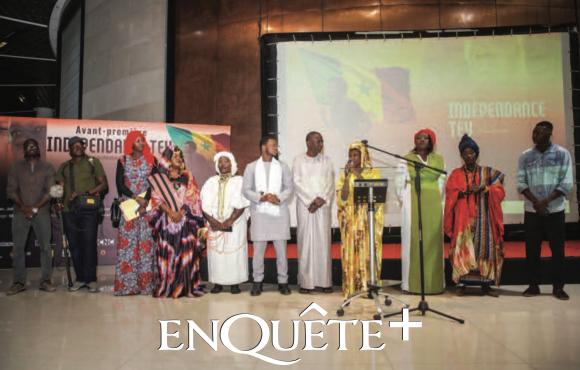
The majestic halls of the museum welcomed a diverse crowd of cinema enthusiasts and activists to witness the unveiling of this highly anticipated work. Co-organized by Sine Films and Wawkumba Film, the screening was more than just a cultural debut; it was a gathering of generations united by the political upheavals that defined Sénégal between 2019 and 2024. Having already gained international attention in the “Front Populaire” section of the Cinéma du Réel festival, the film arrived with significant momentum.
The evening opened with a powerful performance by rapper Leuz Diwan G. Known for his socially conscious lyrics, his set blended urban rhythms with messages of resistance, immediately establishing the documentary’s atmosphere. Indépendance Tey is not merely a political record; it is a human immersion into a society in the throes of transformation.
A generation under the lens
Following his award-winning 2018 documentary on migration, Abdou Lahat Fall has returned to the screen by embedding himself within the FRAPP citizen movement. Through his lens, we follow four distinct figures—Abdoulaye, Bentaleb, Guy Marius Sagna, and Félix—who represent the hopes and internal conflicts of a mobilized generation.
The film captures the arc of recent Sénégalese history: the oil contract scandals, mass street protests, police crackdowns, and the eventual rise of the opposition to power in the 2024 presidential election. However, the true strength of the narrative lies in its focus on the personal toll of activism. We see Abdoulaye, a passionate young man who, despite his dedication, eventually leaves for Canada under family pressure—a quiet tragedy that highlights the difficult choices facing the nation’s youth.
Bentaleb’s story illustrates the physical cost of resistance, marked by arrests and imprisonment. Meanwhile, the film tracks Guy Marius Sagna’s transition from a radical grassroots organizer to a figure operating within official political institutions, raising vital questions about the compromises required by governance in Africa. Finally, Félix, a veteran unionist, serves as the bridge to the past, embodying the long-term fatigue of a life dedicated to social justice.
Balancing activism and artistry
The director’s journey with this project began in 2019 during the initial waves of indignation over national resource management. “I decided to take a camera to a protest at the Place de la Nation,” Fall recalls, noting how he was struck by the raw courage of young speakers like Abdoulaye Seck. This sparked years of immersion at the movement’s headquarters, documenting strategy sessions and moments of profound doubt.
One of the most compelling aspects of the film is how it navigates the thin line between independent African journalism and political advocacy. Fall avoids the trap of pure propaganda by maintaining a critical distance. His voiceover often questions the choices made by the movement’s leaders, offering a lucid perspective that adds layers of complexity to the narrative.
A universal call to action
Beyond the specific borders of Sénégal, Indépendance Tey addresses universal themes of resistance and the human price of political change. It echoes the sentiment of Frantz Fanon, suggesting that each generation must discover its mission and choose whether to fulfill or betray it. Sixty years after the country’s formal independence, this generation is shown seeking a deeper, more personal form of sovereignty.
Cinematographically, the film thrives on its lack of artifice. There are no forced spectacles; instead, the camera favors patient observation and the heavy silence of intimate moments. By showing the flaws and disagreements of his subjects, Fall creates an authentic portrait of a people in motion. This approach has earned the film support from major francophone institutions, including residencies at Sentoo and Produire au Sud, cementing its status in the global landscape of society Africa documentaries.
Ultimately, this premiere served as a vital space for dialogue. Indépendance Tey is more than a film; it is a sensitive portrait of a nation that refuses to succumb to fatalism, continuing to believe that a different future is within reach despite the sacrifices required to get there.