Ebola in Democratic Republic of Congo: a health crisis amid political and security chaos
Health Crisis Analysis / Global Health Observatory
Ebola in Democratic Republic of Congo: a health crisis amid political and security chaos
-

Fatou Élise Ba
Human Security Program Lead at IRIS
On May 17, 2026, the World Health Organization declared the Ebola outbreak in eastern Democratic Republic of Congo—and ongoing cases in neighboring Uganda—an “international public health emergency.” The Africa CDC followed suit the next day. By June 5, both organizations had launched a joint six-month response plan, requesting $518 million in funding. Caused by the rare Bundibugyo strain, for which no approved vaccine or treatment exists, this 17th outbreak is striking a region already devastated by conflict and destabilized by shifting American aid policies. How will this epidemic deepen the already severe security and humanitarian vulnerabilities in eastern DRC? What risks does it pose to regional stability in Central Africa? And what does the resurgence of Ebola reveal about the international community’s capacity to handle major health crises?
In a region torn apart by war and political instability, how is Ebola worsening an already critical humanitarian situation?
This latest Ebola outbreak is striking a region already reeling from multiple crises. The Democratic Republic of Congo is experiencing its 17th Ebola epidemic since 1976—the year the virus was first identified in Yambuku. This time, it’s the rare Bundibugyo strain, which can kill up to half of those infected. The eastern provinces of North Kivu, South Kivu, and Ituri are particularly vulnerable to epidemic spread. Last year alone, the United Nations reported one of the worst cholera outbreaks in 25 years. Since 2020, the region has also seen a massive surge in Mpox cases, with Ituri—ground zero of the current Ebola outbreak—emerging as one of DRC’s most troubled provinces. Poorly connected by roads, plagued by armed group violence, and hosting nearly a million internally displaced people in overcrowded camps, Ituri is a tinderbox for disease spread.
The region’s instability has only intensified since the M23 rebel offensive in 2023. Daily life is marked by forced displacement, squalid living conditions in overcrowded camps, and persistent violence—conditions that not only fuel the spread of pathogens but also cripple the already fragile healthcare system. With limited ability to meet even basic health needs, eastern DRC remains structurally dependent on Western aid. Decades of systemic violence, particularly against women and children, have further eroded social cohesion and public health infrastructure. Against this backdrop, a large-scale epidemic only compounds an already dire situation.
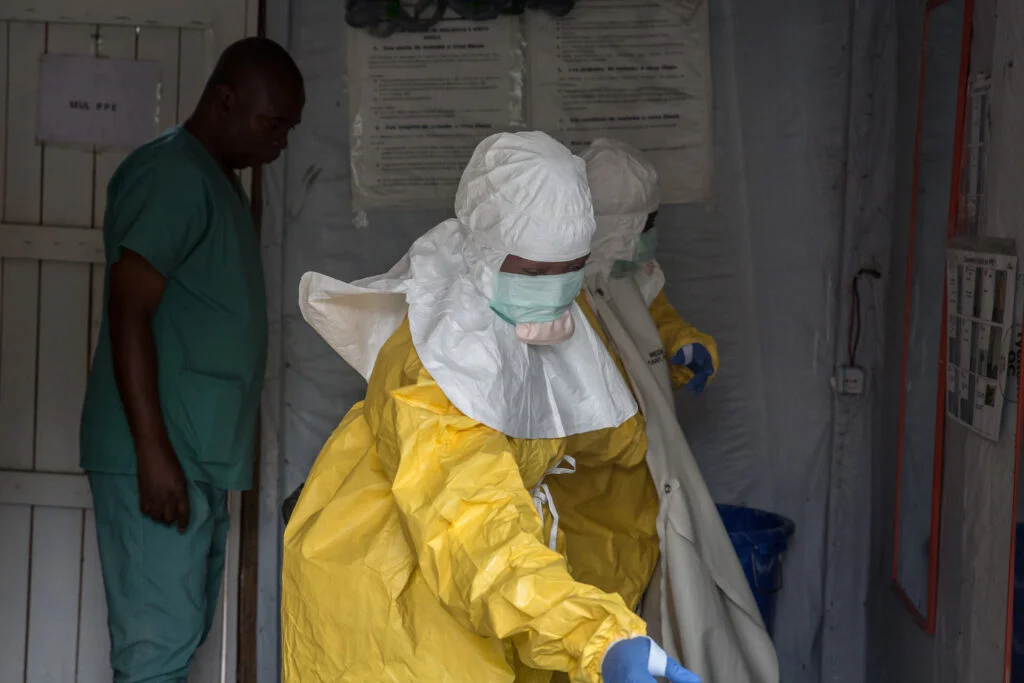
Health Minister Samuel-Roger Kamba Mulamba has called Ebola an “absolute emergency.” As of May 31, 2026, 282 confirmed cases and 42 deaths had been recorded, including 19 new positive tests. By June 1, WHO reported 349 suspected cases under surveillance—primarily in Ituri Province, particularly in Bunia, Rwampara, and Mongbwalu health zones. Bunia’s main hospital quickly became overwhelmed, forcing the establishment of makeshift treatment centers in peripheral and rural areas. Four healthcare workers have since recovered, offering some hope. But by June 5, pressure on the healthcare system intensified further: six health centers in Bunia were temporarily closed for disinfection, reducing the city’s already limited capacity and leaving pregnant women and patients with chronic illnesses without care. In this climate of crisis, Ebola is not only spreading—it’s paralyzing the healthcare response to other life-threatening conditions.
The real challenge lies in the lack of coordinated action from Kinshasa. In eastern DRC, vast areas are partially controlled by the Rwanda-backed M23 rebel group, while numerous armed factions operate for economic gain. The central government’s failure to coordinate the health response with these armed groups—whose territory includes confirmed Ebola cases—leaves the door wide open for further spread. While negotiations may be underway, no formal framework has been established to enable an effective, unified response. In rebel-held Goma, only two Ebola treatment centers are being set up with limited capacity. The M23 claims to recognize the gravity of the situation and has announced contingency plans—but who is really in charge of public health when the state no longer controls the territory?
Community resistance and cultural barriers complicate containment efforts
Community resistance—echoing the 2018–2020 outbreaks—remains a major obstacle. In Rwampara, a protest against the response escalated into the burning of a suspected Ebola victim’s body. Distrust of medical teams runs deep, rooted in cultural norms. In eastern DRC, traditional funeral rites—including washing and touching the deceased—are sacred. Yet these very practices are among the primary transmission routes for Ebola. The refusal of health authorities to return bodies to families is seen as a grave symbolic violation, fueling resentment and conspiracy theories.
This mistrust is not unfounded. Decades of state neglect, violence, and predatory foreign interventions have left communities deeply suspicious of any external intervention, including health responses. For many, the Ebola response is just another form of imposed control.
Could Ebola reshape regional relations in Central Africa?
This epidemic arrives at a time of intense geopolitical tension between the DRC and its eastern neighbors—especially Rwanda, but also Uganda—with relations oscillating between cooperation and confrontation. When a disease spreads across a state unable to control its territory, the response must be regional, if not continental. The Africa CDC, the AU’s operational arm for epidemic response, has warned that up to ten vulnerable countries could be at risk: South Sudan, Rwanda, Kenya, Tanzania, Ethiopia, Republic of Congo, Burundi, Angola, Central African Republic, and Zambia—on top of the DRC and Uganda, which already report seven cases. However, response capacities vary widely. Kenya and Ethiopia have relatively robust health systems, with Kenya already setting up quarantine facilities, while Central African Republic remains one of the continent’s most fragile states, heavily dependent on external aid. South Sudan, meanwhile, faces internal strife and spillover from the war in Sudan.
Epidemics know no borders. The WHO reports that imported cases from Ituri have reached North Kivu and Kampala, Uganda, where two travelers returning from DRC tested positive—one of whom died. A case has also been confirmed in South Kivu, according to M23 spokesperson, with the patient originating from Kisangani in Tshopo Province. These developments have triggered border closures and diplomatic tensions. Uganda suspended flights and passenger transport with the DRC on May 21, 2026. Rwanda closed its border with Goma. These unilateral measures strain already tense bilateral relations.
The conflict in eastern DRC is directly facilitating the spread of Ebola. The disease is advancing in areas like Goma, seized by M23 in late January 2025, and Bukavu, taken in February 2025—raising fears of a regional escalation. Health has become another battleground in the Kinshasa–Kigali rivalry, with M23 positioning itself as a de facto public health actor in the territories it controls. In response to the cross-border threat, the East African Community has urged member states to activate laboratory networks, strengthen border surveillance, and convened an extraordinary ministerial meeting of health ministers on June 1–2, 2026. According to official statements, ministers agreed to harmonize health screening at entry points without closing borders, establish a regional technical working group to coordinate surveillance, and enhance diagnostic capacities and protection for healthcare workers.
Is the international aid system failing in the face of Ebola?
This epidemic is unfolding at a time when the global health response is weakened by shifts in U.S. aid architecture. In January 2025, Washington implemented a four-part cut: withdrawal from WHO, dissolution of USAID, reductions at CDC, and decreased health aid to DRC and Uganda—weakening systems critical for outbreak response. Experts warn these cuts may have delayed detection of the current outbreak.
Today, DRC has signed a bilateral agreement with the U.S., part of a broader “America First” policy. Under the deal, $900 million in health funding over five years is transferred to the U.S. State Department. This shift—from multilateral to transactional bilateralism—is not fully controlled. In response to the Ebola resurgence, the U.S. has committed $23 million in emergency funding and pledged up to 50 clinics, but has not indicated support for a WHO-led response, breaking from past practice. With the U.S. withdrawal from WHO, the organization’s emergency fund (CFE) is operationally weakened, and other donors have been unable to fill the void.
In this context, the response must be led by national institutions in the most affected countries, with support from WHO and NGOs—despite reduced U.S. funding and a hostile security environment. WHO, which declared the outbreak a Public Health Emergency of International Concern (PHEIC), is coordinating the global response. The European Centre for Disease Prevention and Control (ECDC) has issued risk assessments to support coordination, including with Africa CDC. On the ground, medical NGOs like Doctors Without Borders and ALIMA have deployed care teams. The DRC Red Cross is mobilizing volunteers for safe, dignified burials, risk communication, and community engagement. Still, the humanitarian response remains inadequate to curb the epidemic.
On June 5, 2026, WHO and Africa CDC launched a joint six-month response plan (June–November 2026) and issued a $518 million appeal to support African countries in early detection, prevention, and control. Led by the “one plan, one budget, one team” principle championed by WHO Director-General Tedros Adhanom Ghebreyesus, the plan emphasizes country-led coordination involving WHO, Africa CDC, UN agencies (UNICEF, UNHCR, WFP, IFRC, FIND), African governments, and international donors. So far, only $315.8 million has been pledged—well short of the coordinated plan’s needs.
This response reveals a hybrid strategy among African states: some sign bilateral agreements with the U.S., tying health aid to conditions, while others demonstrate coordination through multilateral mechanisms during major crises. Time will tell whether this dual approach proves effective in the long run.