Burkina Faso’s digital repression under Ibrahim Traoré’s regime
Cyber warfare as a tool of political control
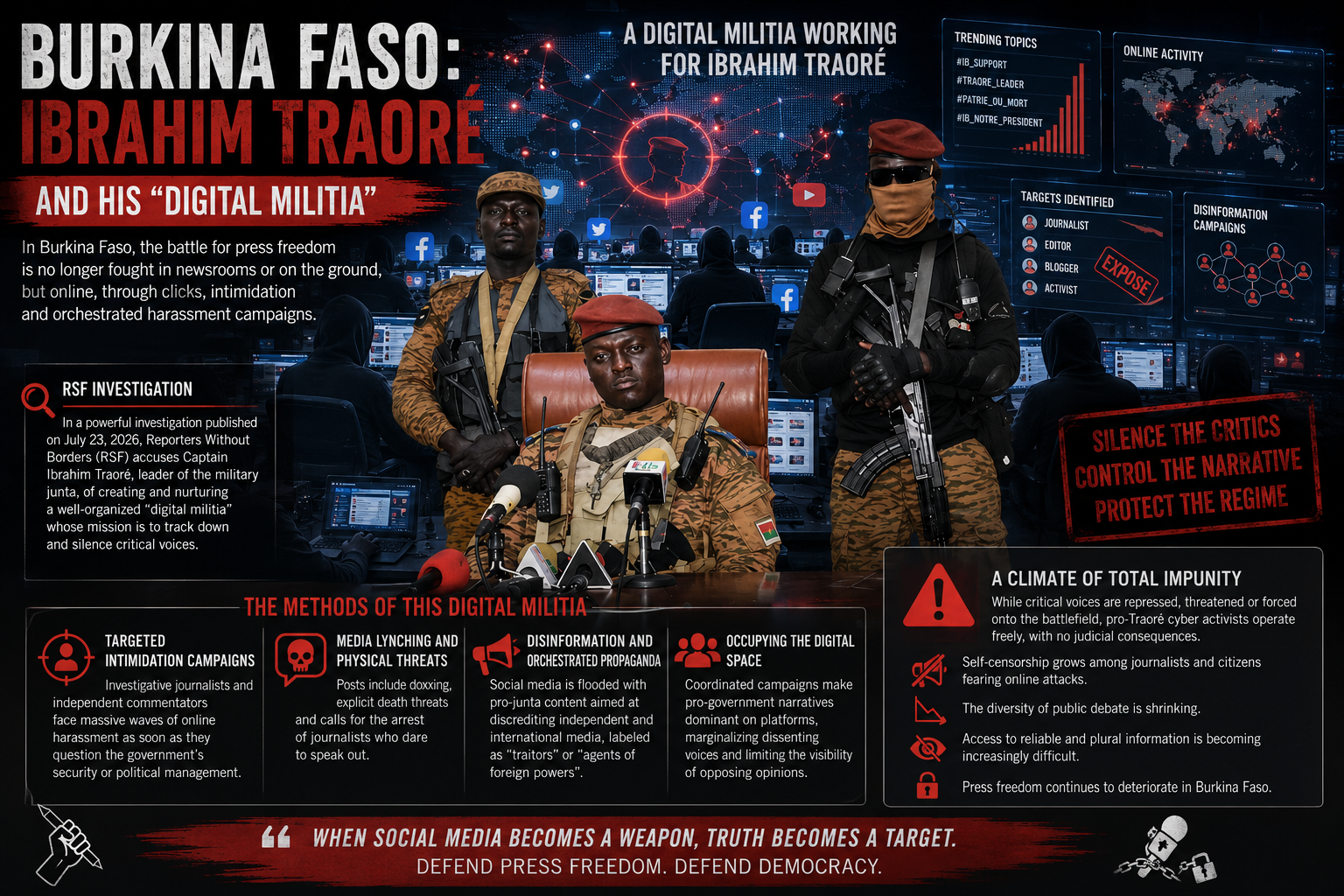
The struggle for press freedom in Burkina Faso has shifted from newsrooms and streets to the digital battlefield, where dissent is silenced not with bullets, but with coordinated online campaigns. A recent investigation reveals how Captain Ibrahim Traoré, the military junta leader, has allegedly mobilized a sophisticated digital militia to suppress critical voices across social media platforms.
Structured intimidation: the rise of the BIR-C
At the core of this strategy lies the Bataillons d’Intervention Rapide de la Communication (BIR-C), a network of cyberactivists operating under a name reminiscent of elite military units. Unlike traditional dissent management, these operatives deploy tactics designed to dominate the digital public sphere and suffocate any form of contradictory debate. Their work goes beyond mere political activism; it represents a systematic effort to make dissent prohibitively costly for those challenging the regime’s narratives.
Tactics employed by the BIR-C
- Targeted intimidation campaigns: Investigative journalists and independent commentators face coordinated cyberharassment whenever they scrutinize the government’s security policies or political decisions.
- Threats and doxxing: Critics are not only subjected to online smear campaigns but also to the public release of personal data, explicit death threats, and calls for their arrest.
- State-sponsored disinformation: Pro-regime content floods social media to discredit both local and international media outlets, often labelling them as ‘traitors’ or ‘foreign agents’.
- Digital space occupation: Coordinated efforts ensure that pro-government narratives dominate key online discussions, pushing dissenting views to the margins and limiting their visibility.
The culture of impunity enabling digital repression
The most alarming aspect of this phenomenon is the total lack of judicial accountability. While critics face swift repression—ranging from forced enlistment to imprisonment—the BIR-C operates with impunity, shielded by tacit state protection. This environment fosters self-censorship among journalists, bloggers, and citizens, who increasingly avoid sensitive topics such as national security, governance, and military operations to evade harassment. The psychological pressure exerted by these campaigns serves as a subtle yet effective tool to stifle free expression without resorting to overt censorship.
Consequences for democratic discourse
Political communication experts warn that when digital spaces are monopolized by coordinated campaigns, public debate loses its diversity. Dissenting opinions become harder to hear, while pro-regime narratives dominate online conversations. In a country grappling with persistent security challenges, this polarization undermines citizens’ access to pluralistic information—a cornerstone for evaluating government policies and national issues.
The methods documented in this investigation mirror tactics observed in authoritarian and hybrid regimes worldwide, where state-aligned cyber networks are deployed to defend political power, discredit independent media, and manipulate public discourse. International press freedom organizations now classify these campaigns as a modern form of repression, less visible than traditional censorship but equally potent in silencing critics.
A broader pattern of press freedom erosion
Digital repression does not exist in isolation. It complements a growing array of restrictions on media freedom in Burkina Faso, including the suspension of international outlets, intimidation of journalists, and forced disappearances. For press freedom advocates, the cumulative effect of administrative measures, security pressures, and online harassment is steadily shrinking the space for independent journalism in the country.
International implications of Burkina Faso’s digital authoritarianism
This investigation underscores the deteriorating state of democratic freedoms and press independence in Burkina Faso since the junta’s rise to power. By weaponizing social media, the Traoré regime transforms these platforms into instruments of political coercion, making independent journalism an increasingly perilous profession. The findings may heighten concerns among Burkina Faso’s international partners, who often assess a nation’s governance quality through indicators of press freedom. A sustained decline in these metrics could tarnish the country’s global image and affect its development partnerships.
Furthermore, this report highlights a broader evolution in information warfare. While propaganda was once confined to state-controlled media, social networks have become the new battleground. The speed of content dissemination, algorithmic amplification, and viral spread now allow certain narratives to dominate while marginalizing opposing viewpoints. For observers, this shift represents one of the most pressing challenges to safeguarding press freedom and democratic debate in politically unstable nations.