Senegal’s economic clash: Faye’s pragmatism vs Sonko’s militancy
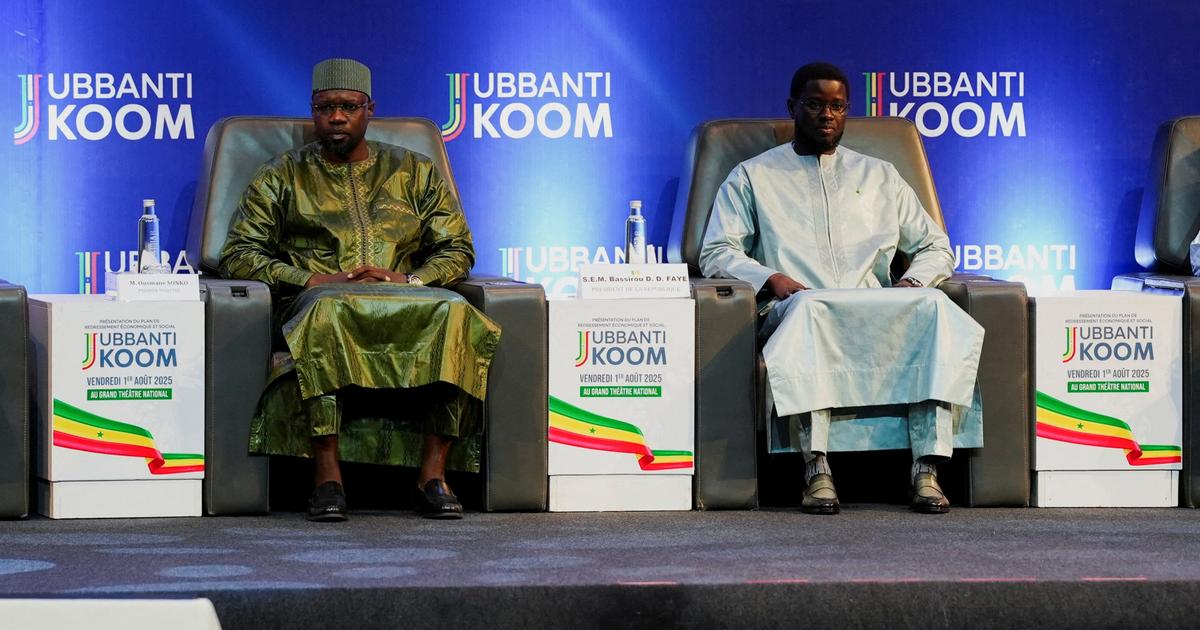
The dismissal of Ousmane Sonko by Bassirou Diomaye Faye on May 23, 2026, marks more than a political rift—it signals the irreconcilable clash between two economic visions that have long coexisted uneasily under the same banner. Two years after Faye‘s historic electoral victory in April 2024, the presidential duo has fractured over three critical economic questions shaping Senegal’s future: debt management, hydrocarbon exploitation, and the very nature of the capital financing the nation’s policies.
Debt: The most visible fault line
Nowhere is the divide more pronounced than in the debt crisis. In September 2024, Sonko publicly exposed undisclosed debt accumulated under the previous administration, with an IMF mission confirming in March 2025 that unreported commitments had reached approximately €7 billion. The country’s actual debt now exceeds 100% of its GDP, with annual debt servicing consuming 5.5 trillion CFA francs (€8.4 billion) and annual refinancing needs nearing 6 trillion CFA francs (€9.1 billion). The sovereign credit rating has been downgraded three times in twelve months.
Two diametrically opposed strategies emerged. Sonko rejected any restructuring, turning debt revelation into a central pillar of his political communication—a direct appeal to public opinion, the diaspora, and his militant base. He refused to be seen as the figure normalizing relations with Washington by negotiating a settlement. Faye, in contrast, pursued engagement with the IMF, hosting a delegation in November 2025 and launching a national dialogue in May 2026 to address the crisis.
The suspended IMF program, closed international financial markets, and the looming threat of sovereign default by 2028 made Sonko‘s position economically unsustainable—even as it remained politically potent for mobilizing the Patriotes africains du Sénégal pour le travail, l’éthique et la fraternité (PASTEF).
Oil and gas: Two approaches, two philosophies
The second—and perhaps most glaring—divide concerns oil and gas contracts. The Sangomar oil field, operational since June 2024 and operated by Australia’s Woodside (82% share), and the Greater Tortue Ahmeyim (GTA) gas field, launched in early 2025 and operated by BP along the Senegal-Mauritania border with an estimated 500 billion cubic meters of reserves, were both projected to generate significant revenues. Both leaders agreed on the need for renegotiation, with Sonko estimating potential gains of 940 billion CFA francs (€1.4 billion) in savings and an additional 1.09 trillion CFA francs (€1.6 billion) in tax revenues from GTA between 2025-2040.
Yet their methods diverged sharply. Sonko took a confrontational stance, publicly accusing multinational operators of unfair deals and issuing ultimatums to BP. He framed the contracts as “unbalanced and unjust.” Faye, since April 2025, described the process as “more than satisfactory”, emphasizing its “normal course.” The oil majors, for their part, remained unmoved—Faye negotiated; Sonko railed; the companies waited.
This was not merely tactical disagreement but a fundamental clash of economic sovereignty philosophies. Sonko embodied an absolutist sovereignist line, arguing that rhetorical rupture with multinationals and Bretton Woods institutions alone generates negotiating power. Faye‘s pragmatism acknowledged that fiscal revenues from Sangomar and GTA would only materialize if operators continued investing and producing—a reality that made hydrocarbon output the country’s most tangible economic lever.
Financing power: Stability over militancy
The third fracture runs deeper—into the very financing of political power. Sonko pioneered a financing model rare in Senegalese politics: the PASTEF relies on mass micro-contributions, diaspora support, and emerging entrepreneurs, particularly in digital and commercial sectors. This funding base explains the party’s parliamentary dominance, with 130 out of 165 deputies owing their seats to Sonko, many pledging allegiance to his person rather than the presidency itself.
Faye, meanwhile, engineered a gradual shift. His “Diomaye président” coalition, relaunched in a general assembly on March 7, 2026, draws support from former civil servants, technocrats tied to previous regimes, and business networks prioritizing institutional stability over militant rupture.
The dismissal on May 23, 2026, formalized this transition. When a state carries debt exceeding 100% of GDP and must refinance €9 billion annually, the luxury of posturing comes at a cost measured in basis points on sovereign bonds. Senegalese euro- and dollar-denominated bonds collapsed as soon as tensions became public—proof that governing with dual messages to financial markets is unsustainable.
Contradictory yet complementary lines
Is Faye‘s line correct while Sonko‘s is flawed? The question misses the point. Sonko‘s revelations about hidden debt constituted an unprecedented act of truth-telling—one no post-independence regime had dared attempt. Without this exposure, the country would continue borrowing against falsified figures. Yet Faye‘s approach, rooted in disciplined negotiations within the global financial system, accepts the painful social cost of recovery to restore investor confidence. Neither vision is complete without the other.
The tragedy for Senegal is that the duo failed to harmonize these imperatives within a unified institutional framework. An architecture capable of housing Sonko‘s radical truth-telling alongside Faye‘s patient recovery was never developed. Senegal’s political system, built around a vertical presidency, proved unequal to the task.
Real economic power triumphs
There is a more unsettling interpretation: multinational corporations remained unperturbed during two years of Sonko‘s rhetorical confrontation with the state. They bet on the long game—the institutional victory of stability over short-term rupture—and they were right. May 23, 2026, in its own way, marks their triumph. This does not mean they orchestrated events; it means real economic power ultimately prevails over political posturing. This is what I call the “real state”—as opposed to the “fictive state” of public declarations.
By 2029, the horizon is wide open. Sonko reverts to a mobile political actor, free to transform the PASTEF into an opposition force, campaign across the diaspora, and challenge the status quo. Faye, now unshackled from Sonko, can finalize an IMF agreement, restructure debt, and present a stability record. Each now plays their hand openly. Senegalese citizens will face a choice in 2029: between asserted sovereignty and managed sovereignty. Neither option is fully satisfactory—nor entirely honest.