Sahel States alliance grapples with unmet promises as challenges mount
The military administrations in Mali, Burkina Faso, and Niger have staked their legitimacy on breaking away from established regional dynamics and distancing themselves from long-standing partners following their seizure of power. The creation of the Alliance of Sahel States (AES) embodies this drive to realign alliances and assert sovereignty, yet three years after the initial coups, escalating security threats and economic hardships continue to undermine these grand objectives.
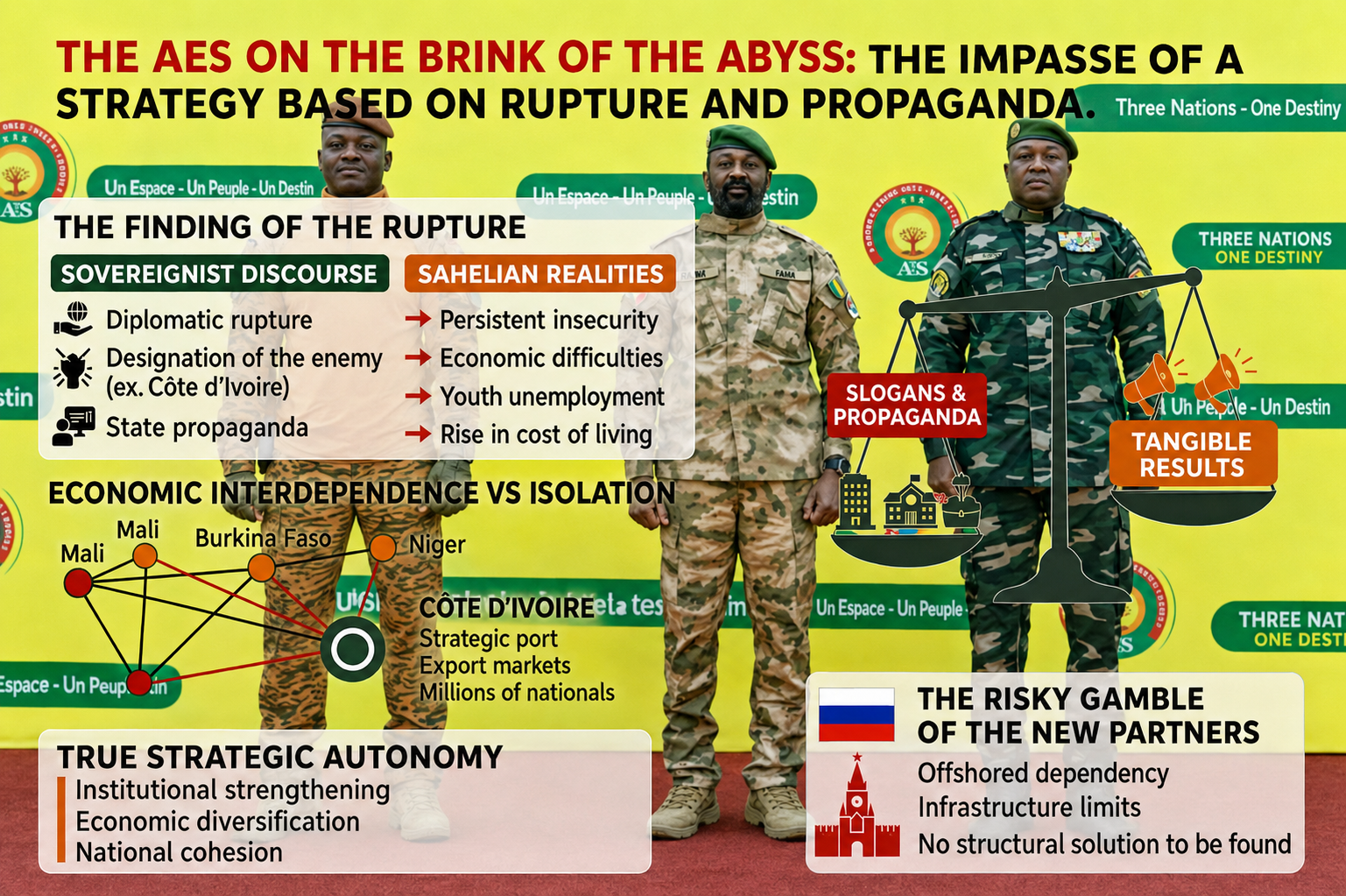
While the AES‘s focus on sovereignty has struck a chord with portions of the Sahelian population—fueled by deep-seated grievances over persistent insecurity and dissatisfaction with international support—the acid test of true independence lies in measurable results. Can these governments guarantee public safety, spur employment, attract capital, ensure essential services, and elevate living standards? The current landscape paints a sobering picture of monumental obstacles still standing in the way.
Sovereignty as a vision, not just a slogan
The AES‘s push for sovereignty has resonated deeply across the region, particularly following widespread frustration with ongoing violence and perceived shortcomings of international alliances. The notion of reclaiming full autonomy over foreign and military policies has found strong support among citizens.
However, sovereignty extends beyond merely discarding agreements or replacing partners; it demands tangible capabilities. A state’s sovereignty is validated through its ability to defend its people, stimulate economic progress, draw investments, deliver dependable public services, and enhance quality of life. On each of these critical fronts, the AES governments face glaring deficiencies, with the chasm between rhetoric and reality expanding daily.
Diverting attention: the politics of external blame
When governments fall short in delivering visible improvements, political narratives often pivot toward rallying support by framing adversarial positions. For the AES, this has manifested in frequent criticism of neighboring states and regional bodies. Côte d’Ivoire, in particular, has been singled out as a target, accused of harboring hostile intentions or serving external interests.
While this tactic can galvanize domestic backing by uniting populations against a shared enemy, it carries significant risks:
It sidelines urgent domestic issues such as soaring living expenses, youth unemployment, crumbling infrastructure, and inadequate access to education and healthcare;
It risks escalating unnecessary diplomatic friction among nations whose economies and societies remain tightly interwoven;
It stifles constructive debate by equating criticism of government actions with implicit allegiance to foreign adversaries.
Côte d’Ivoire maintains a steady diplomatic course
In the face of regional discord, Côte d’Ivoire has adhered to a diplomatic strategy anchored in dialogue and stability. This approach draws from a historical legacy shaped by the principles of Félix Houphouët-Boigny, which prioritize mediation, economic collaboration, and consensus-building.
Despite occasional rhetorical attacks, Abidjan has largely avoided escalatory measures, a strategy guided by both diplomatic caution and economic necessity. Côte d’Ivoire serves as a critical commercial gateway for Sahelian countries, with its ports acting as a vital lifeline for landlocked nations. Trade flows, private investments, and human mobility create interdependencies that political posturing cannot easily dismantle.
Millions of Malians, Burkinabè, and Nigeriens reside, labor, or conduct business in Côte d’Ivoire. A sustained deterioration in bilateral relations would carry far-reaching human and economic repercussions, far beyond the scope of political grandstanding.
The economic toll of diplomatic confrontation
The strategy of confrontation imposes hidden costs that are frequently underestimated. Regional tensions can chill investor confidence, disrupt trade networks, inflate operational expenses, and diminish a nation’s attractiveness to foreign investors. Political instability serves as a warning signal for businesses, and in economies already weakened by security threats, the compounded effect of diplomatic disputes can worsen funding shortages, delay job creation, and stunt economic growth.
Betting on new international partnerships
A core pillar of the AES‘s strategy involves expanding international ties, notably through closer ties with Russia. While diversifying partnerships is a sovereign prerogative, such moves do not automatically translate into tangible benefits in security or economics.
Global experience shows that no external partner can independently resolve systemic challenges such as weak institutions, limited investment, rural poverty, or governance failures. The danger lies in merely substituting one dependency for another without addressing the underlying causes of persistent difficulties.
Authentic strategic autonomy demands strengthening national institutions, professionalizing security forces, improving the investment climate, diversifying economies, and investing in human capital.
Over-reliance on communication, underperformance on results
The AES governments have placed substantial emphasis on political messaging centered on sovereignty, resilience, and national revival. While such narratives can bolster national pride, they cannot indefinitely mask the absence of tangible outcomes citizens demand.
The ultimate measure of leadership success will be concrete benchmarks:
Measurable improvements in security;
Affordable cost of living;
Job creation for young people;
Functional schools and healthcare systems;
Modern infrastructure;
Inclusive economic growth.
These are the standards by which public trust and ultimately, political legitimacy will be judged.
West Africa’s future hinges on unity, not division
The region’s most pressing challenges violent extremism, transnational crime, migration, climate change, food insecurity, and economic development transcend national boundaries. No single state can address these issues in isolation.
Regional cooperation remains essential, whether through existing institutions or innovative frameworks. Treating neighbors like Côte d’Ivoire as perpetual rivals risks further destabilizing a region already strained by overlapping crises.
Conclusion
The Alliance of Sahel States was born from a collective rejection of models deemed inadequate by its founders. This ambition resonates with real aspirations among significant portions of the population.
Yet breaking from the past is not synonymous with effective governance. The AES‘s credibility will be determined not by its declarations of sovereignty, but by its capacity to deliver on security, revive economies, protect freedoms, and foster regional cooperation.
The future of the Sahel will be shaped less by the search for external scapegoats and more by the ability of its leaders to produce tangible results, restore public confidence, and transform dialogue into a catalyst for stability rather than perpetual confrontation.