Niger: the CNSP’s security pledge and the fear that persists far from Niamey
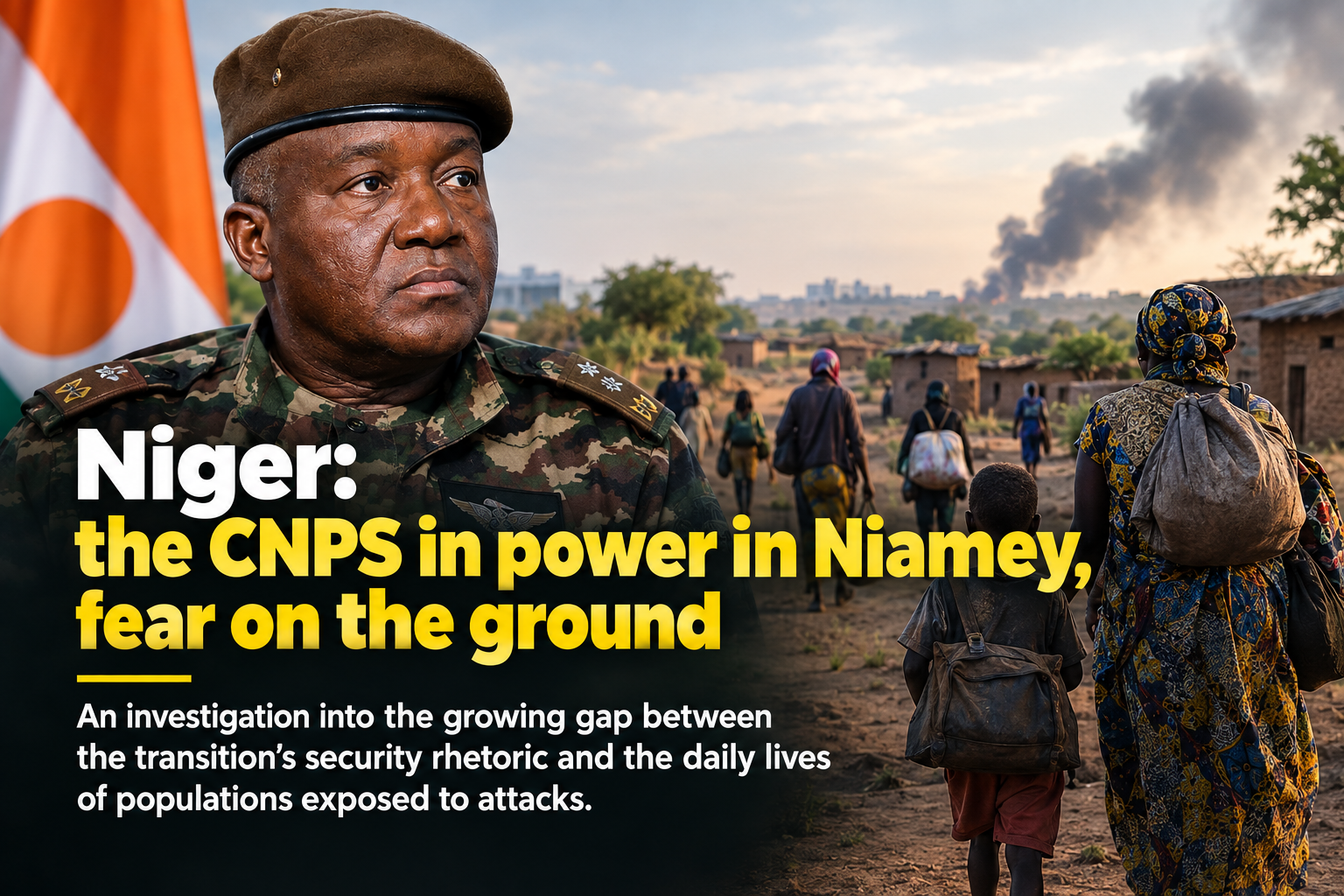
An examination of the widening gap between the security rhetoric of Niger’s transition and the daily experience of communities exposed to armed attacks.
They pledged to reclaim control. To restore safety. To return to Niger its sovereignty and its dignity. Three years on from the July 2023 coup, the Conseil national pour la sauvegarde de la patrie (CNSP) still presents its seizure of power as a historic break with the past.
Yet far from Niamey, a different reality has taken shape.
In areas repeatedly struck by armed groups, communities continue to live with fear, uncertainty and, at times, the conviction that they have been left to fend for themselves. Villages are hit, families displaced, livelihoods brought to a standstill. And one question keeps resurfacing: where are the leaders when the attacks come?
This may well be one of the most unsettling contradictions of the military transition.
A security promise that stops at the capital’s edge
Since taking power, the CNSP has made security the central pillar of its claim to legitimacy. The removal of President Mohamed Bazoum was justified, among other reasons, by the deterioration of the country’s security situation.
The commitment was unambiguous: to do better.
And yet, in the regions most exposed to violence, particularly in the west of the country, attacks continue to dictate the rhythm of daily life. Against that backdrop, an observation fuels growing doubts: the figures who embody the transition are rarely seen in the areas directly affected, at the very moment when residents are confronting the aftermath of an assault.
Statements issued from a distance
The authorities communicate from the capital. They announce operations, hail military successes and promise responses. But for those living close to the most dangerous zones, the questions are far more concrete: who comes to survey the damage? Who meets the bereaved families? Who explains what happened, and what will be done to prevent it from happening again?
A government that has built its legitimacy on security cannot indefinitely confine itself to discussing war from offices in the capital.
Niamey under guard, the hinterlands under strain
This is among the most visible paradoxes of the system installed since the coup.
At the summit, the protection of the regime has become an absolute priority. Signs of mistrust within the military apparatus itself, reshuffles in the hierarchy and the multiplication of control mechanisms all point to a power preoccupied with its own stability.
Meanwhile, far from the political centre, communities face an entirely different form of insecurity: the kind that kills, displaces, shuts schools, destroys local economies and upends ordinary life.
Two realities appear to coexist.
On one side, an authority focused on survival and on securing its own apparatus. On the other, citizens still waiting for the promise of protection made in the aftermath of the coup to translate into something tangible in their lives.
Sovereignty, after all, should not end at the gates of Niamey.
The communities footing the bill for the conflict
Behind every military communiqué lies a reality that official figures seldom capture in full.
There are families leaving their villages.
Farmers hesitant to return to their fields.
Traders whose businesses have ground to a halt.
Children whose schooling has been disrupted.
And entire communities living in anticipation of the next attack.
It is precisely in these territories that the success or failure of the transition ought to be measured.
Not solely in official ceremonies.
Not only in speeches about sovereignty.
But in the state’s capacity to protect those who have no escort, no palace and no dedicated security detail.
The difficulty is not merely military. It is also political.
For when a population feels that its leaders are visible at ceremonies, in speeches and in announcements, yet absent when danger strikes, confidence inevitably begins to erode.
A transition that speaks more than it confronts the ground
The CNSP has built a substantial part of its image on the break with the previous system. New partners, a new diplomatic discourse, the denunciation of foreign influence: communication around sovereignty has become one of the regime’s cornerstones.
But communication is no substitute for presence.
A state can announce victories. It can denounce its adversaries. It can mobilise the vocabulary of patriotism and resistance.
One question nonetheless remains: do people genuinely feel more protected?
This is where official discourse meets its limits.
Sovereignty is not measured only by the number of foreign partners expelled or welcomed. It is also measured by a state’s ability to control its territory and to protect its citizens, above all those living in the most vulnerable areas.
When attacks continue and populations remain exposed, slogans eventually collide with a reality far harder to disguise.
The silence of the ground, the echo of the speeches
The question now confronting Niger extends beyond the person of General Abdourahamane Tiani.
It concerns an entire system of governance.
Can a seizure of power continue to be justified by the security failures of the previous regime without accepting, three years later, to be judged on the very same ground?
Can proximity to the people be claimed while communities in the most exposed areas wait for a more visible state presence?
And above all, how long can a transition ask the population to be patient while the promise that underpinned its arrival in power remains largely unfulfilled?
True patriotism is not measured by the force of a speech.
It is measured by a leader’s willingness to look his people’s suffering in the face.
To go where the state is expected.
To own failures as well as victories.
And to recognise that no power can protect a nation from the offices of the capital alone.
The measure that will ultimately count
In Niger, the authorities continue to speak of sovereignty, security and rupture.
But in the areas where attacks persist, another reality imposes its own questions.
Can a regime present itself as the saviour of a people without going to meet those who live daily with the consequences of insecurity?
This may be where the true record of the transition lies.
Not in slogans.
Not in ceremonies.
Not in televised statements.
But on those roads, in those villages and alongside those families who, when attacks occur, are still waiting to learn whether the state will genuinely reach them.
For governing a country at war is not only about protecting power. It is first and foremost about refusing to leave the people alone with the war.