Mali’s unraveling front and Russia’s Sahel missteps
Mali’s embattled junta grapples with strategic void
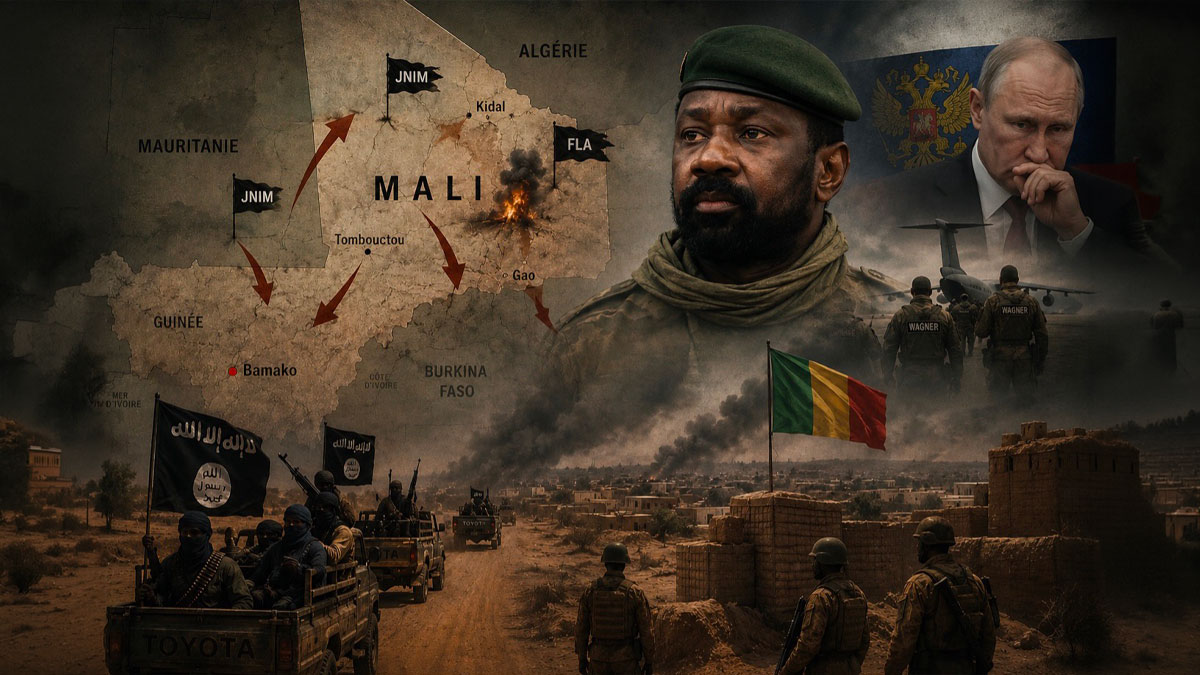
Mali is no longer just a crisis-stricken nation—it has become the epicenter of instability across the Sahel. A perfect storm of jihadist offensives, separatist uprisings, ethnic rivalries, economic collapse, and heavy reliance on Russian military support has pushed the Malian state to the brink of regional fragmentation. The coordinated assault launched on April 25, 2026—spearheaded by the JNIM (an Al-Qaeda affiliate) and the FLA (representing Tuareg separatist demands in Azawad)—marks a dangerous escalation. No longer confined to remote desert clashes, these attacks now target critical urban hubs, military outposts, and logistical corridors that serve as the lifelines of Bamako’s authority.
Once touting promises of full territorial recovery, the expulsion of French influence, and a new strategic alliance with Moscow, the junta under Assimi Goïta now faces a harsh reality: symbolism alone cannot replace operational strength. Ousting French forces was achievable; replacing their intelligence networks, aerial support, regional partnerships, and on-the-ground expertise proved far more elusive.
Breaking peace pacts without the means to enforce victory
The unilateral abandonment of the 2015 Algiers Accords—a fragile but functioning political barrier against renewed northern conflict—served as a defining miscalculation. While deeply flawed and inconsistently enforced, these agreements provided a fragile framework to mitigate large-scale hostilities. By declaring them obsolete in January 2024, Bamako gambled on military dominance over political negotiation, assuming force alone could restore control. Yet such an endeavor demands disciplined forces, robust intelligence, air superiority, sustained logistics, local consent, and administrative continuity—resources Mali’s junta conspicuously lacks.
What the regime possesses instead is a militarized power structure, a potent anti-Western narrative, a strong internal repression apparatus, and a Russian ally adept at regime protection—though ill-equipped to stabilize a vast, fractured nation riddled with trafficking networks, insurgencies, and historical grievances. True sovereignty is not declared; it is demonstrated—through control of roads, schools, markets, mines, customs, and barracks. Without these, sovereignty becomes a hollow banner waving over a collapsing reality.
Jihadists and separatists: a tactical alliance, not a shared vision
Recent operational alignment between the JNIM and FLA does not imply ideological unity. The jihadists seek an armed Islamic order transcending national borders, while the Azawad separatists demand regional autonomy or independence rooted in ethnic and territorial identity. Yet in war, shared enemies can forge temporary alliances even without shared goals. By targeting Bamako and its Russian-backed defense structure, these groups saturate Malian forces, forcing them to scatter resources across multiple fronts—diluting troop strength, fuel supplies, reconnaissance, and morale.
The true battleground lies not in territorial capture, but in the erosion of public trust in the state. When civil servants flee, soldiers hesitate, local leaders negotiate with armed groups, traders pay protection fees, and citizens perceive Bamako as distant and impotent, the state weakens even where flags still fly. This psychological breakdown may prove more decisive than any battlefield loss.
Assessing Mali’s military: garrison duty amid relentless attrition
The Malian Armed Forces labor under structural constraints: defending a vast territory with limited personnel, vulnerable supply lines, and a mobile enemy. Insurgents need not hold cities permanently; they can ambush convoys, block routes, encircle outposts, tax villages, and disrupt commerce—imposing intermittent sovereignty from the shadows. The state, however, must maintain visible control, protect civilians, and sustain administrative presence. This asymmetry lies at the heart of counterinsurgency failure: the state must be everywhere; the insurgent chooses where to strike.
A successful attack on a key installation such as Kati—or casualties among top security officials—would send shockwaves beyond the battlefield. It wouldn’t necessarily mean immediate fall of the capital, but it would signal that the crisis has pierced the heart of power. Doubt seeps into every garrison, every governor’s office, every alliance. When that happens, the state begins to capitulate internally long before it collapses externally.
Russia’s limitations: protecting the regime is not nation-building
Russia’s engagement in Mali has been marketed as a bold alternative to French influence. Offering political shielding, training, advisors, combatants, and a powerful anti-Western narrative, Moscow has given Bamako a new lexicon: sovereignty, order, anti-terrorism, and liberation from colonial legacies. Yet on the ground, stabilization requires far more than coercion. It demands local intelligence, tribal accords, development, administration, justice, border security, inter-community reconciliation, and political reconciliation. Paramilitaries can win firefights; they cannot rebuild institutions. They can intimidate; they cannot govern. They can defend palaces; they cannot integrate hostile peripheries.
Russia’s war in Ukraine already strains its military, logistical, and financial resources. Its African venture was conceived as a low-cost operation—political influence, resource access, security contracts, and global propaganda. But as the Malian theater evolves into a war of attrition, costs rise, and Moscow must prioritize where to invest its dwindling capital. Mali risks transitioning from a showcase of Russian influence to a strategic quagmire. Replacing a French flag with a Russian one is one thing; preventing jihadists, separatists, and criminal networks from hollow out the state from within is another entirely.
Scenarios of economic collapse: gold, trafficking, and state survival
Mali’s economy hinges on gold, agriculture, external aid, informal trade, and the state’s ability to control its fiscal arteries. As security deteriorates, so does the revenue base. Gold mines—both industrial and artisanal—become battlegrounds for control. Armed groups tax, extort, and smuggle, draining state income while forcing higher military spending. This creates a vicious cycle: less security leads to fewer resources; fewer resources lead to less security.
The trans-Saharan trade routes are not merely smuggling corridors—they are economic arteries sustaining communities dependent on livestock, fuel, foodstuffs, and legitimate commerce. When Bamako loses control of these routes, it loses influence over daily life. Where the state withdraws, others step in: jihadists, traffickers, warlords, and local strongmen. Mali’s instability does not remain contained. It radiates across borders into Niger, Burkina Faso, Mauritania, Algeria, Senegal, Guinea, and Côte d’Ivoire. The Sahel is not a collection of isolated crises; it is a strategic depth where porous borders and transnational communities render disintegration contagious.
The Sahel States Alliance: sovereignty proclaimed, but means absent
The Alliance of Sahel States—Mali, Niger, and Burkina Faso—has forged a new political identity: rejection of Western influence, severance from France, critique of regional norms, and pursuit of alternative partnerships. Yet this proclaimed sovereignty emerges from states with overstretched armies, fragile economies, militarized institutions, and expanding jihadist threats. The alliance may serve as a political bloc and symbolic force, coordinating declarations and anti-Western rhetoric. But can it deliver mutual defense when all members are vulnerable? Can it stabilize Mali if Niger and Burkina Faso must also defend their capitals, mines, and borders? The paradox is stark: an alliance of fragilities does not create strength; it may only produce shared isolation and amplified propaganda. Without real resources, intelligence, legitimacy, and administrative capacity, such a union risks becoming a confederation of emergencies rather than a shield of resilience.
Geopolitical consequences: France departs, a void remains
France’s withdrawal from Mali closed a chapter marked by strategic missteps, political misunderstandings, and deep-seated resentment across the Sahel. Perceived as a neo-colonial power unable to defeat jihadism and too entangled with local elites, Paris increasingly became a liability rather than a stabilizing force. Yet the failure of French policy does not equate to Russian success. Anti-French sentiment can energize political narratives, but it cannot alone forge security. Sovereignist rhetoric may win temporary legitimacy, but it cannot replace governance, justice, or economic development.
Russia has filled the vacuum left by France, yet it has not resolved the core challenge: how to govern the Sahel? With what institutions? Through what social contracts between center and periphery? Under what economic model? In what balance among ethnic groups, clans, pastoralists, urban centers, and rural communities? These questions remain unanswered, and without them, any external power risks sinking into prolonged conflict. France learned this lesson the hard way. Russia may now be learning it as well.
Three plausible futures for Mali
First scenario: A three-way civil war. Bamako retains control of the capital and key cities, the JNIM dominates vast rural zones, and the FLA consolidates influence in the North and Azawad heartlands. The country remains formally united but substantively fragmented—a patchwork of competing sovereignties. This appears most likely in the absence of a decisive victor and with continuous erosion of state capacity.
Second scenario: Internal collapse of the junta. Military setbacks, leadership losses, growing dissent within the armed forces, and perceived Russian inefficacy could trigger fractures within the regime. In a system born of coups, coups remain a plausible recourse. A new faction might attempt to salvage power by dismantling the old order, risking further destabilization.
Third scenario: De facto secession. Not formally declared or internationally recognized, but practiced on the ground. Northern Mali could become a durable zone outside Bamako’s control, governed by an unstable blend of Tuareg factions, local militias, jihadists, traffickers, and external patrons. The result: a Sahelian Somalia—residual institutions clinging to fragmented sovereignty.
The ripple effect: why Europe cannot afford to look away
Europe tends to view Mali as a distant concern—a mistake with costly consequences. The Sahel influences migration flows, terrorism, resource access, illicit trade, Russian influence, Mediterranean security, and West African stability. A fragmented Mali expands space for jihadist networks, criminal routes, and pressure on coastal states. It diminishes Europe’s ability to shape a region from which it is being gradually expelled—politically, morally, and militarily.
Europe’s twofold error: first, framing the Sahel primarily as an external security challenge; second, losing credibility without offering a viable alternative. Dialogue has focused on terrorism, migration, military training, and support missions. Too little attention has been paid to justice, corruption, rural economies, communal conflicts, demographics, water access, education, employment, legitimacy, and long-term development. Without addressing these, no external intervention can yield lasting stability.
Mali as a mirror of global disorder
The Malian crisis reveals an uncomfortable truth: changing external protectors does not guarantee state survival. France failed to stabilize the country. Russia appears to be struggling similarly. The junta wielded sovereignty as a slogan, yet real sovereignty demands capabilities that cannot be bought with propaganda or foreign mercenaries.
A state does not always die with the fall of its capital. It dies earlier, when roads go unprotected, schools close, villages pay taxes to armed groups, convoys move only under escort, soldiers lose faith in orders, allies withdraw or demand concessions, and citizens stop believing in the state’s promise. Mali is perilously close to this threshold. It may not fall tomorrow. Bamako may not collapse. But the unraveling is undeniable. The crisis is no longer peripheral. It has become existential. It is not confined to the North. It threatens the very idea of the Malian state.
The junta sought to prove that military force, backed by Russia and freed from Western constraints, could rebuild national unity. Instead, it has demonstrated that without policy, force consumes itself. Without legitimacy, sovereignty is hollow. Without administration, military victory is fleeting. Without engagement with the peripheries, the center becomes a besieged fortress.
Mali is not merely a Sahelian front. It is a reflection of a disordered world: competing external powers, fragile states, hybrid wars, criminal economies, jihadism, sovereignist propaganda, mineral wealth, and abandoned populations. In this reflection, the failures of many actors are visible: France, Russia, military juntas, regional bodies, Europe, and an international order far better at analyzing crises than preventing them.