Kemi seba’s controversial arrest in south africa reveals ties to extremist group leader
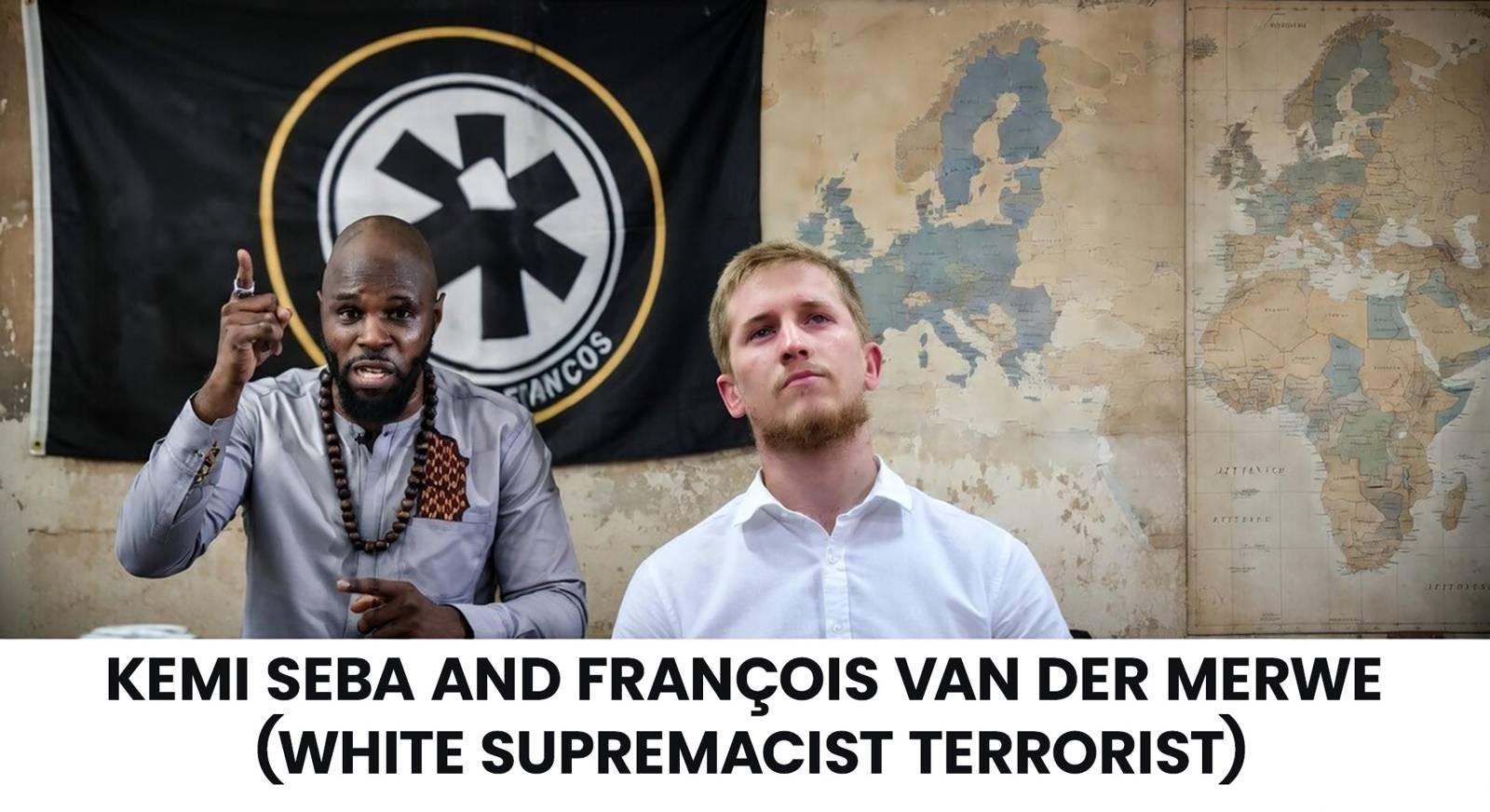
Certain police interventions do more than just enforce the law; they pull back the curtain on hidden alliances. The detention of activist Kemi Seba on South African soil on Wednesday, April 15, is a prime example. This arrest was not merely about Seba himself, but about the individual standing beside him and the financial transactions that allegedly linked them.
The leader of the bittereinders: françois van der merwe
François van der Merwe, a 26-year-old born in Pretoria, serves as the director of the Bittereinders. This organization is not viewed by the South African state as a simple political movement; it has been formally classified as a terrorist group. To understand the gravity of Seba’s association with Van der Merwe, one must examine the radical ideology and history that define this organization.
The group’s name is a direct reference to the final, uncompromising phase of the Second Boer War. Historically, the “Bittereinders” were Boer guerrillas who refused to accept defeat against British forces, viewing any peace treaty as a betrayal of their heritage. Van der Merwe has revived this name to signal a similar refusal to accept the current socio-political reality of South Africa. His movement is built on the belief that the political power held by Black South Africans is a direct threat to the survival of the Afrikaner people.
A vision for a racially exclusive state
The Bittereinders advocate for a Volkstaat—a sovereign, racially segregated territory where Black South Africans would be denied citizenship. This objective mirrors the demands of the most radical Afrikaner nationalists from the early 1990s, such as the AWB, who used violence and bombings to try and stop the transition to democracy. Van der Merwe represents the modern face of this extremist legacy.
Since forming the group in 2021, Van der Merwe has been a vocal critic of the ANC and the EFF, describing the post-Apartheid constitutional order as an “occupation.” His group doesn’t just protest; they engage in paramilitary training. Members are filmed participating in tactical drills and self-defense exercises at security academies, footage of which the group often shares publicly to showcase their readiness for conflict.
A history of legal trouble and radicalization
Van der Merwe’s personal record is as volatile as his politics. In late 2023, he was arrested for a pub assault. While out on bail, he led a group of Bittereinders to a courthouse in Groblersdal, where he was again taken into custody after breaching police lines and assaulting an officer. During these legal battles, he often quoted the phrase “Soet is die Stryd” (Sweet is the Struggle), a signal to his followers that state pressure only served to strengthen his resolve.
The 250,000 rand transaction
It is this radical figure that Kemi Seba allegedly sought out for assistance. According to the Hawks, South Africa’s elite organized crime unit, Seba is suspected of paying Van der Merwe approximately 250,000 rands (over 13,000 euros). This payment was reportedly made to facilitate an illegal crossing of the Limpopo River into Zimbabwe, allowing Seba and his son to bypass official border controls on their way to Europe.
Under South African counter-terrorism laws, providing funds to a leader of a designated terrorist organization is a major criminal offense, regardless of the intended use of the money. By handing over this significant sum, Seba has moved beyond political association into the realm of criminal financing.
The collapse of a political narrative
For years, Kemi Seba has cultivated an image as a champion of Black sovereignty and a fierce critic of Western imperialism. His rhetoric, which resonated across francophone Africa, focused on the dignity of the African continent and resistance against systems of oppression. However, his alleged financial support for Van der Merwe creates a massive ideological contradiction.
The Bittereinders do not just oppose the current government; they seek to restore a system of Apartheid and deny the fundamental rights of Black citizens. For an activist whose brand is built on pro-Black advocacy to fund a group that views Black political existence as an “aberration” marks a total breakdown of his public persona.
Kemi Seba now faces a complex legal battle involving charges of illegal immigration, conspiracy, and the potential financing of terrorism. Beyond the courtroom, he faces a historical reckoning: the man who claimed to fight for African liberation is now accused of bankrolling those who wish to bring back the era of racial segregation.