From Egungun to restitution: what Benin’s Fnac Saint-Lazare month is already setting off in Paris
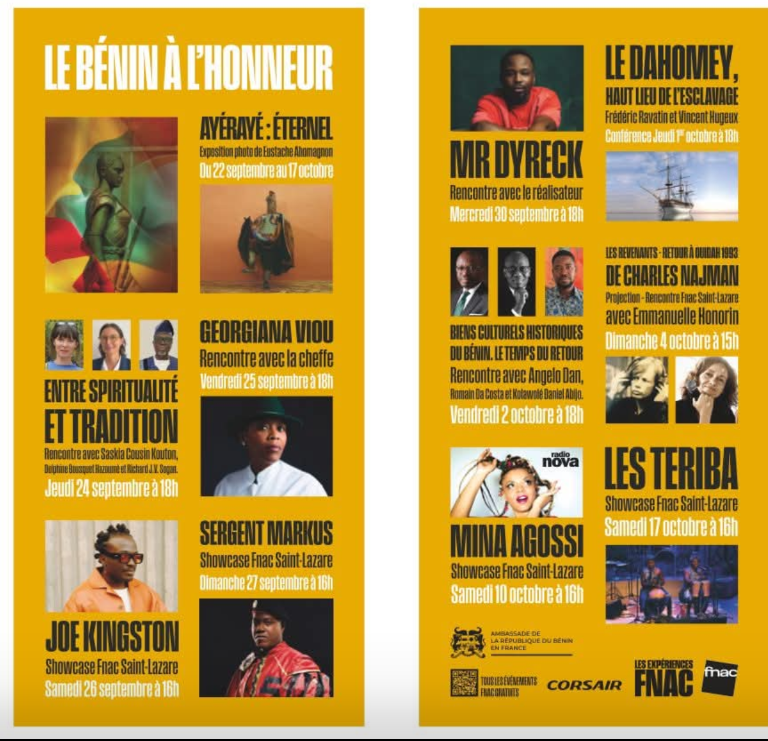
On September 22, 2026, Fnac Saint-Lazare begins a 26-day occupation of its own Paris building — and the reaction is already spreading well past the shelves. Until October 17, the store’s third-floor meeting forum becomes a stage for Benin, with a program assembled in partnership with the Embassy of the Republic of Benin in France for a number of the listed events. Photography, literature, gastronomy, cinema, slam and jazz share one address, and each of them opens a different argument about how a West African country is seen from Paris, and how it wants to be seen.
That is precisely why the announcement has triggered more than curiosity. A French cultural chain handing a month to Benin raises questions about visibility, memory and money — and about what actually stays behind once the last set is packed up.
A program that refuses the postcard version of Benin
Nothing here is designed as an exotic display. The line-up deliberately moves across several registers: spiritual traditions, the history of the kingdom of Dahomey and the slave trade, the return of cultural property, and on the other side of the ledger, contemporary art, books, food and current music. Read together, those themes sketch a country that argues with its own past rather than posing in front of it.
The full run, date by date
- September 22 – October 17: the photographic exhibition Ayérayé: Éternel, devoted to Beninese photographer and designer Eustache Ahomagnon, whose work sits where image meets textile creation, exploring memory, spirituality and the contemporary scene through the world of the Egungun — figures tied to ancestor worship among the Yoruba.
- September 24: a conversation on spirituality, traditions and Beninese heritage with sociologist and author Saskia Cousin Kouton, journalist Delphine Bousquet Hazoumè and researcher Richard J.V. Sogan.
- September 25: chef Georgiana Viou, born in Benin, recounts her path and presents her book Oui cheffe! From Benin to the Michelin star: the journey of a fighter, making the case for gastronomy as a channel of cultural transmission.
- September 26: a showcase by Beninese artist Joe Kingston, whose “Afro futur vibes” universe merges hip-hop with contemporary African sounds.
- September 27: poet and slam artist Sergent Markus presents Vodun Gospel, an album fed by musical references drawn from vodun culture.
- September 30: a carte blanche for director, co-producer and cinematographer Mr DYRECK, whose work between Benin and France represents a generation using images to tell West Africa differently.
- October 1: writer and journalist Vincent Hugeux in conversation with engineer and scientific scenographer Frédéric Ravatin about Dahomey and the history of slavery, including the Boat of Memory project in Ouidah, conceived as a memorial device for the slave trade.
- October 2: the restitution of cultural property between France and Benin, examined by Ambassador Angelo Dan, Romain Da Costa and heritage curator Kolawodé Daniel Abidjo.
- October 4: screening of Retour à Ouidah 1993. Les Revenants, Charles Najman’s documentary on the return to Ouidah, followed by a discussion with journalist, producer and programmer Emmanuelle Honorin.
- October 10: jazz singer Mina Agossi presents Dynamic. Tribute to Dinah Washington.
- October 17: closing showcase by Teriba, described as Benin’s first all-female music group, formed in 2002 and known for its a cappella singing and its drive to promote Beninese cultural heritage.
The memory thread that will dominate the debate
The most sensitive moments fall in early October, and they are the ones most likely to travel beyond the room. A conversation on Dahomey and slavery, then a session on restitution, push the program into territory where culture and diplomacy overlap. The inclusion of Ambassador Angelo Dan alongside a heritage curator signals that this is not a purely artistic exercise: it engages directly with a process that has reshaped cultural relations between the two countries.
The point is no longer simply to exhibit works or introduce artists. It is to interrogate how a nation narrates its past, safeguards its heritage and defines its place in the world — and to let a Paris audience sit in on that interrogation.
Cinema as the bridge between then and now
The screening of Charles Najman’s documentary, made in the context of the 1992 Ouidah festival, links archival images of return with present-day questions about memory, identity and the ties between Benin and its diaspora. For many viewers, that continuity may be the most consequential part of the month: it reframes Ouidah not as a historical footnote but as a living reference point.
Contemporary Benin gets equal billing
Alongside the historical weight, the schedule keeps room for work being made right now — Mr DYRECK’s cinematographic carte blanche, Mina Agossi’s jazz tribute, and Teriba’s a cappella closing set. This balance matters to the outlook. A program built only on memory risks freezing a country in its past; one built only on novelty loses the context. Fnac Saint-Lazare has opted to hold both at once.
What Paris is expected to take from it
Three questions will likely frame the reactions. First, access: every announced event is free and open within the limits of available seating, which widens the audience but also raises expectations about turnout. Second, durability: will the conversations started in September still be alive in November, or will they end with the exhibition? Third, reach: whether a bookstore residency can shift how the Beninese diaspora sees itself represented in the French capital, and how French audiences see Benin.
After October 17
Whatever the final attendance figures, the month leaves a template worth watching. From photography to gastronomy, from slam to jazz, from cinema to history, the program builds a plural portrait of a country whose heritage keeps feeding new work — and reminds anyone paying attention that Beninese culture is not a fixed inheritance. It is passed on, reinvented and contested.
Between vodun traditions, the memory of Dahomey, the history of the slave trade, restitution debates and emerging artistic voices, an entire narrative of Benin is being invited into the heart of Paris. The real test comes after the lights go down.