Bamako under siege: JNIM torches vehicles as junta’s strategy crumbles
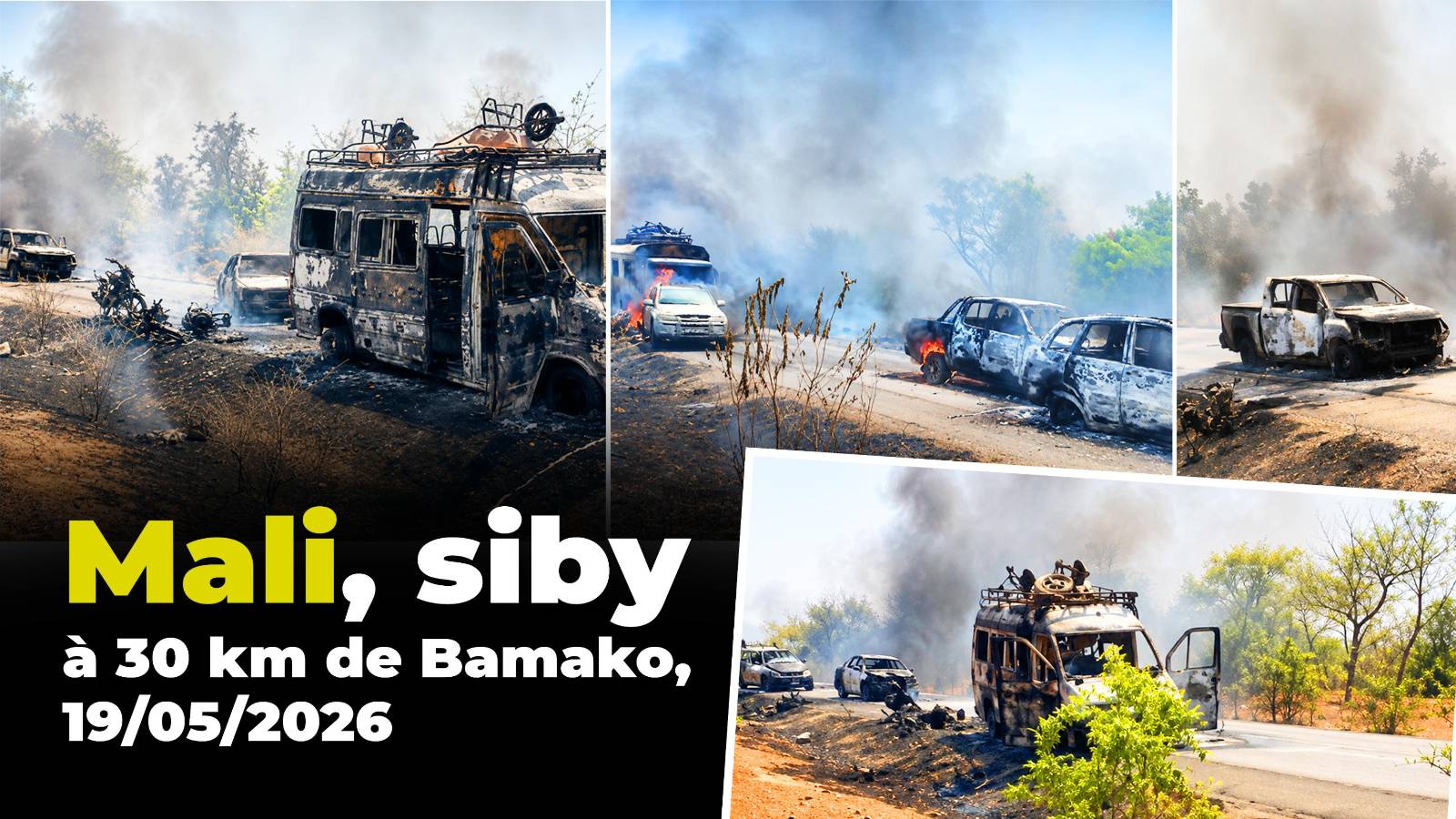
Is Bamako still protected? This question, once unthinkable, now looms over the Malian capital with grim urgency. On May 19, 2026, the rural commune of Siby—just 30 kilometers from the city—became the stage for an unprecedented assault. Militants from the Group for the Support of Islam and Muslims (JNIM) torched dozens of cargo trucks, transport vehicles, and Hilux pickups in a calculated, relentless strike. The attack lays bare a truth the authorities have long tried to obscure: Bamako is under siege, and the junta’s military strategy—bolstered by its Russian partners—has failed.
Flames at the gates of the capital
The national highway toward Guinea turned into an inferno on Tuesday afternoon. Survivors and local transporters recounted how armed motorcyclists descended on convoys near Siby, intercepting them with minimal resistance. The scene was one of devastation: refrigerated trucks, public minibuses, and private vehicles were reduced to smoldering wrecks. Columns of black smoke rose for miles, sending panic rippling through Bamako’s outskirts.
Beyond the immediate economic toll for struggling merchants, the message was clear. Striking Siby—a cultural and tourist jewel tied to the Kouroukan Fouga charter—proved no corner of Mali is beyond reach.
A siege designed to suffocate
The Siby attack wasn’t an isolated incident but the culmination of a months-long JNIM strategy. Militants have tightened a stranglehold on nearly every major road supplying Bamako. Traveling the route to Ségou, the axis to Senegal, or the southern corridor to Guinea and Côte d’Ivoire has become a deadly gamble.
The JNIM enforces its will through mobile checkpoints, extorting drivers and torching cargo of those who defy its bans. By severing Bamako’s lifelines, the group aims to collapse the city’s economy and society. Essential goods grow scarcer by the day, pushing prices to unsustainable highs and fueling public discontent that the transitional government struggles to quell.
Russia’s mercenaries fail to deliver
Confronted with such bold attacks, the junta’s narrative of a military resurgence clashes with grim reality. Since international forces withdrew, the ruling junta has staked its credibility on its partnership with Russian paramilitaries—formerly known as Africa Corps. Yet the facts reveal a stark failure to protect Malian lives.
The Russian mercenaries, bankrolled by Malian taxpayers, proved incapable of anticipating or halting a major assault just half an hour from the Koulouba presidential palace. Their tactics—brutal, reactive, and focused on securing mines rather than combating insurgents—offer no viable solution to the asymmetric warfare waged by the JNIM. Joint FAMa-Russian patrols lack foresight and territorial coverage, leaving critical roads vulnerable. Heavy reliance on digital propaganda only underscores the depth of their operational shortcomings.
A reckoning for Bamako
The attack on Siby is a final warning. Denial can no longer substitute for defense policy. By permitting the JNIM to encircle Bamako and strike at its doorstep, the junta and its Russian allies have exposed their strategic impotence. For ordinary Malians, the illusion of recovered sovereignty and total security evaporates in the glow of burning vehicles and severed roads. If Bamako is to avert total collapse, a fundamental reassessment of its military choices and alliances is no longer optional—it is a matter of national survival.