In Mali, local expressions like “Bonya” (respect), “woro songo” (the price of kola nuts), or “buru songo” (the price of bread) serve as linguistic veils for a troubling reality: the culture of illicit “small gifts” that fuels widespread corruption. While this phenomenon causes growing alarm, it appears to be increasingly tolerated by the general public.
Why has this form of graft become so integrated into the social fabric? Furthermore, how can a problem be challenged when it is perceived as acceptable by the majority?
According to the “Dictionary of Corruption” by Transparency International, the term refers to the misuse of delegated authority for personal gain. When viewed through this lens, acts of corruption are a daily occurrence across Mali.
This issue is visible in public services and administrative interactions, often manifesting as bribes, undue favors, or various forms of influence peddling.
The story of Myriam (a pseudonym), a commercial director at a Bamako advertising agency, illustrates the severity of the situation. “Every time I secure a contract, representatives from the client organization demand a percentage for themselves. It is a take-it-or-leave-it deal,” she explains with frustration. Myriam admits she is unsure if her business can survive this environment, noting that this type of extortion has become almost traditional.
Corruption also appears in more mundane settings: a bribe to speed up paperwork, a “gift” to pass an exam, or using connections instead of merit to gain an advantage. These routines have become so common that they are viewed as standard practice in many industries.
Entrepreneur Omar Keita shares a similar experience. After waiting in line for an entire day, he felt forced to give 10,000 F.CFA to a fuel pump attendant who refused to serve him without a “gratification.”
This happened during a recent fuel shortage in Mali, triggered by militant attacks on tanker trucks traveling from Sénégal and Côte d’Ivoire. Keita described feeling “deeply hurt” by his own actions, yet such transactions have become so normalized that they create a self-sustaining cycle. As these habits spread, the perception of corruption as a social evil fades—a cultural shift that cements its place in society.
Sibiri Diarra, a retired international civil servant, notes that in the United Nations system, gifts were strictly regulated and could not exceed a specific value without being classified as corruption. While even large international organizations face scandals, Mali lacks the public awareness of such regulations, leaving the door wide open for exploitation. Anti-corruption advocates in the country argue that the absence of real legal consequences only emboldens the practice.
Sociologist Mohamed Abdellahi Elkhalil, an expert on Sahelian social and security issues, suggests that corruption has permeated every level of Malian society. He describes a “normalization” that threatens the very pillars of the nation’s democracy and economy. According to him, this trend is sociological rather than cultural, driven by the desire to live beyond one’s financial means.
Oumar Korkosse, from the Network of Traditional Communicators for Development (Recotrade), points out that poverty and unemployment act as catalysts. He explains that when wages are low or paid late, minor acts of corruption become a survival mechanism for many, even those who value integrity.
This reality moves the issue beyond politics and law into the realm of morality. During a workshop in Bamako in April 2025, the Malian Association for the Fight against Corruption and Financial Delinquency (AMLCDF) emphasized the need to build a civic conscience based on ethics and respect for the public good. They believe civil society initiatives, civic education, and religious leaders are vital to sparking this change.
A deep-rooted crisis in Mali
A March 2024 survey by Afrobarometer indicates that citizens perceive judges, magistrates, business leaders, tax officials, and security forces (police and gendarmerie) as the most corrupt. Many respondents admitted to paying bribes to access basic public services.
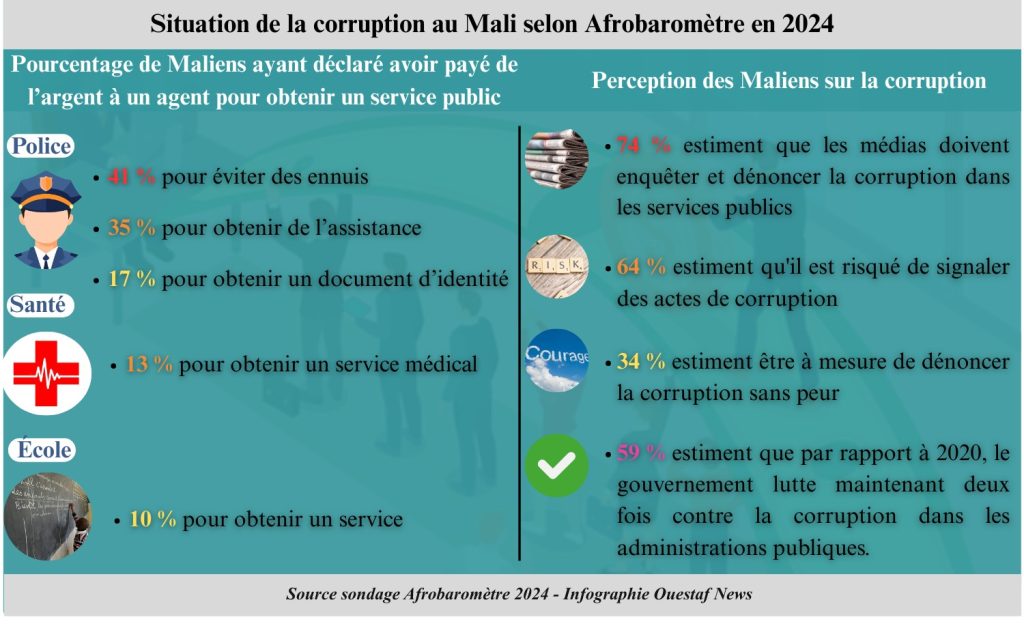
On the roads, the situation is particularly frustrating for people like Ousmane Diarra, a motorcycle taxi driver. He claims police stop him several times a day for the same reasons. Regardless of whether his paperwork is in order, he says he must pay 1,000 or 2,000 F.CFA at every checkpoint. “It’s exhausting,” he says, noting he spends a significant portion of his day pleading with officers.
The Afrobarometer data shows that corruption is most prevalent within public administrations, including hospitals and schools. Because of these systemic issues, Mali’s international reputation remains poor.
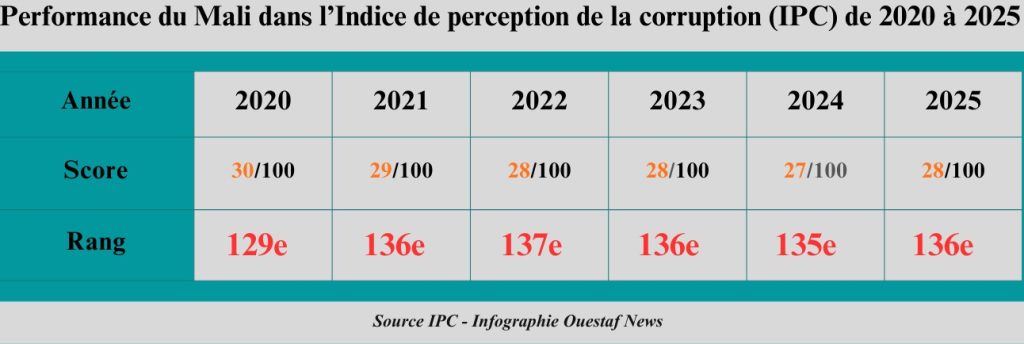
In the 2024 Corruption Perceptions Index (CPI) by Transparency International, Mali scored 27 out of 100, ranking 135th out of 180 nations. The 2025 report showed little change, with a score of 28/100 and a rank of 136th. This stagnation highlights the persistence of the problem.
Governance experts note that Mali is consistently identified as a country where the public sector is viewed as heavily corrupt by analysts and business leaders alike.
Furthermore, the World Bank’s 2023 Worldwide Governance Indicators gave Mali a score of -0.86 for corruption control. This is significantly lower than the global average of -0.04, reflecting the weak capacity of national institutions to manage and fight the issue.
“When the population loses faith in the integrity of their institutions, corruption becomes a survival strategy,” concludes Me. Soumaré Boubacar, a lawyer in Bamako. “People start thinking: if everyone else is doing it, why shouldn’t I?”