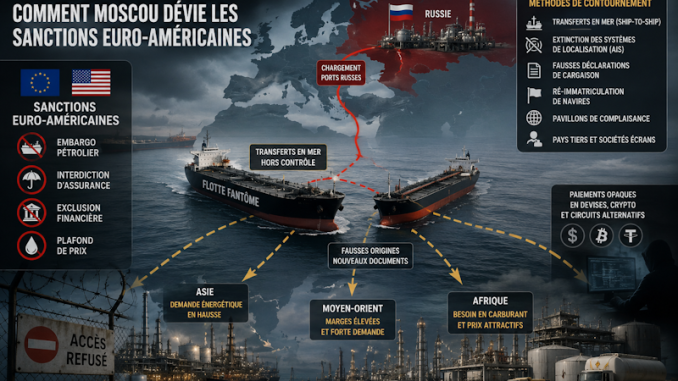
Investigative reports reveal that Morocco has emerged as a critical transit hub for Russian petroleum products, circumventing Western sanctions imposed after the Ukraine invasion. Documents and maritime tracking data suggest sophisticated networks are rerouting sanctioned fuel through North African ports before it potentially reaches European markets.
Geneva-based trader facilitates covert fuel transfers
Swiss trading firm Alvari SA has played a central role in these operations, according to shipping records analyzed by international observers. Between 2025 and early 2026, three vessels—Tranquil Sea, Duke II, and Eldia—shuttled Russian diesel and fuel oil from Baltic terminals to Morocco’s Jorf Lasfar and Mohammedia ports. These shipments, totaling tens of millions of dollars, involved complex financial transactions executed through Moroccan banking institutions connected to powerful economic groups.
The Tranquil Sea case exemplifies the elaborate deception tactics employed. Despite being placed on the United Kingdom’s sanctions list in late 2025 for suspected sanctions violations, the vessel completed its journey to Morocco. Ukrainian authorities allege the ship previously served as a surveillance platform targeting NATO military movements, while Finnish authorities detained it for allegedly damaging underwater cables. Alvari SA has denied any involvement in vessel operations through its legal representatives.
False documentation obscures Russian origins
To disguise the true provenance of the fuel, Cypriot commercial authorities issued fraudulent certificates claiming Turkmenistan as the origin. These documents facilitated ship-to-ship transfers in international waters near Gibraltar, conducted under the guise of routine logistical operations labeled as “Off Port Limits” (OPL) transactions. Such transfers, typically reserved for minor port services, have become a favored method for evading sanctions on refined petroleum products.
Financial records indicate payments were processed in US dollars between Attijariwafa Bank—controlled by the royal holding Al Mada—and the offshore branch of the Banque Centrale Populaire. Moroccan fuel distributors reportedly secured discounts of approximately $7 per metric ton compared to European price benchmarks, amounting to significant cost advantages given current market conditions where non-Russian diesel trades $15 above these indices.
Diplomatic timing further raises questions about official involvement. As the Tranquil Sea approached Morocco’s shores in late 2025, Moroccan Foreign Minister Nasser Bourita conducted high-level talks in Moscow with his Russian counterpart Sergey Lavrov. This meeting preceded a crucial United Nations Security Council vote on the Western Sahara issue, where Russia ultimately abstained—a decision viewed favorably in Rabat.
Spain detects suspicious fuel flows from Morocco
Spanish customs authorities and industry analysts have documented a sharp increase in diesel imports from Morocco since late 2024. While Morocco lacks domestic refining capacity, shipping data from Kpler shows 645,000 tons of Russian diesel arrived in 2025, comprising 45% of the country’s total fuel imports. The volume surged to 489,000 tons in the first four months of 2026 alone.
Spanish petroleum industry representatives express concern that this fuel may be re-exported into the European Union, particularly following disruptions in Middle Eastern oil transit routes. In March and April 2026, Spain received 76,000 tons of Moroccan diesel at ports including Tarragona, Barcelona, and Bilbao—marking a return to pre-2022 trade patterns after a near-total absence during the initial sanctions period.
Spanish refiners, represented by the Spanish Association of Fuel Industries (AICE), warn that this practice undermines legitimate market competition and calls for stricter enforcement against potentially illicit fuel imports.
Parallel investigations confirm suspicious trade patterns
Both investigations—one focusing on North African routes and the other on Spanish re-exports—paint a consistent picture of a covert supply chain. While neither report provides definitive proof that every shipment follows this exact path, maritime tracking data, customs documentation, and industry testimonies strongly suggest systematic circumvention of sanctions. The inherent opacity of global petroleum markets makes it challenging to trace refined products once they enter commercial blending networks.