One year of the Suminwa II government: José Mpanda’s telecom achievements
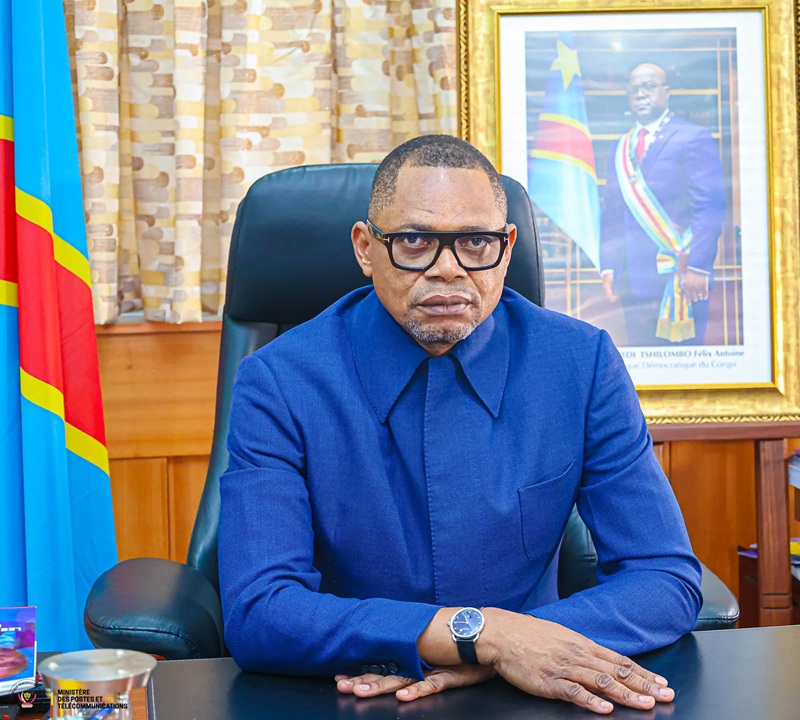
Exactly one year after his appointment as Minister of Posts and Telecommunications under the Suminwa II government, Me José Mpanda Kabangu has delivered transformative results in restoring the Democratic Republic of the Congo’s (DRC) voice on the global stage.
Restoring international credibility in telecommunications
Upon taking office, Me Mpanda conducted urgent consultations with telecom operators and public administration officials. His diagnosis revealed critical gaps: the DRC was isolated in key international bodies due to unpaid dues and lacked influence in shaping global telecom policies. Within weeks, he spearheaded efforts to settle over 34 years of arrears to the Universal Postal Union (UPU), securing the DRC’s right to speak and vote once again—a breakthrough achieved after decades of exclusion.
His most historic accomplishment came in October 2025, when he successfully negotiated the return of the African Telecommunications Union (ATU) headquarters from Nairobi to Kinshasa. The decision was ratified during the 7th Plenipotentiary Conference in Abuja, Nigeria, in July 2026. Starting January 2027, the ATU Secretary-General, Kezias Kazuba Mwale from Zambia, will operate from Kinshasa, fulfilling a long-overdue promise. This move places the DRC at the table of decision-making in continental telecom governance and guarantees a seat on the ATU’s Administrative Council.
Me Mpanda’s next strategic milestone is positioning the DRC for a seat on the International Telecommunication Union (ITU) Administrative Council for the 2027–2030 term. He will officially submit the DRC’s candidacy in November 2026 during the Plenipotentiary Conference in Doha, Qatar. This bid aligns with President Félix-Antoine Tshisekedi’s vision of transforming the DRC into a digital hub by 2030 and leveraging global telecom governance to secure development financing.
Reforming national telecom administration and improving service delivery
Domestically, Me Mpanda has overhauled the General Secretariat of Posts, Telecommunications, and New Information and Communication Technologies (PTNTIC). Within 144 days, he delivered 13 new vehicles—including three large buses and several jeeps—marking the first major fleet renewal in decades. Staff received salary grid adjustments, promotions based on merit and seniority, and rehabilitation of the administrative building.
To stabilize the business climate for telecom operators, he resolved long-standing legal uncertainties by converting licenses for major players—Airtel, Vodacom, Orange, and Africell—into clear, enforceable titles. He also halved, retroactively, a decade-long moratorium on Congolese ownership requirements in telecom firms, ensuring compliance with the 25% national participation clause and the 5% employee shareholding stipulated by telecom law.
Building digital infrastructure: the path to 2030 connectivity goals
Me Mpanda has laid the groundwork for the DRC’s digital transformation by launching a $1.5 billion infrastructure program for 2026–2030. The plan includes:
- Deploying at least 54,000 km of fiber-optic backbone, with an initial 10,000 km funded by the World Bank and Agence Française de Développement under the National Digital Transformation Program (PTN);
- Constructing 30,000 new towers, beginning with a pilot phase of 3,000 towers in the holy city of Nkamba, Kongo Central;
- Acquiring a sovereign communications satellite in partnership with China Unicom, currently under negotiation.
To accelerate rural connectivity, the Universal Service Development Fund (FDSU) has signed agreements with mobile operators, committing funding for at least 10 new antennas each in peri-urban and rural zones. These efforts aim to connect all 145 territories, close the digital divide, expand the tax base, and revitalize the postal service.
A vision in motion: from policy to people-centered impact
Me Mpanda’s leadership reflects a broader strategy: to restore the DRC’s sovereignty in global telecom governance, improve public administration, and empower local operators. His reforms—from international representation to domestic infrastructure—signal a new era for the country’s digital future. With President Tshisekedi’s support, the goal of a fully connected DRC by 2030 is within reach.