Jnih’s expanding grip on Mali raises regional alarm
Is Mali on the brink of falling under JNIM’s total control?
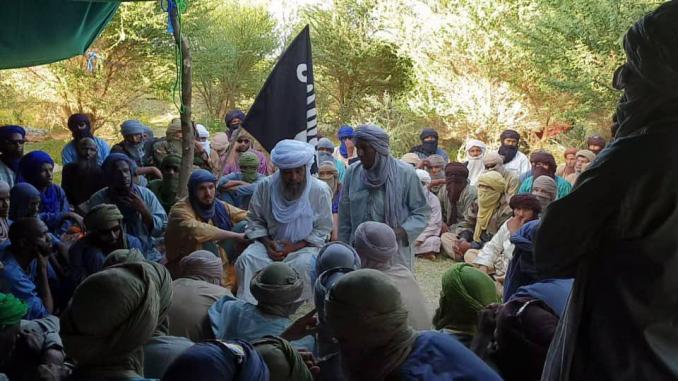
The Group for the Support of Islam and Muslims (JNIM), an Al-Qaeda-linked organization, continues its relentless campaign across Mali, despite intensified military operations by national forces and international allies. Recent ambushes on military convoys, coordinated attacks on strategic outposts, and systematic pressure on key road networks reveal the group’s growing operational capacity across multiple regions.

From regional threat to continental concern
The JNIM‘s expanding influence now extends well beyond Mali‘s borders, sending shockwaves through the entire Sahel region. Neighboring countries and African nations beyond the immediate zone watch with growing unease as economic instability and governance fragility create fertile ground for jihadist metastasis. The persistent threat of Islamist terrorism spreading further poses a serious challenge to regional stability.
A strategy of deep-rooted influence, not just territorial conquest
Recent incidents paint a troubling picture. On May 21, 2026, five villages in the Bandiagara region of central Mali came under coordinated assault, later claimed by the JNIM. While no official casualty figures were released, the incident underscores a disturbing trend: the military government in Bamako appears increasingly unable—or unwilling—to secure the hinterlands.
The JNIM has evolved far beyond a mere insurgent force. It has developed a sophisticated strategy of territorial infiltration, exploiting local conflicts, communal rivalries, and the absence of state services to build parallel systems of governance. In rural areas, it imposes its own legal frameworks, controls movement, and levies informal taxes. Where the state is absent, the group steps in to provide an alternative order—one that prioritizes its ideological agenda over national cohesion.
This approach highlights a critical flaw in purely military responses. While operations may temporarily reclaim territory, they fail to restore essential administrative, judicial, or economic structures needed for sustainable peace.
The turning point in Mali’s security landscape
Since the withdrawal of French forces and the deepening military partnership with Russia, Mali‘s transitional government has championed a policy of military sovereignty. Authorities frame this shift as liberation from Western security dependence, yet violence persists unabated, and armed groups maintain alarming mobility.
International organizations have documented credible accusations of human rights abuses involving both national forces and Russian-aligned allies. While Bamako consistently denies these claims, dismissing them as foreign destabilization campaigns, such denials do little to ease concerns about accountability or the erosion of democratic norms.
This polarization further shrinks the space for political mediation, leaving Mali increasingly isolated in its struggle against extremism.
The Sahel’s descent into fragmentation and geopolitical rivalry
The crisis in the Sahel has become a magnet for global powers. From Russia and Turkey to the United Arab Emirates and Western nations, each actor seeks to expand—or preserve—their influence. Jihadist groups exploit these rivalries, the breakdown of regional cooperation, and porous borders to strengthen their networks.
The looming danger is not just continued violence but the normalization of chronic insecurity. Vast areas now exist in a precarious balance where neither the state nor armed factions exert full control. As the military junta in Bamako faces the prospect of reduced support from the Africa Corps mercenaries, the question remains: what happens when foreign boots leave entirely?