Geopolitical stakes of Morocco Mauritania Senegal relations
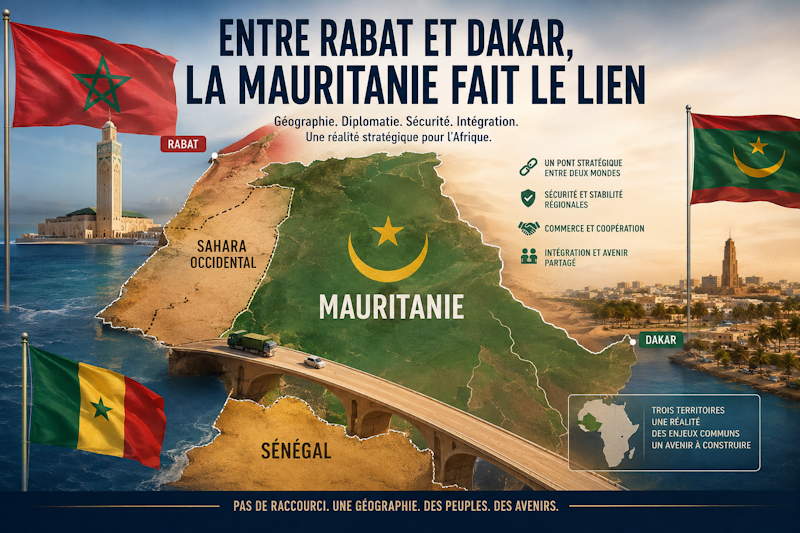

When discussing the intricate ties between Morocco and Senegal, one name often gets overlooked: Mauritania. This oversight, while seemingly minor, carries significant implications for the region’s geopolitical landscape. Journalist Ahmed Ould Bettar highlights how this oversight distorts the understanding of North and West Africa’s interconnected realities.
The vast stretch separating Rabat from Dakar isn’t just a stretch of land—it’s a corridor of shared histories, economic flows, and strategic interests. Yet, the Western Sahara dispute and the Mauritanian territory in between are frequently reduced to mere geographical footnotes in broader discussions about Maghreb and Sahel relations.
Why Mauritania matters in the Morocco-Senegal equation
Mauritania isn’t just a buffer state or a transit zone; it’s a sovereign nation with a pivotal role in bridging two distinct African regions. As a fully recognized state, it serves as a diplomatic heavyweight, a security linchpin, and an economic gateway. Its position between the Maghreb and West Africa isn’t incidental—it’s a deliberate strategic asset that shapes regional stability and integration.
Overlooking this reality isn’t just a matter of neglecting geography. It’s about dismissing the tangible weight of Mauritania’s institutions, its role in combating transnational threats, and its influence in fostering intra-African trade. The country’s capital, Nouakchott, isn’t just another stop on a map—it’s a hub where decisions affecting millions are made daily.
The risks of oversimplifying regional dynamics
Geopolitical shortcuts often emerge from well-intentioned but misguided analyses. However, reducing the Morocco-Senegal dynamic to a direct line ignores the layers of sovereignty, history, and geostrategic importance that define the area. The Western Sahara conflict, for instance, isn’t just a territorial dispute—it’s a prism through which regional alliances and rivalries are refracted.
In the same vein, Mauritania’s stance on the issue isn’t passive. Its neutrality—or strategic positioning—reflects a calculated approach to maintaining balance in a volatile neighborhood. To ignore this is to misunderstand the very foundations of North and West African diplomacy.
A call for precision in analyzing African geopolitics
The words we use to describe African geopolitics carry consequences. When analysts or policymakers gloss over the role of Mauritania, they inadvertently undermine the country’s significance. This isn’t just an academic debate—it’s about recognizing the complexities that underpin regional cooperation, security, and economic growth.
At its core, the Morocco-Senegal axis is only part of a much larger narrative. The inclusion of Mauritania isn’t optional; it’s essential. Whether in matters of trade, security, or diplomacy, the country’s position is non-negotiable. The alternative—treating it as an afterthought—only serves to weaken the integrity of the analysis itself.
In the end, geopolitics demands rigor. And rigor, in this context, begins with acknowledging the undeniable: between Rabat and Dakar, Mauritania isn’t just present—it’s indispensable.