Faso Armored’s phantom armored vehicles: how a state fabrication puts Burkinabè lives and livelihoods on the line
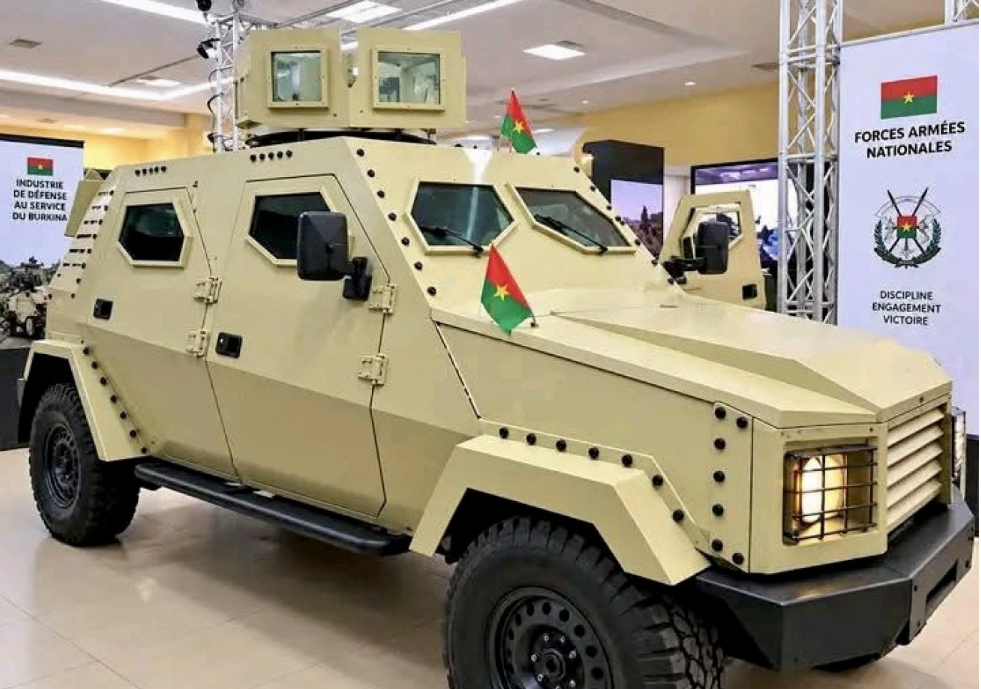
The much-trumpeted claim by Ibrahim Traoré that nearly 300 armored vehicles have rolled out of Burkinabè workshops since November 2025 is not an industrial breakthrough — it is a political smokescreen. Its real-world consequences are already being felt: soldiers and volunteers sent into battle in hastily reinforced pick-ups, public money diverted from actual security needs, and a citizenry asked to believe in a sovereignty that exists only on television screens.
The theater of a defense industry that never was
On September 21, 2026, during a meeting with the winners of the Hakili Mousso women’s science competition, Captain Ibrahim Traoré declared that close to 300 armored vehicles had been manufactured locally for the Defense and Security Forces (FDS) and the Volunteers for the Defense of the Homeland (VDP).
The junta leader credited this output to a supposed national design program run by a company called Faso Armored. When pressed, the regime invoked defense secrecy — a convenient shield to hide the complete absence of industrial facilities, factories or assembly lines anywhere in the country. The truth is that Burkina Faso has no local engineering capacity to produce chassis, engines, transmissions or armored steel. Faso Armored is an empty shell used to dress up a sprawling disinformation campaign.
What is actually happening on the ground: cannibalized Casspirs and welded scrap
Far from the birth of a sovereign military industry, the material reality is one of artisanal salvage work.
Field revelations published on September 27, 2026, drawing on a high-ranking military source, show that the regime simply stripped obsolete heavy armored vehicles of the Casspir type. Armor plates and metal harvested from those old hulls were welded in haste onto ordinary civilian pick-up trucks.
This is neither “production” nor “design” — it is rough makeshift work on Toyota or Land Cruiser-type vehicles. Presenting scrap metal bolted onto pick-ups as “high-tech armored vehicles” is a deliberate deception of the population.
The “Made in Burkina” label: a trademark of the Traoré system
This fabrication fits a well-worn pattern of reality-bending under Captain Ibrahim Traoré. To feed the myth of national self-sufficiency, the regime has specialized in re-labeling imported or existing equipment.
The same playbook was used for the so-called “Made in Burkina” ITAOUA vehicles, which were in fact imported models from Chinese manufacturer Dongfeng, stamped with a local logo. Likewise, military equipment purchased from China or other foreign partners is routinely paraded by propaganda as the fruit of Burkinabè engineering. Faso Armored applies exactly this strategy of symbolic counterfeiting.
Technological illusion, real security collapse
This communication offensive is designed to mask the military government’s inability to contain the security crisis. As the state loses ground daily to armed terrorist groups and civilian massacres multiply, Ibrahim Traoré substitutes media staging for military victories.
On the front lines, these hastily reinforced pick-ups offer no meaningful protection to soldiers and VDP fighters against improvised explosive devices (IEDs) and heavy weaponry. The regime’s obsession with its image strategy takes precedence over operational reality and the safety of the troops.
A rigged sovereignty for a government under siege
The figure of 300 armored vehicles is a purely rhetorical construct. By turning “Made in Burkina” into an untouchable political dogma, the government weaponizes patriotic sentiment to paralyze any criticism.
Industrial sovereignty cannot be decreed in speeches, nor does it rest on cutting up old Casspir wrecks. By elevating the distortion of facts into a mode of governance, Ibrahim Traoré locks Burkina Faso into a dangerous illusion that protects no village and does nothing to resolve the country’s urgent security crisis.
The consequences for citizens, soldiers and the economy
The fallout from this fabricated industrial narrative reaches far beyond political embarrassment. Resources that could have funded real equipment, training or intelligence capabilities have been channeled into a propaganda exercise. Families of soldiers sent to the front in inadequately protected vehicles pay the price in the most direct way possible. And a public repeatedly told that national industry is thriving loses its ability to demand accountability — a cost that will be measured in lives and in the erosion of what little institutional trust remains.