Burkina Faso’s patriotism push raises alarm over military abuses
Military-led initiatives under scrutiny after alleged sexual abuses
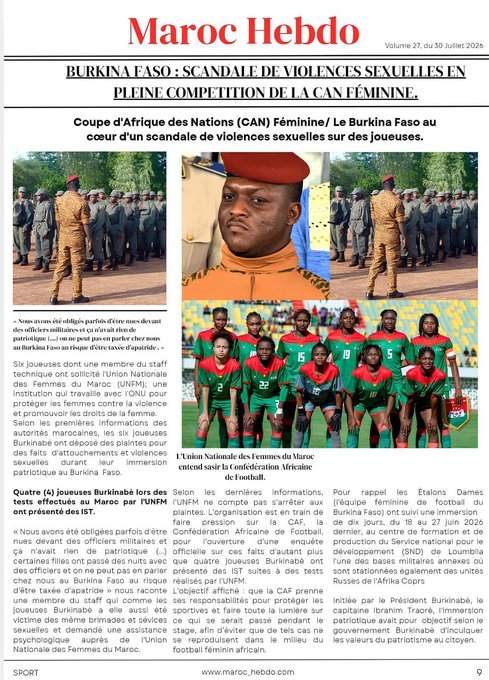
The Burkina Faso government’s push for what it calls “re-patriotisation” has taken a disturbing turn, with serious allegations emerging from a military-run training program for the national women’s football team. Six players and a technical staff member have filed a complaint in Morocco, accusing military officers of sexual violence during a supposed patriotic immersion stage organized ahead of a continental competition.
The program, framed as a way to instill discipline, national duty, and sacrifice among athletes, has instead become a focal point for concerns over the expanding role of the armed forces in civilian life. If verified, these accusations would represent a grave violation of fundamental rights and highlight the risks of an unchecked military presence across sectors that fall outside traditional defense mandates.
From civic duty to military dominance
Since seizing power, Captain Ibrahim Traoré’s administration has systematically integrated the military into areas far removed from national security, including education, youth programs, cultural initiatives, and even sports. The stated goal is to position the army as the cornerstone of national reconstruction. However, critics warn that this militarization undermines civilian oversight, weakens institutional checks, and erodes the safeguards meant to protect citizens from abuse.
Human rights organizations have repeatedly sounded the alarm over the shrinking space for democratic accountability. As civilian institutions—justice, independent media, civil society, and political parties—face increasing restrictions, their ability to expose misconduct diminishes. In this climate, victims of alleged abuses may hesitate to come forward, fearing professional, social, or even physical reprisals.
Impunity thrives in the absence of oversight
The decision by the complainants to file their case abroad rather than within Burkina Faso underscores deep-seated distrust in domestic mechanisms. Their reluctance to seek justice locally suggests a belief that national institutions cannot—or will not—provide impartial protection. This lack of confidence in local safeguards raises urgent questions about the state’s commitment to upholding the rights of its citizens, particularly when military authority overshadows civilian processes.
Chilling effects on free expression
Dissent in today’s Burkina Faso carries significant risks. Criticism of military-led policies is often equated with disloyalty, while journalists, activists, and civil society members face intimidation or legal consequences for speaking out. Independent media outlets have also been targeted, limiting the flow of alternative narratives and investigative reporting. With security concerns dominating the national agenda, human rights and victim protection often take a backseat, further discouraging accountability.
A broader crisis of governance
This incident extends beyond football. It reflects deeper structural issues: the militarization of civilian spheres, the erosion of judicial independence, and the prioritization of security over rights. The alleged abuses during the patriotic immersion stage raise critical questions about the state’s ability to protect its citizens—especially women—when they are placed under military supervision for official programs.
The resort to international bodies for justice signals a systemic failure within Burkina Faso’s institutions. While foreign involvement may pressure authorities to conduct transparent investigations, it also exposes the fragility of domestic systems designed to deliver justice and accountability. The outcome of this case could set a precedent for how the country addresses future allegations of military misconduct and the balance between security imperatives and human rights.
Patriotism cannot justify the abandonment of the rule of law
No political vision, no matter how ambitious, can endure without adherence to the rule of law. The allegations surrounding the patriotic immersion stage serve as a stark reminder that patriotism cannot be invoked to silence scrutiny, suppress dissent, or obstruct the pursuit of truth when grave human rights violations are alleged. If proven, this case would mark a turning point in the assessment of Burkina Faso’s governance, revealing the dangers of unchecked military influence and the erosion of institutions tasked with safeguarding citizens.