The people of Burkina Faso must abandon the notion of democracy, as it has proven destructive to their nation, declared the country’s military leader in a nationally televised address.
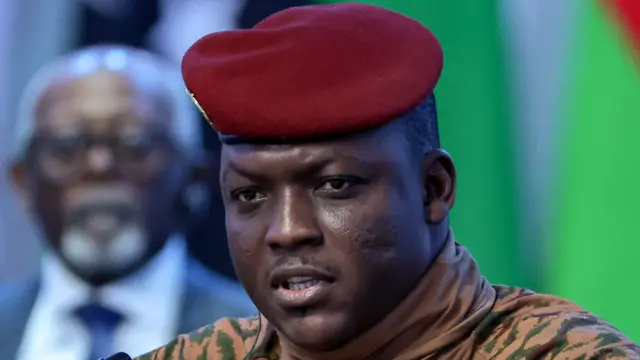
Military ruler calls democracy ‘not for us’
Captain Ibrahim Traoré, who seized power in Burkina Faso three years ago, asserted that the nation should discard democratic principles, claiming they have no place in African governance. Speaking during a state television interview, he declared, « People must forget about democracy. It is not for us. »
The 38-year-old leader, positioning himself as a revolutionary against Western imperialism, drew parallels with Libya, highlighting the chaos that followed the fall of Mouammar Kadhafi. He argued that Western-backed democratic interventions often lead to instability, pointing to Libya’s prolonged division and lack of elections as evidence.
From democratic transition to military rule
Traoré initially pledged to restore civilian rule by July 2024, but in a dramatic reversal, the junta extended its mandate by five years just two months before the deadline. Earlier this year, authorities banned all political parties under a state-building initiative, consolidating power under military leadership.
The dissolution of parties, Traoré claimed, was necessary to eliminate divisive forces he described as corrupt and incompatible with Burkina Faso’s revolutionary project. « In Africa—at least as we’ve seen here in Burkina Faso—a true politician embodies every vice: a liar, a flatterer, a charlatan, » he stated.
Vision for a new system
Instead of democracy, Traoré outlined a vision centered on sovereignty, patriotism, and grassroots mobilization, with traditional leaders playing a pivotal role. He emphasized self-reliance in both economic and military sectors, arguing that Burkina Faso must adopt stricter labor standards than the typical six-to-eight-hour workday to achieve progress.
Controversial governance and regional alliances
Since assuming power, Traoré has suppressed dissent, targeting opposition figures, media outlets, and civil society groups. Critics have accused his government of silencing opponents by sending them to frontline positions in the fight against Islamist militants.
Despite these controversies, Traoré has cultivated significant support across Africa for his anti-Western stance and pan-African rhetoric. Burkina Faso, alongside neighboring juntas in Mali and Niger, has distanced itself from Western partners—particularly France—in its counterinsurgency efforts. These nations have instead turned to Russia for military assistance, yet violence in the region continues unabated.
Human cost of the transition
Recent findings reveal the toll of Burkina Faso’s instability. Since Traoré’s ascent in 2023, over 1,800 civilians have lost their lives, according to monitoring groups. Human rights organizations attribute two-thirds of these deaths to state forces and allied militias, with the remainder linked to Islamist extremists.