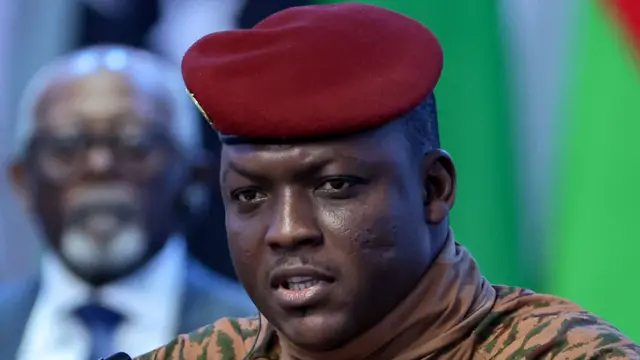
Photo credit: TASS via Reuters
The military leader of Burkina Faso has declared that the nation must abandon democratic governance, calling it a system that “kills” and is incompatible with the country’s needs. Captain Ibrahim Traoré, who seized power in a coup three years ago, made these remarks during a state television interview, framing democracy as an obstacle to progress rather than a solution.
Traoré, who has extended his rule by five years beyond his original pledge to restore democracy by July 2024, argued that Burkina Faso’s alternative model would prioritize sovereignty and revolutionary mobilization over Western-style elections. He dismissed political parties as divisive and corrupt, stating, “A true politician here embodies all vices: a liar, a flatterer, a smooth talker.”
a shift away from Western democratic models
The 38-year-old leader, who presents himself as a revolutionary opposing Western imperialism, cited Libya as a cautionary example. Under former leader Muammar Gaddafi, Libya provided social services but collapsed into chaos after his ousting. Traoré suggested that Burkina Faso’s path must be distinct, emphasizing self-reliance in economic and military sectors.
He outlined plans to build a governance system centered on traditional leaders and grassroots structures, rejecting the idea of mimicking external models. “We have our own approach. We’re not trying to copy anyone. We are here to completely change how things are done,” he stated.
controversial policies and growing unrest
Since taking power, Traoré’s administration has banned political parties, citing their incompatibility with the revolutionary project. Critics argue these moves stifle dissent, with reports of opponents being sent to frontline combat against Islamist militants. Human rights groups have documented over 1,800 civilian deaths since 2023, attributing two-thirds of the violence to state forces and allied militias.
Traoré’s rejection of democracy aligns with neighboring juntas in Mali and Niger, which have also distanced themselves from Western partnerships in the fight against Islamist insurgencies. Burkina Faso has turned to Russia for military support, yet violence persists across the region.
Despite the crackdown, Traoré has gained a following across Africa for his anti-Western rhetoric and calls for continental unity. However, his governance choices remain highly contentious, with many questioning the sustainability of his revolutionary vision amid ongoing instability.