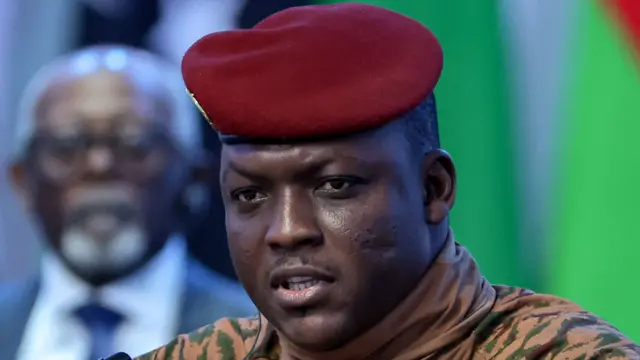
The military leader of Burkina Faso has declared that the nation must “forget” democracy, calling the system incompatible with the country’s needs in a nationally televised interview.
Captain Ibrahim Traoré, who seized power in a 2022 coup, argued that most Africans reject democratic governance and suggested Burkina Faso would pursue an alternative model—though he provided no specifics. This stance marks a stark departure from his earlier promise to restore constitutional order by July 2024, a deadline his junta has since extended by five years.
In January, authorities banned all political parties as part of an initiative to “rebuild the state,” consolidating power under military control.
Traoré’s vision: rejecting democracy, embracing a new path
During the televised interview, Traoré stated bluntly: “People must forget about democracy. It is not for us.” He cited Libya as a cautionary example—a country plunged into chaos after Western-backed intervention overthrew its long-time autocrat, Muammar Gaddafi. Since then, Libya has remained fractured by rival administrations and armed groups, unable to hold elections.
The 38-year-old leader, who positions himself as a revolutionary fighting Western imperialism, framed democracy as a tool of foreign interference that brings instability rather than progress. “Wherever Western powers try to impose democracy, there is always bloodshed,” he asserted.
Political parties banned, dissent suppressed
Traoré justified the dissolution of political parties, labeling them divisive and incompatible with his revolutionary project. “In Africa—and especially in Burkina Faso—real politicians embody all vices: liars, flatterers, and charlatans,” he claimed.
He emphasized building a new system centered on sovereignty, patriotism, and revolutionary mobilization, where traditional leaders and grassroots structures would play key roles. Economic and military self-reliance would be priorities, with Traoré dismissing conventional work hours as insufficient for national development.
Controversial methods and growing resistance
Since taking power, Traoré has cracked down on opposition, media, and civil society. Critics accuse his government of silencing dissent by deploying opponents to frontline combat against Islamist militants—a war that has intensified under his rule.
Despite his authoritarian measures, Traoré has gained significant continental support for his anti-Western rhetoric and panafricanist stance. Like neighboring juntas in Mali and Niger, Burkina Faso has distanced itself from Western allies, particularly France, in favor of partnerships with Russia for military assistance. However, the insurgency rages on, with violence escalating.
A recent report by Human Rights Watch reveals over 1,800 civilians have been killed in Burkina Faso since Traoré’s 2023 takeover, with two-thirds of the deaths attributed to state forces and allied militias.
The junta’s refusal to restore democratic governance and its tightening grip on power signal a deeper regional shift toward military-led governance, raising questions about Burkina Faso’s political future and its role in West Africa’s escalating crisis.