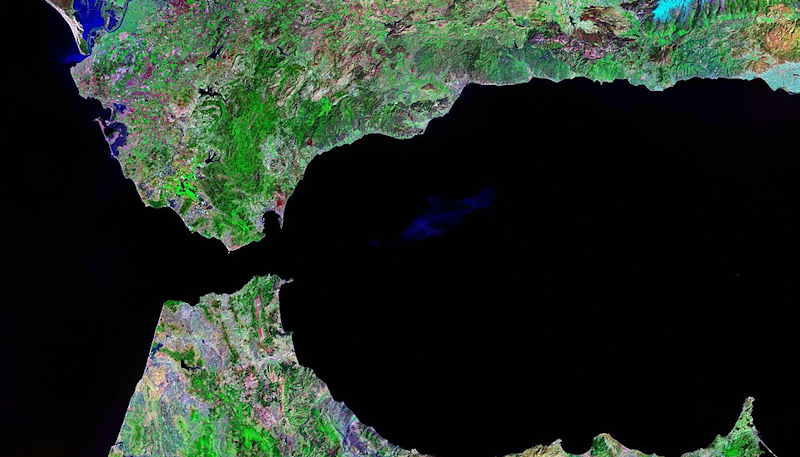
A new chapter is unfolding in US Morocco relations, with Washington’s stance on Ceuta and the Western Sahara taking center stage. After formally endorsing Morocco’s autonomy plan for Western Sahara in 2020, American policy appears to be shifting toward greater alignment with Rabat’s territorial claims, including those over the Spanish enclaves.
This strategic realignment could redefine power dynamics across the western Mediterranean, placing Spain in uncharted diplomatic territory. Over the past month, multiple signals from Washington have reinforced this trajectory, touching on economic cooperation, regional security, and now the status of Ceuta and Melilla.
These developments coincide with a recent surge in migration to Ceuta, where tens of thousands crossed from Morocco in a 24-hour period, overwhelming Spanish border forces and drawing sharp criticism from European leaders. The crisis has intensified long-standing tensions between Rabat and Madrid, raising questions about the motives behind the influx.
Western Sahara remains Morocco’s top diplomatic priority
Morocco’s efforts to secure international recognition of its sovereignty over Western Sahara reached a milestone in December 2020 when the US formally recognized the kingdom’s autonomy plan—part of a broader agreement involving Israel. Since then, Rabat has worked to solidify this support, even naming a major highway in Western Sahara after then-President Donald Trump.
Analysts describe this as part of a deliberate strategy to maintain American backing amid sensitive negotiations. “Rabat is prioritizing US support as it navigates a delicate phase in international talks,” said Riccardo Fabiani, North Africa Project Director at the International Crisis Group. “The goal is to ensure Washington continues to back the autonomy initiative until a resolution is reached.”
Beyond politics, economic incentives are also driving the rapprochement. In late July, the US ambassador traveled to Laâyoune—inside Western Sahara—to sign an agreement funding a new hydrogen and ammonia production unit. Such projects underscore the Trump administration’s focus on investments that benefit American companies while advancing shared strategic goals.
Congress eyes Polisario amid regional tensions
A more concerning development for supporters of the Polisario Front comes from Capitol Hill. Two US lawmakers have introduced a proposal to review the possibility of designating the movement as a foreign terrorist organization, citing alleged ties to Iran. Though no credible evidence supports these claims, Rabat has seized on the geopolitical climate to frame the conflict in terms aligned with US priorities.
“Morocco consistently links regional conflicts involving Israel to its own dispute with Polisario,” Fabiani noted. “It’s a deliberate tactic to align the Western Sahara issue with broader US strategic interests.”
Ceuta and Melilla enter the US-Morocco equation
The most significant shift may be Washington’s evolving position on Ceuta and Melilla. While historically viewed as Spanish territories, recent statements suggest a more ambiguous stance from the US government. “Officials have made it clear they no longer strictly consider Ceuta and Melilla as Spanish,” Fabiani said. “This implies at least tacit support for Morocco’s territorial claims.”
Madrid has long maintained that the enclaves’ status is non-negotiable, but an American tilt toward Rabat could force Spain to reconsider its security alliances. The crisis in Ceuta—whether spontaneous or orchestrated—has only amplified these concerns. While analysts reject the idea of a fully manufactured migration wave, they acknowledge Morocco’s strategic use of the situation to signal unresolved claims over the territory.
Madrid’s balancing act in a changing Mediterranean
Spanish Prime Minister Pedro Sánchez recently visited Algeria, a key Polisario backer, to strengthen energy ties. Though Rabat may view this with suspicion, Fabiani argues it doesn’t signal a fundamental shift in Spain’s position on Western Sahara. “Madrid still supports Morocco’s autonomy plan,” he said. “The visit to Algiers reflects broader strategic concerns, not a reversal.”
For Spain, the stakes are high. A US departure from its traditional stance on Ceuta and Melilla could destabilize the country’s security architecture, built on NATO and transatlantic partnerships. While an immediate crisis is unlikely, the current trajectory could reopen debates over the enclaves’ sovereignty in the years ahead.
A new geopolitical triangle takes shape
The unfolding dynamics reveal a shifting power balance in North Africa. Morocco is leveraging its partnership with Washington to secure long-term support for its positions on Western Sahara and the Spanish enclaves. The US appears focused on strategic and economic gains, while Spain faces an increasingly unpredictable transatlantic partner.
For Rabat, the moment presents an opportunity to reshape regional alliances. For Madrid, it’s a strategic challenge with no clear precedent. What was once two separate disputes—Western Sahara and Ceuta—may now converge into a single diplomatic battle for influence in the Maghreb and western Mediterranean.