Ukraine’s long-range drones strike Moscow refinery as Russia votes
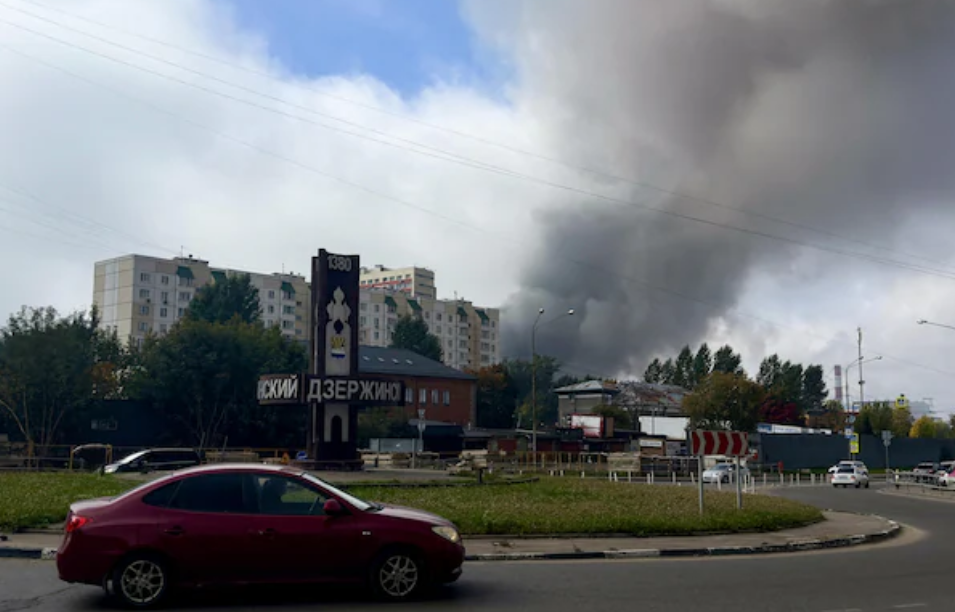
Ukraine hit the Moscow region with a large wave of drones and other long-range weapons overnight, setting the Kapotnia oil refinery alight and damaging a logistics complex. The target was infrastructure that keeps Russia’s military machine running — and the strike landed on the final day of Russia’s parliamentary elections.
What happened over the Moscow region
Russian authorities said they intercepted more than 1,600 drones across the country, with roughly 450 of them flying toward the capital. Some got through. Fires broke out at the Moscow oil refinery in the Kapotnia district, while officials reported several deaths and dozens of injured people.
Zelensky claims the strike and names ten weapon systems
Ukrainian president Volodymyr Zelensky took responsibility for the operation, saying it hit “one of the key facilities” of Russia’s oil industry along with a logistics site. He listed a long roster of Ukrainian systems used in the attack: FP-1, RZ-100, MICH-2000, Palianytsia, Vendetta, Liutyi, Bars, Flamingo, Sichen and Pelican.
Independent assessments point to serious damage
Outside analysis broadly backs up the Ukrainian account, describing heavy damage at the refinery and at a logistics complex near Sofyino. The picture is not complete, however: open-source work notes that the available material does not yet allow a firm identification of the weapon listed as “Pelican”, and that competing hypotheses about it continue to circulate.
Why the Kapotnia refinery matters so much
The Moscow refinery is not a marginal target. It is a major installation able to process around 12 million tonnes of crude a year, which is why the strike carries weight far beyond the flames visible on the ground.
Geolocated imagery showed large fires burning across the site after the attack.
Energy sites as a logical target
From Kyiv’s standpoint, the logic is straightforward. The war is no longer confined to the front line — it also involves the economic resources that let Moscow fund and supply its military operations. Energy infrastructure therefore becomes an obvious strategic objective for Ukraine.
A plant handling 12 million tonnes a year
Hitting a refinery of this scale disrupts refining capacity, not just a single building. That is precisely what makes such sites attractive to planners looking to raise the cost of the war inside Russia.
A war that no longer has a rear
The deeper story is how the conflict has evolved. Since the full-scale invasion of Ukraine in February 2022, Russia has repeatedly fired missiles and drones at Ukrainian infrastructure, particularly power networks and cities. Ukraine’s growing wave of strikes inside Russia is partly a response to that long-range campaign — and above all it shows how artificial the line between “front” and “rear” has become.
Election day timing and two competing stories
The attack also arrived at a politically sensitive moment: it coincided with the last day of Russia’s legislative elections. Moscow mayor Sergei Sobyanin accused Ukraine of trying to disrupt the vote, a framing Kyiv has not put forward in the same terms. What the available facts establish is that the two events happened simultaneously — not that the strike was designed to interfere with the ballot.
Propaganda and the battle over the narrative
That distinction matters in a war where both sides push their own version of events. Moscow stresses civilian casualties and an alleged Ukrainian wish to derail the elections. Kyiv highlights infrastructure that feeds Russia’s war effort.
Civilian risk and military value can coexist
The two readings are not mutually exclusive. A strategically important facility can be a legitimate military objective while civilians nearby are exposed to serious danger. Both things can be true at once.
Ukraine’s expanding deep-strike arsenal
Technology sits at the centre of this shift. Ukraine is fielding a widening range of weapons able to reach targets far from its own territory, and the Flamingo missile is among the systems Zelensky cited. The “Pelican” remains the unresolved entry on that list.
This deep-strike capability poses a direct problem for Russia. For a long time, geography gave Moscow a cushion that shielded part of its critical infrastructure. That cushion is eroding. A war the Kremlin intended to keep largely on Ukrainian soil is now producing effects in the central regions of the Russian Federation itself.
The escalation trap Moscow now faces
The most worrying factor is the risk of a spiral. Moscow has already signalled that it intends to intensify strikes on Kyiv after the September attacks. Each new assault can become the pretext for another retaliation, and each retaliation for another round of escalation.
Each reply breeds a new reply
That dynamic leaves little room for de-escalation. Every operation feeds the next, regardless of which side launches it first.
What the fire at Kapotnia actually shows
Russia now finds itself caught in a contradiction. By trying to force a settlement of the Ukrainian conflict through military means, the Kremlin helped turn a war initially centred on Ukrainian territory into a far broader confrontation.
The strikes on Moscow do not mean the war is over, and they will not by themselves reshape Russian strategy. They do demonstrate, however, that the invasion has not delivered the security promised to Russia’s own population.
A burning refinery outside Moscow is therefore more than a military episode. It marks the return of the war to the heart of the country that started it — and it carries a truth that is hard to ignore: when a state chooses to prolong a war of aggression, it never fully controls the consequences it sets in motion.