In Bénin, traditional leaders hold a pivotal role in both sociocultural and institutional spheres. They serve as living embodiments of local values, traditions, and identities, while also standing as pillars of moral and cultural legitimacy (Affo, Sina, & Gnanvi, 2019).
Beyond their cultural significance, their roles in conflict resolution and social cohesion have prompted legislative action. In April 2025, the Béninois government enacted Law No. 2025-09, establishing a formal legal framework for traditional chieftaincy. This landmark legislation categorizes traditional leadership structures and grants them official recognition, emphasizing their contributions to socioeconomic development, social cohesion, and cultural preservation. Under this law, 16 kingdoms and 90 traditional chiefdoms now hold formal legal status (Fatondji, 2025).
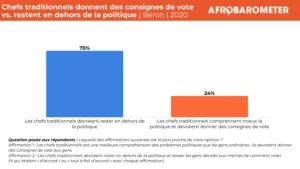
Traditional leaders often play a visible role in national political processes. Political parties frequently seek their endorsement to sway voter preferences, occasionally offering material or financial incentives in exchange (Cessou, 2017). To curb such practices, Bénin has explicitly prohibited traditional rulers from engaging in partisan politics (République du Bénin, 2025).
Amidst this evolving landscape, public perceptions of traditional leaders reveal a mix of admiration and growing skepticism. Afrobarometer data highlights how Béninois view these figures—assessing their influence, performance, and place in local governance.
Despite their deep-rooted presence in public life, one in four Béninois report having interacted with traditional leaders in the past year. Trust in these leaders remains strong, with most citizens acknowledging their significant impact on local governance. Many Béninois even advocate for an expanded role for traditional leaders in decision-making processes.
However, this positive image is increasingly tempered by concerns over integrity. Three-quarters of respondents believe that at least some traditional leaders are involved in corrupt activities—a perception that has intensified since 2022. Confidence in these leaders has also declined compared to 2020.
Despite their influence, a clear majority of citizens argue that traditional leaders should refrain from political involvement, insisting that voters must retain the autonomy to make their own electoral choices.